EconomyHigh
Unspent 2026 Capital Budget Moves to 2027: What It Means
The Finance Ministry says unspent 2026 capital money will roll into 2027 as Nigeria tries to end overlapping budgets. Here is what that means for projects.
By Chiamaka Prudence Published 7 min read Editorial Policy Report a correction
The Federal Government will carry whatever is left of its 2026 capital budget into 2027, the Federal Ministry of Finance said on Friday, 20 November 2026. The plan is part of a push to stop running more than one federal budget at the same time and to return to a single annual budget cycle. The ministry said the decision came out of a meeting of the Economic Management Team (EMT), the group of senior officials that steers economic policy, held in Abuja on 18 November and led by Taiwo Oyedele, the Minister of Finance and Coordinating Minister of the Economy.
According to the ministry, the EMT wants to harmonise the budget around more realistic revenue and financing assumptions, improve how the budget is carried out and tighten fiscal discipline. It gave no figure for how much of the 2026 capital budget is still unspent.
The Big Number: how large is the capital budget being moved?
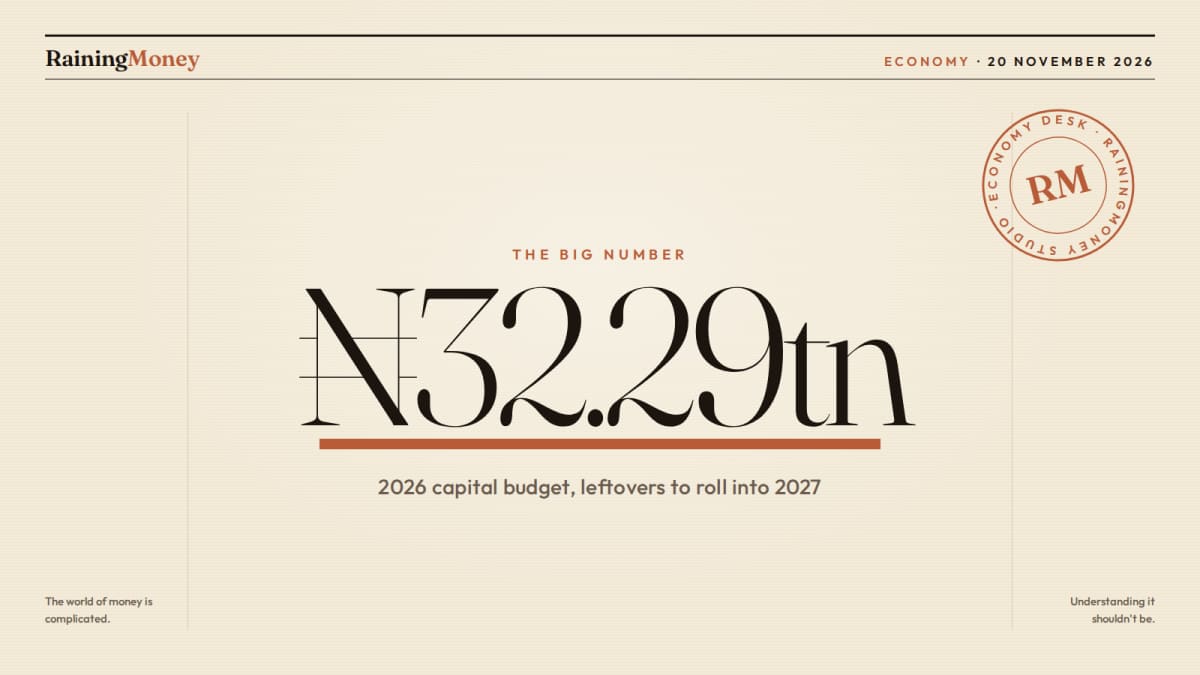
The 2026 budget signed by President Bola Tinubu on 17 April 2026 allows total spending of ₦68.32tn. About ₦32.29tn of that is capital expenditure, the money meant for things that last, such as roads, bridges, power lines, hospitals and school buildings. That is roughly 47% of the whole budget (derived: ₦32.29tn divided by ₦68.32tn). The rest covers salaries and running costs (about ₦15.4tn), debt service (about ₦15.8tn) and statutory transfers, money the law sets aside for particular bodies (about ₦4.8tn).
| Item | Amount |
|---|---|
| Total spending approved | ₦68.32tn |
| Capital spending | ₦32.29tn |
| Debt service | ₦15.8tn |
| Recurrent (non-debt) spending | ₦15.4tn |
| Statutory transfers | ₦4.8tn |
| Projected revenue | ₦36.87tn |
| Deficit (to be borrowed) | ₦31.46tn |
Projected revenue is ₦36.87tn, so the plan relies on borrowing about ₦31.46tn to close the gap. That gap is why the EMT keeps returning to the phrase "realistic revenue and financing assumptions".
What changed?
Two things. First, the government has now formally linked the end of 2026 to the start of 2027: unfinished capital work from this year will be funded through next year's budget. Second, it says it is moving toward one budget per year from here on.
Mr Oyedele had signalled this in October. Speaking in Abuja at the launch of a World Bank report, he said the government should not run several budgets at once, that the 2025 capital budget had been extended to December, that 2024 had been cleared, and that whatever was left of 2026 would be moved into 2027. He said the 2027 budget would be different, while noting that the timing of its passage was not fully in his hands.
Why are there overlapping budgets at all?
Nigeria's financial year is meant to run from January to December. In practice, the capital part of each budget has been kept open well past its year, so ministries can keep spending on projects already started. That means two budgets run side by side.
The 2025 capital budget shows how this works. It was due to close on 31 December 2025. The National Assembly has extended it four times:
| Extension | New end date |
|---|---|
| Original | 31 December 2025 |
| First | 31 March 2026 |
| Second | 30 June 2026 |
| Third | 30 September 2026 |
| Fourth | 31 December 2026 |
The fourth extension passed both chambers on 29 September 2026, and the President signed it the next day. The presidency said it gives ministries, departments and agencies (MDAs) more time to finish capital projects already under way.
Meanwhile the 2026 budget took effect on 1 April 2026. So for most of this year, the 2025 and 2026 capital budgets have both been open.
What caught our attention?
Three things stand out.
- The 2026 capital budget for MDAs had barely started by mid-year. The Budget Office's second-quarter implementation report put implementation of the 2026 MDA capital budget at zero as at 30 June 2026, because agencies were still spending money released under the extended 2025 programme. Total capital spending across all funding lines in the first half was about ₦4.18tn, a wider measure that includes 2025 carry-overs, loans tied to specific projects and donor-funded work.
- Cash has lagged far behind the plan. In the first quarter of 2026, ₦1.69tn was released for capital spending against a pro-rated quarterly budget of ₦8.07tn. That is about 21% of the plan (derived: 1.69 divided by 8.07). Federal revenue in that quarter was ₦5.08tn against a target of ₦9.22tn.
- This promise has been made before. In October 2025, the then finance minister, Wale Edun, told senators the government would stop extending budgets beyond their year. In December 2025, presenting the 2026 budget, President Tinubu promised to end overlapping budgets and said all capital liabilities from earlier years would be funded and closed by 31 March 2026. The 2025 capital budget is now open until 31 December 2026.
RainingMoney's reading: moving 2026 leftovers into 2027 is itself a form of rollover. The difference the government is claiming is that the leftovers will sit inside the 2027 budget instead of running as a separate budget beside it. Whether that ends the overlap depends on how the 2027 budget is written and on whether the 2025 programme actually closes on 31 December.
Finance Speak → Human Speak
- Capital expenditure: money spent on things meant to last for years, like a new road or a hospital building. Paying salaries is recurrent spending, which repeats every year.
- Budget implementation: how much of the money approved has actually been released and spent.
- Rollover or carry-forward: taking money approved for one year and allowing it to be spent in the next.
- Overlapping budgets: when last year's budget is still being spent while this year's has started, so more than one budget runs at a time.
- Financing assumptions: the government's guess of how much it can borrow, and at what cost, to cover the gap between spending and revenue.
What does it mean for ordinary Nigerians?
Nothing changes in anyone's account today. The effects are slower. Capital spending pays contractors, who pay workers and suppliers. When releases are late or pushed into the next year, projects stall, contractors wait for payment and jobs on site can stop. A road that was in the 2026 budget may now be paid for out of 2027.
RainingMoney's reading: a single budget each year would make it easier for citizens and lawmakers to check what was promised against what was delivered. With several budgets open at once, it is hard to tell which year's money paid for which project, and harder to hold anyone to account for delays.
The policy analyst Dele Oye, citing the second-quarter report, has called for the January-to-December financial year to be enforced with a binding budget timetable, and for a year-end statement that shows exactly what is carried over.
What else did the EMT discuss?
The ministry said the meeting also covered work on a 2027 Finance Bill to update tax laws, a 90-day plan on food prices targeting cassava, yam, maize and rice, a 90-day power plan aimed at steady grid supply of about 5,500 megawatts, and a draft National Development Plan for 2026 to 2036. It said real GDP grew 4.43% in the second quarter and that headline inflation fell to 14.06% in October.
What is still unknown?
- How much of the 2026 capital budget is unspent and will move into 2027.
- Whether the 2025 capital budget will close on 31 December 2026, or be extended a fifth time.
- When the 2027 budget will be presented and passed, and how the carried-over 2026 projects will appear in it.
- What the National Assembly will do. Mr Oyedele said in October that lawmakers would enable the clearing of the 2025 and 2026 budgets, without giving details.
The Bottom Line
The government says it wants one budget a year, and it is using the 2027 budget to absorb what 2026 could not spend. With the 2025 capital budget extended four times and 2026 MDA capital spending at zero by mid-year, the test is simple: whether 31 December 2026 really is the last day for 2025's money, and whether 2027 starts and ends on time.
Sources & Verification
- Sources: Nairametrics
- Editorial note: This explainer is an original RainingMoney adaptation of the report, RainingMoney has added explanatory context.

Correspondent, OnitshaOnitsha
Chiamaka Prudence
I am a technology and finance enthusiast with a keen interest in digital innovation, emerging financial trends, and the evolving ways technology is shaping businesses and everyday life. I enjoy…
Author profile & archive →The Money Print
Market intelligence before the market opens.
Pan-African capital flows and the stories behind the numbers, on weekday mornings.