TechnologyMedium
Crypto Firms Must Register for Nigerian Tax by 30 November
Nigeria's tax service gives crypto exchanges and wallet firms until 30 November to register on a new tax portal and until 31 December to link their systems.
By Chiamaka Prudence Published 6 min read Editorial Policy Report a correction
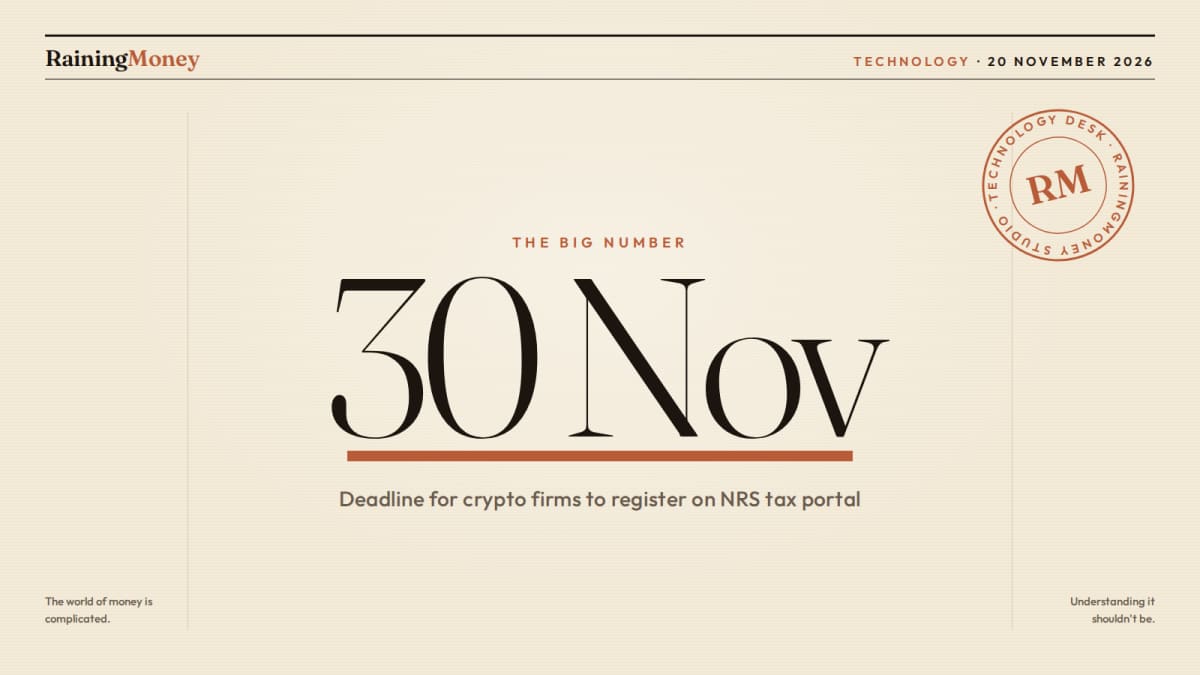
Nigeria's tax authority has given companies that run crypto exchanges, wallets and other digital asset services until 30 November 2026 to register on a new online tax portal. They then have until 31 December 2026 to connect their systems to it. The Nigeria Revenue Service (NRS) set out both deadlines in a public notice this week, and says firms that miss either one could face statutory penalties and other enforcement action.
The portal is called the VASP Tax Portal. VASP stands for virtual asset service provider: any business that buys, sells, holds, moves or issues crypto and other digital tokens for customers. The rule covers Nigerian firms and foreign ones alike, as long as they serve people living in Nigeria, whether or not they have an office in the country.
Who has to register?
The NRS defines the group by what a business does, whatever name it trades under. The notice lists activities including:
- exchanging crypto for naira or other currencies, or for other digital tokens;
- sending or transferring digital assets for customers;
- holding crypto for customers in custodial wallets;
- running crypto trading platforms, including peer-to-peer (P2P) marketplaces where buyers and sellers deal directly;
- payments, settlement and cross-border remittances that use digital assets;
- issuing, distributing or redeeming tokens;
- staking, crypto lending and borrowing.
Two groups are left out. Individuals who use crypto for their own purposes do not have to register on the portal, and neither do businesses that simply accept crypto as payment for their own goods and services. The tax authority says their existing obligations stay the same.
What exactly must the firms do, and by when?
The process has two stages, and a firm only counts as registered once it has finished both.
Stage one, by 30 November. Firms fill in a registration form with their business details, their Tax Identification Number (TIN), contact information, a description of their digital asset activities, and details of their registration for anti-money laundering checks.
Stage two, by 31 December. Firms link their own systems to the portal. Once connected, the tax authority can receive information about transactions, work out how much tax is due and collect it. The NRS says the detailed reporting rules and the technical specifications for the link will be shared during this stage.
From today, 20 November, that leaves firms 10 days for the first step and about six weeks for the second.
Is this a new tax on crypto?
No new tax is being created, the NRS says. The portal is a new pipe for collecting taxes that already exist under the two tax laws that took effect with Nigeria's 2025 tax reform: the Nigeria Tax Act, 2025 and the Nigeria Tax Administration Act, 2025. Section 79 and the Fifth Schedule of the administration law set out what businesses in this space must do: register, keep records, report, file returns and pay. Section 71 of the same law allows the tax authority to use technology to run the system.
The portal will handle three taxes that can be paid in digital tokens, introduced in phases: Value Added Tax (VAT), stamp duty and withholding tax. Taxes paid in naira will keep going through Rev360, the tax authority's existing online platform, and its other usual channels.
The taxes themselves were spelled out earlier this year. Guidelines issued in August 2026 set a 1.5% stamp duty on transfers from tokens into ordinary money and from ordinary money into tokens. The same set of rules says medium and large companies that make profits from crypto and other digital assets pay 30% income tax on those gains.
What does a 1.5% stamp duty look like in practice?
Stamp duty is a small tax charged on a transaction or document. A worked example, derived from the 1.5% rate: if a customer turns tokens worth ₦200,000 into naira, 1.5% of ₦200,000 is ₦3,000. On a ₦1 million transfer, it would be ₦15,000. The guidelines set the rate; the portal is how the platform will report and pay it. How much of that cost platforms pass on to customers is up to each firm and has not been announced.
Does registering mean a crypto firm is licensed?
No. The NRS is clear that signing up on the tax portal is not a licence or permission to offer crypto services in Nigeria. Firms still need approval from the regulators that oversee them, such as the Securities and Exchange Commission (SEC) and the Central Bank of Nigeria (CBN).
Those regulators have been busy too. On 5 November 2026, the CBN issued rules for digital assets that are not securities. Under them, a company that wants to issue a stablecoin backed by a foreign currency (a token meant to hold a steady value, such as one dollar) needs at least ₦15bn in paid-up capital, and the rules tighten approval and identity checks for P2P crypto trades on platforms. The SEC has proposed separate rules that would require digital asset exchanges and custodians to hold at least ₦2bn in capital. Those SEC rules are still proposals.
The tax authority says it may share what it collects through the portal with regulators and law enforcement where the law allows, subject to data protection rules.
Why is Nigeria doing this now?
The move ties into a global standard. The Financial Action Task Force (FATF), the international body that sets rules against money laundering and terrorist financing, asks countries under its Recommendation 15 to register and supervise crypto service providers. The portal's registration form includes anti-money laundering details for that reason.
RainingMoney's reading: there is also a plain revenue reason. Crypto trading in Nigeria has been large and mostly outside the tax net. A system that connects directly to platforms lets the tax authority see transactions as they happen, instead of waiting for firms to declare them. That is the same approach the NRS has taken with electronic invoicing for large companies.
What does this mean for ordinary crypto users?
If you buy, sell or hold crypto for yourself, you do not have to register on this portal. What changes is the platform you use. Once a platform is connected, your trades on it are likely to be reported to the tax authority, and taxes such as the 1.5% stamp duty may be taken at the point of the transaction.
A few practical points follow:
- Expect more checks. Platforms must send identity and transaction details, so they may ask customers to confirm their details or link a TIN.
- Watch your platform's notices. If a platform serving Nigerians fails to register, it may face penalties and enforcement. Firms that pull back from Nigeria usually tell customers first.
- Registration is not a seal of approval. A platform on the tax portal is not, for that reason alone, licensed or safe. Licensing still sits with the SEC and the CBN.
What we don't know yet
Several things are still open. The tax authority has not published the technical details for stage two; it says they come during integration. The penalty for missing the deadlines is described only as statutory penalties and enforcement, and the notice did not spell out amounts. It is also not yet clear how strictly the rules will be enforced against foreign platforms with no office in Nigeria, which the notice says are covered. The list of firms that register by 30 November will be the first sign of how the industry is responding.
Sources & Verification
- Sources: BusinessDay
- Editorial note: This explainer is an original RainingMoney adaptation of the report, RainingMoney has added explanatory context.

Correspondent, OnitshaOnitsha
Chiamaka Prudence
I am a technology and finance enthusiast with a keen interest in digital innovation, emerging financial trends, and the evolving ways technology is shaping businesses and everyday life. I enjoy…
Author profile & archive →The Money Print
Market intelligence before the market opens.
Pan-African capital flows and the stories behind the numbers, on weekday mornings.