EconomyMedium
South Africa Holds Rate at 7.25% as Policymakers Split
South Africa's central bank held its rate at 7.25% despite 5.2% inflation, with three of seven members wanting a hike. What it signals for Nigeria's MPC.
By Betini Udom Published 6 min read Editorial Policy Report a correction
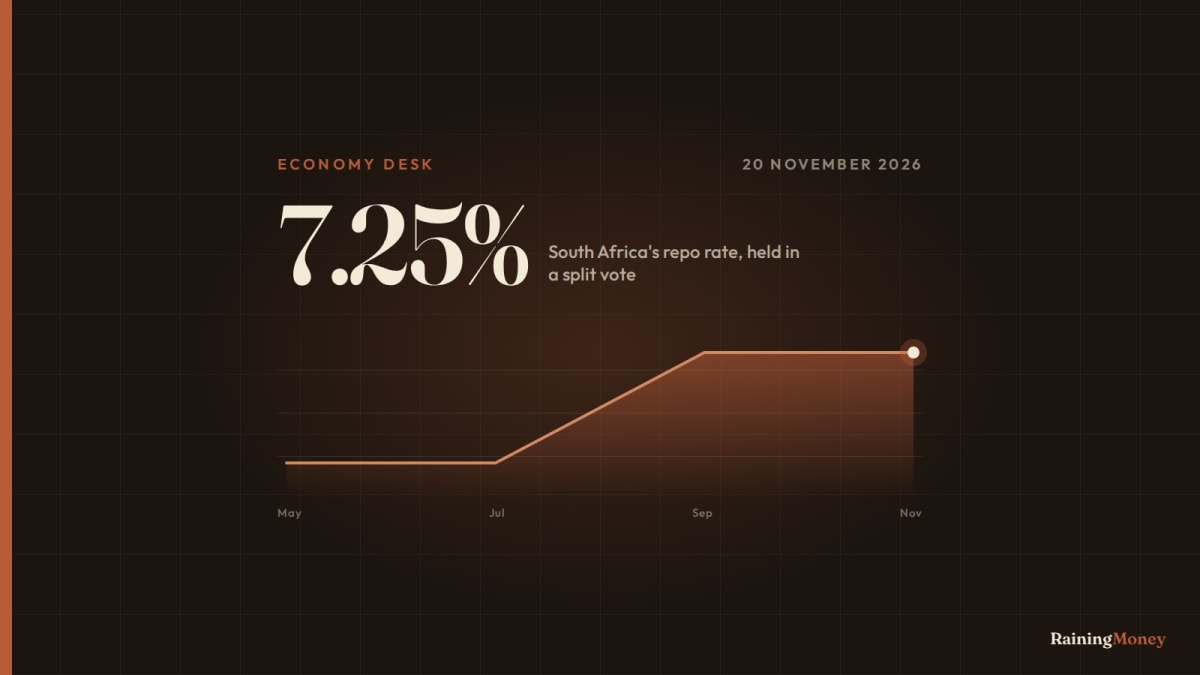
South Africa's central bank left its main interest rate unchanged at 7.25% on Thursday, 19 November 2026, even though prices there are rising at their fastest pace in more than two years. The decision was close. Four members of the South African Reserve Bank's (SARB) Monetary Policy Committee voted to hold, and three wanted a 25 basis point increase, one report says. The bank also pushed back the date by which it expects inflation to return to its 3% target, to the third quarter of 2028 from late 2027.
The hold came a day after official data showed annual inflation jumped to 5.2% in October from 4.5% in September, the highest since May 2024. Nineteen of 20 economists in one survey had expected the bank to stand still, so the decision itself was no surprise. The narrow vote and the warning that came with it are the real news.
What is a repo rate, and why does it matter?
The repo rate is the interest rate the SARB charges commercial banks when they borrow from it. It works like Nigeria's Monetary Policy Rate (MPR). When the central bank moves it, banks move the rates they charge households and businesses. In South Africa, banks price loans off the prime lending rate, which now stands at 10.75% after two increases totalling 50 basis points this year.
A basis point is one hundredth of a percentage point, so 25 basis points is 0.25 percentage points. Higher rates make home loans, car loans and business credit dearer. People and firms borrow and spend less, and over time that eases the pressure on prices.
How did South Africa get here?
For most of 2026 the SARB has been tightening as an energy shock linked to the Iran war pushed up fuel costs. The table shows its decisions since May.
| Meeting | Decision | Repo rate | Vote |
|---|---|---|---|
| May | Raise 25 basis points | 7% | 4 to 2 |
| 23 July | Hold | 7% | 4 hold, 2 hike |
| 23 September | Raise 25 basis points | 7.25% | Unanimous |
| 19 November | Hold | 7.25% | 4 hold, 3 hike (one report) |
May's increase was the bank's first in three years. Derived: the repo rate was 6.75% before it (7% minus 0.25 points), so the bank has added half a percentage point this year.
Fuel did most of the damage. One report says fuel prices in October were 42.9% higher than a year earlier, which pushed transport inflation to 15.2% and added 2.1 percentage points to the headline rate. Core inflation, which strips out food and energy to show underlying price pressure, rose to 4.2% from 4% in September.
Why does a split vote matter?
A central bank's vote tells markets what might come next. In September every member backed a rise. This time three of seven wanted another one. That means a single change of mind at the next meeting could tip the committee towards a higher rate.
Governor Lesetja Kganyago said the bank had decided to pause for now and would not hesitate to raise rates if needed. He said the current setting is tight enough to bring inflation down, but the bank is ready to act if price pressures persist. Policymakers warned they could resume increases next year if inflation pressures intensify.
Derived: with the repo rate at 7.25% and inflation at 5.2%, the gap between the two is 2.05 percentage points (7.25 minus 5.2). That gap is what savers and lenders earn after inflation. It has narrowed as prices have risen, which is one reason three members wanted to go further.
The later target date matters too. The bank had expected inflation back near 3% towards the end of 2027 when it raised rates in September. It now sees that happening in the third quarter of 2028. It kept its 2026 growth forecast at 1.2% and expects output to grow 2% by 2029. Unemployment rose to 33.7% in the third quarter, one report says. A weak economy with a third of workers jobless makes every rate increase painful, and that tension shows in the vote.
What does the US have to do with it?
A great deal. The US Federal Reserve raised its policy rate by 25 basis points to a range of 3.75% to 4% in September. Minutes of its 27–28 October meeting, released on 18 November, showed nearly all its officials thought more increases would be needed to bring US inflation back to 2%.
When US rates rise, investors can earn more on safe dollar assets, so money tends to leave emerging markets such as South Africa and Nigeria. Their currencies weaken, and imported goods, including fuel, cost more in local money. On Wednesday, 18 November, the rand fell as much as 1.9% to its weakest level against the dollar since March, after the gold price dropped below $3,800 an ounce. Bets on a Fed increase were weighing on the currency, because they threaten the extra return the rand offers over the dollar.
RainingMoney's reading: this is the squeeze the SARB is in. If it holds while the Fed keeps raising rates, the gap that attracts foreign money to South African bonds shrinks, the rand could weaken further and import prices could rise. If it raises rates, it adds pain to an economy forecast to grow 1.2% this year. The three votes for a hike suggest some members fear the first risk more.
What could this signal for Nigeria's rate decision next week?
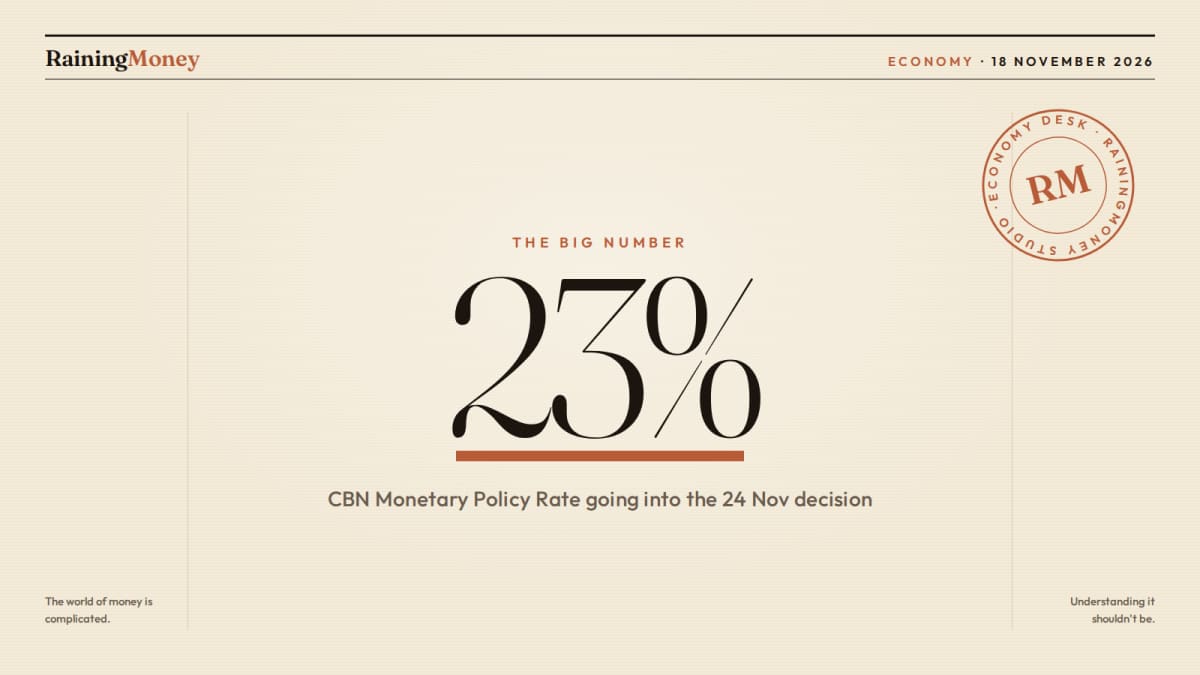
The Central Bank of Nigeria's (CBN) Monetary Policy Committee meets on 23 and 24 November, its last scheduled meeting of 2026. Nigeria is moving the other way from South Africa. The CBN cut its MPR to 23% from 26.5% in September, a 350 basis point reduction it called an operational reset.
Nigeria's inflation slowed to 14.06% in October from 14.63% in September, the lowest since September 2020. Food inflation was 19.13% and core inflation 10.78%. Derived: the MPR sits 8.94 percentage points above headline inflation (23 minus 14.06), a much wider cushion than South Africa's 2.05 points.
Analysts polled ahead of the meeting mostly expect a hold at 23%, with a small cut as the main alternative. Two of them, Igho Erakpotobo of Futureview Financial Services and Francis Nkem of Iron Capital Asset Management, named the chance of higher US interest rates as a reason for caution. Others pointed to festive-season dollar demand, spending ahead of elections and recent pressure on the naira.
RainingMoney's reading: South Africa's vote has no direct bearing on Nigeria's rate. The two banks do face the same outside force. Pretoria's decision shows that a central bank with inflation running well above target can still choose to wait. It also shows how much a hawkish Fed weighs on emerging-market currencies. Nigeria's wide gap between its policy rate and inflation gives the CBN room to cut. The pressure on the rand this week is a reminder of why it may choose to keep that room for now.
What does this mean for ordinary Nigerians?
The same US rate pressure that is pulling at the rand also affects the naira, and a weaker naira raises the cost of imported food, fuel and medicine. Whatever the CBN decides on Tuesday will shape what Nigerians pay to borrow in 2027.
What do we not know yet?
- The full vote breakdown appears in only one report so far; the SARB's own statement will confirm it.
- Whether the Fed raises rates again at its next meeting, and how far emerging-market currencies move if it does.
- Whether South Africa's fuel shock fades, as the bank hopes, or spreads into wages and other prices.
- Whether the CBN holds at 23% or cuts again on 24 November.
Sources & Verification
- Sources: BusinessDay
- Editorial note: This explainer is an original RainingMoney adaptation of the report, RainingMoney has added explanatory context.

Founder and Editor-in-ChiefAbuja
Betini Udom
Founder and Editor-in-Chief of RainingMoney. Covers Nigerian, pan-African and global markets, finance and economic policy.
Author profile & archive →The Money Print
Market intelligence before the market opens.
Pan-African capital flows and the stories behind the numbers, on weekday mornings.