
TechnologyMedium
Kuda Cuts About 40 Jobs and Bets on Lending to Turn a Profit
Nigerian digital bank Kuda is cutting about 40 jobs, its second round this year, and plans bigger consumer loans to make the group profitable by 2027.
By Betini Udom Published 6 min read Editorial Policy Report a correction
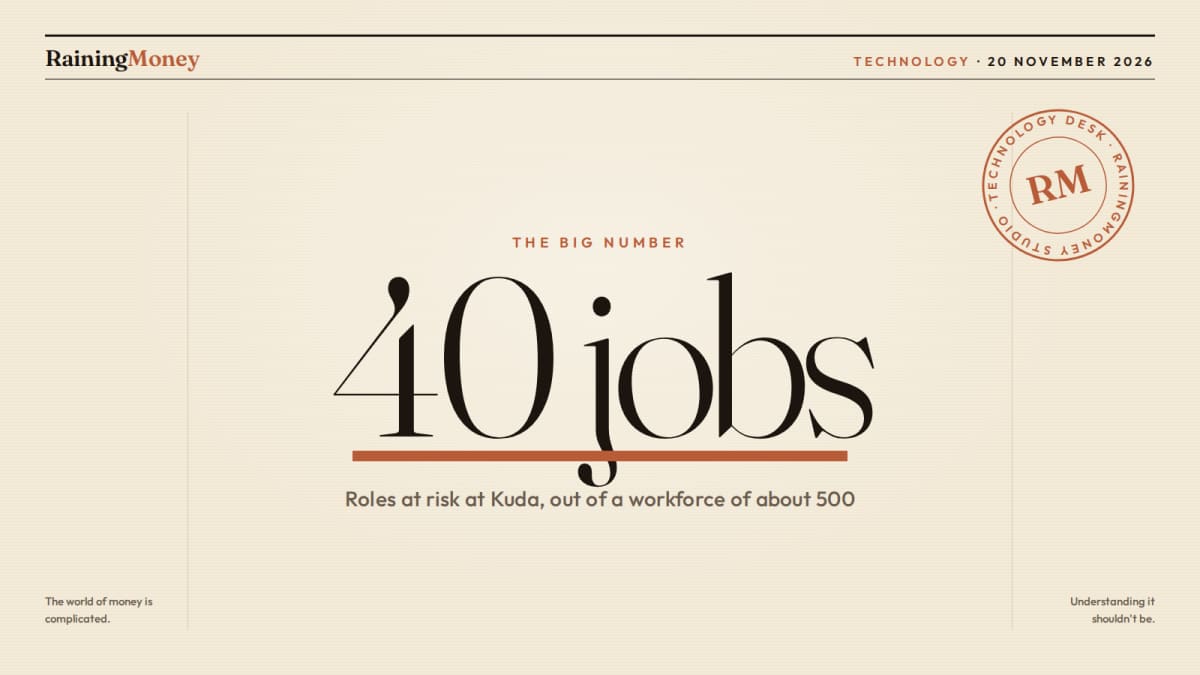
Kuda, the Nigerian digital bank, is cutting about 40 jobs in its second round of layoffs this year. The company announced the plan on Thursday, 19 November 2026. It says the cuts will help it reach profitability across the whole group by 2027. Alongside the cuts, it plans to grow by lending more money to its customers, including larger loans for things like cars and homes.
The company's statement did not give a number. Co-founder and chief executive Babs Ogundeyi put the roles at risk at around 40, out of a workforce of about 500. Reports put the cut at roughly 7.5% of staff. Derived: 40 out of 500 is 8% (40 divided by 500), so the 7.5% figure implies a workforce nearer 530. Either way, about one employee in every 12 or 13 is affected.
What is Kuda?
Kuda is a bank that runs mainly through a phone app, with no branches for customers to walk into. People use it to receive salaries, send money, pay bills and save. Its parent company is based in the United Kingdom, and its Nigerian business is a licensed microfinance bank. In January 2026 the Central Bank of Nigeria (CBN) upgraded that microfinance licence to a national one. The company says it has about 8 million customers.
The job cuts reach beyond Nigeria. They affect staff in Nigeria, the United Kingdom, South Africa, Canada, Tanzania, Uganda and Ghana. Affected workers will go through a consultation process before final decisions are made, and the company says it will offer a support package.
Why is Kuda cutting jobs again?
The first round came in March 2026, when the company reorganised several departments and was reported to have let go of hundreds of people, with marketing among the hardest hit. At the time, executives told staff the cuts were not driven by financial pressure or by individual performance. Both rounds are part of a plan Kuda calls "Kuda 2.0", which narrows the business down to its core products and customers.
Mr Ogundeyi said this round is about running the company more efficiently. He said the Nigerian bank is already profitable, though he declined to share figures. The harder task is making the whole group, including its operations outside Nigeria, profitable by 2027. He also said investors who have put money into the company will at some point expect a real financial return, beyond a rising paper value.
The national licence adds pressure. It requires Kuda to hold at least ₦5bn in paid-up capital, which is money shareholders have put into the bank and which must stay there as a safety cushion. Mr Ogundeyi described it as idle capital the bank has to keep. RainingMoney's reading: money that has to sit still cannot be spent on growth, so cutting running costs becomes more important.
How is the business doing?
The most recent full-year figures are for 2024, from filings the parent company made in the UK. They show the group's loss fell to $5.83M in 2024, from $35.11M in 2023, a drop of 84%. Management said cost control was the main reason. Staff costs fell 46% to $6.31M.
Revenue, the money a business takes in before costs, fell 15% to $18.34M when counted in dollars. Management blamed the naira's fall against the dollar. Counted in naira, revenue at the Nigerian bank nearly doubled to ₦21.2bn. When the naira loses value, the same naira income converts into fewer dollars, which is why the two figures move in opposite directions.
| Measure | 2023 | 2024 |
|---|---|---|
| Group loss | $35.11M | $5.83M |
| Group revenue (in dollars) | $21.61M | $18.34M |
| Customer deposits (Nigerian bank) | ₦96bn | ₦83.2bn |
Customer deposits, the money people keep in their Kuda accounts, fell to ₦83.2bn from ₦96bn. Derived: that is a fall of ₦12.8bn, or about 13% (12.8 divided by 96). No audited figures for 2025 or 2026 have been reported.
Why are digital banks turning to lending?
A bank earns money in two main ways. It charges fees on transactions, such as transfers and card payments, and it earns interest by lending out money. Many app-based banks grew by offering cheap or free transfers to win customers. That brings in users, but fees on each transfer are small. Lending can earn far more, because the borrower pays interest over months or years.
Until now, Kuda's main credit product has been an overdraft, which lets a customer spend a little more than they have in their account for a short time, often to get through the days before payday. Chief operating officer Nosa Oyegun said the company had offered overdrafts and some other loans but had not built its product around credit. He said the next stage is to serve customers beyond transactions. The plan is to add more conventional consumer loans, for purchases such as cars and houses, similar to the quick loans some large Nigerian banks offer. Overdrafts and existing loans will stay.
What are the risks of lending more?
Bigger loans paid back over longer periods are harder to manage than small overdrafts. A lender has to judge more carefully who can repay, wait longer to get its money back and have a way to recover it when people fall behind. Household budgets in Nigeria are under pressure from high prices, which can make repayment harder.
Kuda is already chasing old debts. Its credit team is running a campaign that gives customers with long-overdue loans a limited chance to settle them, with the window open until 23 December. Some customers have said online that their overdue balances were reduced.
What does this mean for customers and their money?
The company says the job cuts will not affect customers, and that their funds and services remain available. Kuda remains a CBN-licensed bank, so the job cuts do not change the rules it must follow.
As with any licensed microfinance bank in Nigeria, deposits at Kuda are covered by the Nigeria Deposit Insurance Corporation (NDIC). Since 2024 that cover has been up to ₦2m per depositor at a microfinance bank. If a covered bank fails, the NDIC pays depositors back up to that limit. Larger balances are repaid only from whatever can later be recovered from the failed bank's assets. Nothing in this week's news suggests any risk of that at Kuda.
For borrowers, the change could mean more loan products in the app over time. RainingMoney's reading: a bank that wants loans to be repaid usually checks applicants more closely, so larger loans may come with stricter checks than overdrafts have.
What is still unknown?
- The exact number of jobs and the precise share of the workforce. The company's statement gave neither.
- When the new consumer loans will launch, how much Kuda will lend and at what interest rates.
- Any figures for 2025 or 2026, including how profitable the Nigerian bank is.
- How many people lost their jobs in March.
The next signs to watch are the launch of the new loan products, the parent company's filings for 2025 and whether the group meets its 2027 profitability goal.
Sources & Verification
- Sources: BusinessDay
- Editorial note: This explainer is an original RainingMoney adaptation of the report, RainingMoney has added explanatory context.

Founder and Editor-in-ChiefAbuja
Betini Udom
Founder and Editor-in-Chief of RainingMoney. Covers Nigerian, pan-African and global markets, finance and economic policy.
Author profile & archive →The Money Print
Market intelligence before the market opens.
Pan-African capital flows and the stories behind the numbers, on weekday mornings.