MarketsMedium
Nine NGX 30 Giants Trade With Free Floats Below 20%: Why
BUA Cement, Dangote Cement, MTN and six other NGX 30 firms have under 20% of shares in public hands. Why they still trade, and why it matters to investors.
By Chiamaka Prudence Published 7 min read Editorial Policy Report a correction
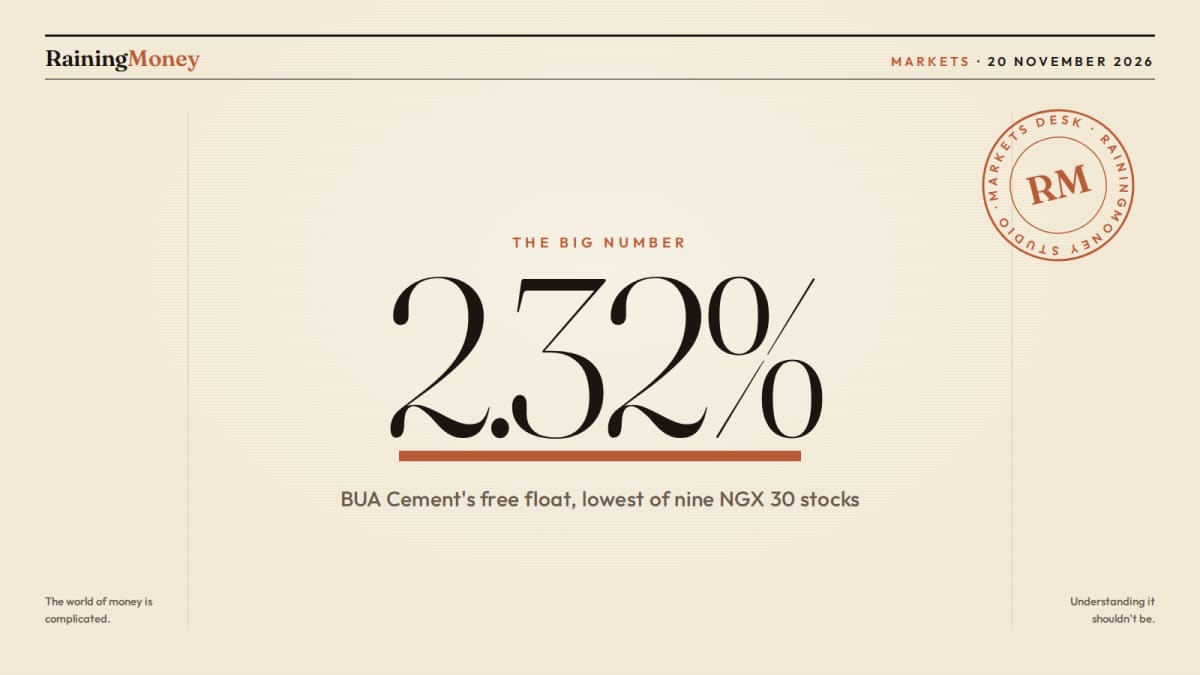
Nine of the 30 biggest companies on the Nigerian Exchange (NGX) have less than 20% of their shares in the hands of ordinary investors, and all nine still trade normally. They are BUA Cement, International Breweries, BUA Foods, Dangote Cement, Transcorp Hotels, HBM Nigeria, Transcorp Power, Geregu Power and MTN Nigeria. BUA Cement has the smallest public stake of the group at 2.32%. MTN Nigeria has the largest at 18.92%.
They remain listed because the exchange's rules give big companies a second way to qualify: a minimum naira value of shares in public hands instead of a minimum percentage. The NGX and the Securities and Exchange Commission (SEC), the capital market regulator, have been reviewing those rules since March 2026. No outcome has been published.
What is a free float?
A company's free float is the share of its stock that ordinary investors can actually buy and sell on the exchange. It leaves out shares held by founders, parent companies, directors and other strategic holders who rarely trade. If a company has 100 shares and its parent owns 90, the free float is 10 shares, or 10%.
The free float is the part of the company that moves through the market every day. When it is small, the pool of shares available to everyone else is small too, however large the company is.
How do companies with tiny floats stay listed?
The NGX rules set two tests, and a company only has to pass one of them:
- Premium Board (the exchange's top tier): at least 20% of shares in public hands, or publicly held shares worth ₦40bn or more.
- Main Board: at least 20% of shares in public hands, held by at least 300 shareholders, or publicly held shares worth ₦20bn or more.
- Smaller companies on the Growth Board must float at least 15% of their shares.
For a very large company, a small percentage can still be worth a lot of money. BUA Cement's 2.32% public stake was worth about ₦230.51bn at October 2026 prices, well above the ₦40bn bar. Derived: that is about 5.8 times the Premium Board threshold (₦230.51bn divided by ₦40bn).
So a free float below 20% does not on its own mean a company has broken the exchange's rules. Passing the value test also says nothing about how widely the shares are spread among investors.
The rules are enforced against companies that fail both tests. On 1 March 2026 the exchange issued deficiency notices to eight Main Board companies, including Champion Breweries and UPDC, for falling short of the free float requirement. It gave them extra time to comply, with quarterly progress reports. Persistent breaches can lead to trading restrictions or suspension.
Which companies are on the list?
| Company | Free float (share of stock in public hands) |
|---|---|
| BUA Cement | 2.32% (lowest of the nine) |
| International Breweries | Below 20%; exact figure not published |
| BUA Foods | Below 20%; exact figure not published |
| Dangote Cement | About 11% (March 2026); under 10% (October 2026) |
| Transcorp Hotels | Below 20%; exact figure not published |
| HBM Nigeria | Below 20%; exact figure not published |
| Transcorp Power | Below 20%; exact figure not published |
| Geregu Power | Below 20%; exact figure not published |
| MTN Nigeria | 18.92% (highest of the nine) |
Reports differ on Dangote Cement. In March 2026 its free float was put at about 11%. A report in October 2026 said it was below 10%, with its parent, Dangote Industries, holding 86.65% as of December 2025. The gap may reflect different dates or share counts; the table shows both.
Across all 30 companies in the index, publicly held shares were worth ₦42.12tn at the end of October 2026, or 27.13% of their combined market value of ₦155.25tn. Put simply, for every ₦100 of value in these companies, about ₦27 sits with the investing public. The 30 companies made up about 94% of the whole ₦165.11tn equity market.
At the other end, the big banks are widely held. Guaranty Trust Holding Company's free float is estimated at 99.90%, Fidelity Bank's at 99.26%, FCMB Group's at 97.98%, Zenith Bank's at 84.96% and Access Holdings' at 84.93%.
Why should an ordinary investor care?
A small free float matters in two ways.
It can be harder to trade. Liquidity is how easily you can buy or sell a share at a fair price without moving that price yourself. With fewer shares changing hands, a buyer may struggle to find sellers, and a seller may have to accept a lower price to get out.
Prices can swing harder. When only a thin slice of a company trades, a modest wave of buying or selling has a bigger effect on the price. Shareholder groups have made this point: in July 2026, Patrick Ajudua, president of the New Dimension Shareholders Association of Nigeria, said concentrated ownership limits the supply of shares available to investors, which affects liquidity and price movements. He called for strict enforcement of the 20% rule and said several Premium Board companies still have controlling shareholders holding more than 80% of their stock.
Dangote Cement shows how sharp the moves can be. On Tuesday, 17 November 2026, its shares fell 9.99%, the maximum allowed in one day, to ₦1,323.00. That followed a 10% fall on 5 November. No reason for the 17 November drop was published. RainingMoney's reading: no single day's move can be pinned on a thin float. When few shares are in public hands, though, a heavyweight stock can more easily jump or slide by the daily limit and pull the whole market with it.
A small float also affects market indices. Indices such as the NGX 30 are weighted mainly by a company's total market value. A company can therefore carry great weight in an index even when most of its shares never trade.
Where does the review stand?
On 16 March 2026 the NGX confirmed it was working with the SEC to review free float requirements, with the aim of improving liquidity and investor participation. Temi Popoola, Chief Executive Officer of NGX Group, said the review covers how to improve existing free float levels, how to make sure the exchange's free float data is accurate, and whether the current requirements still suit the market as it grows.
He also said the exchange was considering "whether elements of free float should play a greater role in how some of our indexes are structured." In practice, that could mean index weights that count only the shares the public can trade, in place of total market value.
Some in the market expect tighter rules to help. Peter Omoregie, Managing Director of CardinalStone Securities, said in March that higher free float requirements would raise liquidity, though controlling shareholders in closely held companies might have to sell down part of their stakes.
Eight months on, no new thresholds, deadlines or index changes have been announced.
What could change, and what is still unknown?
- Whether the NGX and SEC will raise the percentage or value thresholds, or drop the value test for the largest companies.
- If the rules tighten, how much time companies would get to comply, and how controlling shareholders would sell down: by placing shares with investors, by public offers, or both.
- Whether index weights will move to free float, which would reduce the weight of closely held giants in the NGX 30.
- The exact current free float of seven of the nine companies, which the latest reports do not publish.
RainingMoney's reading: if large owners are eventually required to sell down, more shares would reach the market over time. That could make the biggest stocks easier to trade, though a large sale can also weigh on the price while new shares are absorbed. For now the rules are unchanged, and the nine companies remain fully compliant through the value test.
Sources & Verification
- Sources: BusinessDay
- Editorial note: This explainer is an original RainingMoney adaptation of the report, RainingMoney has added explanatory context.

Correspondent, OnitshaOnitsha
Chiamaka Prudence
I am a technology and finance enthusiast with a keen interest in digital innovation, emerging financial trends, and the evolving ways technology is shaping businesses and everyday life. I enjoy…
Author profile & archive →The Money Print
Market intelligence before the market opens.
Pan-African capital flows and the stories behind the numbers, on weekday mornings.