EconomyMedium
NNPC and CBN Sign Deal on Oil Dollars and Energy Funding
NNPC and the Central Bank of Nigeria signed an MoU on FX, export proceeds and energy financing. What they agreed, and what it could mean for the naira.
By Betini Udom Published 7 min read Editorial Policy Report a correction
The Nigerian National Petroleum Company Limited (NNPC) and the Central Bank of Nigeria (CBN) signed a memorandum of understanding (MoU) on Wednesday, 18 November 2026, at the central bank's headquarters in Abuja. The agreement sets out how the national oil company and the country's monetary authority will work together on foreign exchange (FX), on getting money from exports into the Nigerian economy and on financing for the energy sector. It also commits the CBN to guide NNPC as it designs ways to raise capital using its balance sheet and assets.
An MoU is a written statement of intent. It records what two parties plan to do together and how they will organise the work. It is usually less binding than a contract. No money value, duration or full text for this agreement has been made public.
Who signed, and what did they agree to?
NNPC's Group Chief Executive Officer, Bashir Bayo Ojulari, and CBN Governor Olayemi Cardoso spoke for the two sides. Mr Ojulari described the MoU as the structure that sets out the principles and framework for how the two institutions will work together where energy and finance meet. According to the company's account, it covers:
- Lining up NNPC's plans with the country's monetary and energy goals, to support economic and financial stability.
- Tackling problems that affect trade and FX transactions, so that money earned from exports flows into the Nigerian economy.
- Building financial structures, with CBN guidance, that let NNPC raise capital using its balance sheet and assets.
- Closer work on digital payments, better protection of the critical systems behind NNPC's operations, and bringing NNPC's processes up to the standards of Nigeria's financial system.
The two sides will run a joint steering committee and a joint working committee, with members from both institutions, and say they will track progress against defined performance indicators. NNPC said its treasurer, John Etukudo, will oversee the process for the company.
Why does the central bank care about an oil company?
Oil is a major source of Nigeria's dollars. When crude is sold abroad, buyers pay in dollars. How quickly those dollars come home, and whether they reach the local market, affects how many dollars are available to banks, importers and families who need them. That in turn affects the exchange rate, the number of naira it takes to buy one dollar.
Mr Cardoso said the MoU formalises a long working relationship between the two institutions. He said closer coordination on account management, funds transfers and liquidity support (making sure cash is there when payments fall due) could strengthen the management of government revenue and make FX inflows into the market more predictable. He also said the CBN could use its convening power, its ability to bring big lenders and investors to the table, to attract global institutions and financing structures for developing Nigeria's gas and for oil and gas investment.
NNPC's Group Chief Financial Officer, Adedapo Segun, said the company will line up its local payments, payments to contractors and FX conversions with CBN rules, to support the naira and reduce dollarisation. Dollarisation is when people and companies inside the country price, save or pay in dollars instead of naira. It weakens demand for the local currency.
What does raising capital against its assets mean?
A company with valuable assets, such as oil fields, pipelines or stakes in joint ventures, can use them to raise money in several ways. It can borrow and offer the assets, or the future income from them, as security for the loan. It can sell part of an asset to a partner. It can issue bonds that are repaid from future earnings. NNPC has not said which route it will take, how much it wants to raise or when.
The CBN's role, as described by both sides, is to give guidance on these structures. RainingMoney's reading: the central bank's input matters because large deals of this kind often involve borrowing and repaying in dollars, which touches the FX market and the banks the CBN supervises.
The plan follows earlier moves to raise money from NNPC's assets. The company launched a bidding process in December 2025 to sell stakes in some oil and gas assets, and has been reported to be planning to cut its holding in selected fields by at least 25%. One report in January 2026 said NNPC was aiming to raise at least $30B by 2030 through asset sales and new investment. That figure is unconfirmed.
Is the naira under pressure right now?
The deal comes in a week when the naira has softened. It closed at ₦1,363.23 per dollar in the official market on 18 November, from ₦1,355.80 the day before, its weakest level in 18 days. Total FX inflows into the official market fell to $807.6M in the latest week reported, from $2.48B the week before. Gross external reserves, the stock of foreign money the CBN holds, stood at $54.76B on 17 November, below a peak of $55.26B on 27 October.
| Measure | Earlier | Latest |
|---|---|---|
| Naira per dollar, official market | ₦1,355.80 (17 Nov) | ₦1,363.23 (18 Nov) |
| Weekly FX inflows, official market | $2.48B (prior week) | $807.6M (latest week) |
| Gross external reserves | $55.26B (27 Oct peak) | $54.76B (17 Nov) |
RainingMoney's reading: the MoU did not cause any of these moves and will not change them overnight. They show why a steady flow of oil dollars matters so much to the central bank.
What rules already apply to oil export dollars?
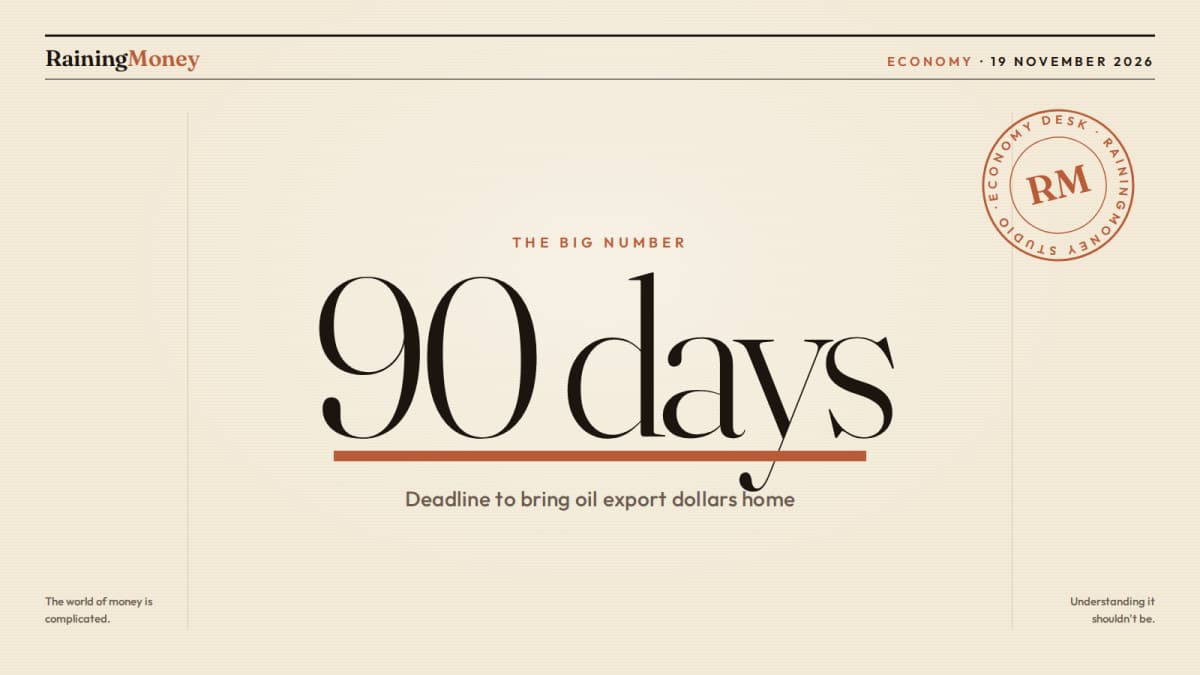
Under a CBN circular dated 8 January 2025, money from oil and gas exports must be brought back and credited to the exporter's export proceeds domiciliary account (a dollar account at a Nigerian bank) within 90 days of the bill of lading date. A bill of lading is the shipping document issued when cargo is loaded onto a vessel. Non-oil exporters get 180 days. The same circular ended CBN approvals for banks asking to extend those deadlines on customers' behalf.
The published accounts of the MoU do not mention new deadlines or changes to these rules for NNPC. The change they describe is a standing channel between the two institutions. Mr Segun said the agreement replaces irregular arrangements for handling financial issues with a more coordinated approach.
Could this help Nigeria pump more oil?
Mr Segun linked better financial coordination to attracting the investment needed to lift crude output from its current 1.8 million barrels per day to 3 million barrels per day. He gave no target date. Derived: that would be an extra 1.2 million barrels a day, about two-thirds more than today (1.2 divided by 1.8). More crude sold abroad would, in principle, mean more dollars earned.
RainingMoney's reading: new oil output depends on drilling and investment that take years, so any effect of this agreement on production would be slow.
What does it mean for ordinary Nigerians?
Nothing changes in anyone's bank account this week. The agreement is a framework, and its effects depend on what the committees produce. If it works as described, the main benefit would be indirect: a steadier supply of dollars into the official market, which supports a more stable exchange rate. A stable naira helps keep the prices of imported food, fuel and medicines more predictable for households and traders.
Mr Ojulari said NNPC's board, appointed on 2 April 2025, inherited serious problems, including legacy loans and deep-rooted issues across the company. He said the partnership is meant to deliver results and called it essential and timely.
What is still unknown?
- The full text of the MoU has not been published.
- NNPC has given no amount or timetable for raising capital against its assets.
- It is not clear whether NNPC's own export earnings will be handled differently from today.
- Neither side has said how, or how often, progress against the performance indicators will be reported to the public.
The first signs to watch are announcements from the joint committees, any NNPC bond or asset-backed financing, and the weekly figures for FX inflows and external reserves.
Sources & Verification
- Sources: Premium Times
- Editorial note: This explainer is an original RainingMoney adaptation of the report, RainingMoney has added explanatory context.

Founder and Editor-in-ChiefAbuja
Betini Udom
Founder and Editor-in-Chief of RainingMoney. Covers Nigerian, pan-African and global markets, finance and economic policy.
Author profile & archive →The Money Print
Market intelligence before the market opens.
Pan-African capital flows and the stories behind the numbers, on weekday mornings.