EconomyMedium
CBN Rate Decision Next Week: Will the MPC Hold at 23%?
The MPC meets on 23 and 24 November with the policy rate at 23% and inflation at a six-year low. What a hold or a cut would mean for your loans and savings.
By Betini Udom Published 5 min read Editorial Policy Report a correction
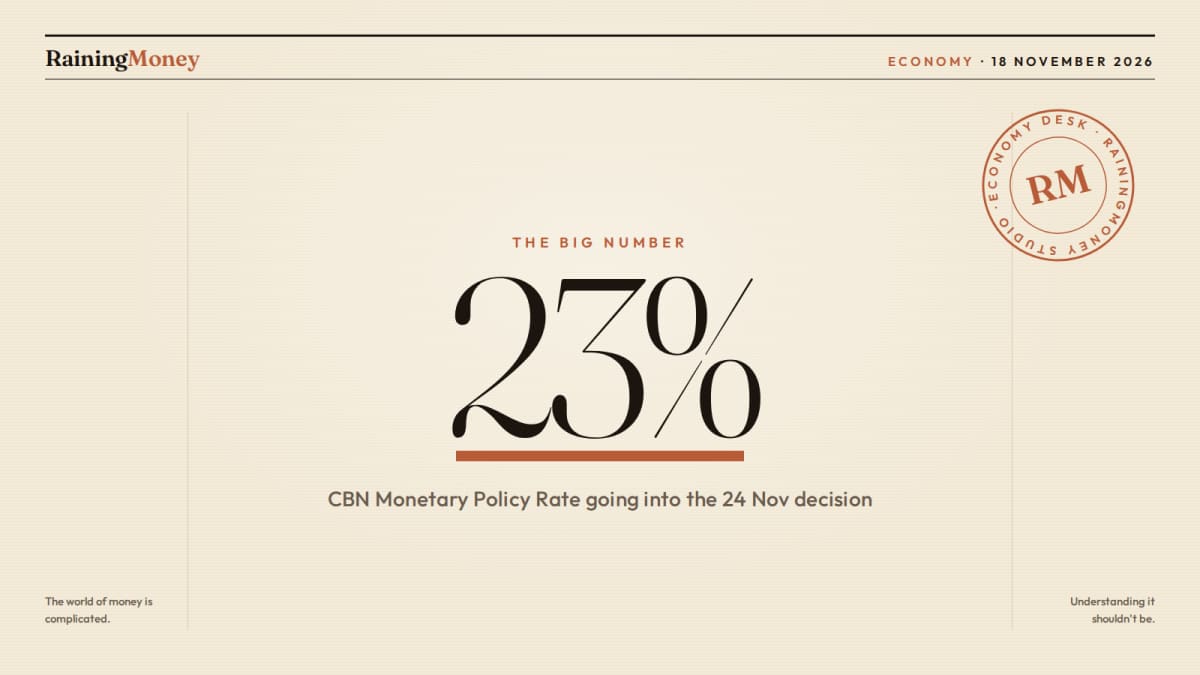
The Central Bank of Nigeria (CBN) decides on interest rates next week, and the case for a cut has grown since economists last made their predictions. The bank's Monetary Policy Committee (MPC) meets on 23 and 24 November 2026, with the decision due on 24 November. Its benchmark rate, the Monetary Policy Rate (MPR), stands at 23%.
Five market experts surveyed before the latest inflation figures all expected a hold. Since then, October data showed inflation falling to 14.06%, a six-year low, and one of the main worries behind the "hold" view, a jump in underlying prices, reversed. Here is what the decision is about and how it reaches your pocket.
What is the MPR, and why does it matter to me?
The MPR is the anchor for interest rates across the economy. When the CBN raises it, banks, the government and businesses usually pay more to borrow, and savers usually earn more. When it cuts, the reverse tends to happen over time. The MPC, a committee of 11 members chaired by the CBN Governor, normally meets every two months to set it.
The rate also affects prices. High rates make borrowing expensive, which slows spending and helps cool inflation. They also attract foreign investors to Nigerian bonds and bills, which brings in dollars and supports the naira.
How did the rate get to 23%?
The rate was 27% at the start of the year. In February 2026 the MPC cut it by half a percentage point to 26.5% and held it there for months. Then, on 22 September, it cut by 3.5 percentage points (350 basis points) to 23%. That was the largest cut since December 2006 and took the rate to its lowest since February 2024.
CBN Governor Olayemi Cardoso called September's move "an operational reset to enhance the effectiveness of monetary policy." The point was to bring the MPR closer to the rates banks were actually charging each other, which were around 22%, rather than to loosen policy. The MPC also set the band around the MPR at 0.5 points above and 3 points below, and kept the cash reserve requirement, the share of deposits banks must leave with the CBN, at 45% for commercial banks.
What has happened to inflation since then?
| Month (2026) | Headline | Food | Core |
|---|---|---|---|
| August | 15.39% | ||
| September | 14.63% | 19.59% | 12.95% |
| October | 14.06% | 19.13% | 10.78% |
Headline inflation measures how much prices overall rose over the past year. Core inflation leaves out farm produce and energy, whose prices jump around, so it shows the underlying trend. In September, core prices rose 1.11% in a single month, which worried analysts. In October they fell 0.53% month on month. Food prices also fell for a second month, by 0.75% in October.
One figure points the other way. Overall prices rose 0.43% in October compared with September, faster than September's 0.06%. So the yearly rate is falling, but the month-to-month pace picked up.
What do the experts expect?
In a survey published on 15 November, before the October data, all five experts expected the MPC to hold at 23%. Ire Osaro of First Securities Brokers said a pause would let the CBN judge the effect of September's big cut. Adaeze Onyemachi of Blue Marina Securities pointed to food prices that remain high. Sola Oni of Sofunix cited September's rise in monthly core inflation. Israel Adebomi of STL Capital said the committee would want stronger evidence on inflation, the exchange rate and liquidity. Chukwudi Nga of MorganCapital Securities also expected a hold but said a modest cut could not be ruled out.
Since that survey, the October figures have weakened at least one of those arguments, as monthly core inflation turned negative. Some coverage has since described the six-year low in inflation as strengthening the case for a possible cut.
What are the arguments for and against a cut?
For a cut: The MPR is now about 8.94 percentage points above inflation (derived: 23% minus 14.06%). That gap, called the real interest rate, is wide, which gives the CBN room to ease without letting inflation run. Businesses also complain that bank lending rates remain around 30%, far above the MPR.
Against a cut: The naira has softened, with the street rate near ₦1,445 per dollar this week and dollar inflows falling. Food inflation is still above 19%. The 2027 election campaign is expected to pump money into the economy, and the CBN Governor has warned that election spending must be watched closely. A cut could make Nigerian bonds less attractive to foreign investors just as the naira needs their dollars.
What would each outcome mean for my money?
- A hold would keep borrowing costs and savings rates roughly where they are. Treasury bill and bond yields, which already sit below the MPR, could drift lower if markets expect a cut later.
- A cut would likely push down what fixed deposits, money market funds and Treasury bills pay over the coming months. It may, over time, lower some loan rates, though banks have been slow to pass on earlier cuts.
Neither outcome is a reason on its own to move your savings; this explains how the decision could feed through.
What isn't known yet?
- How the MPC will weigh the naira's recent softness against falling inflation.
- How the 11 members of the committee will vote.
- Whether the CBN will change other tools, such as the cash reserve requirement, instead of the rate.
Sources & Verification
- Sources: BusinessDay
- Editorial note: This explainer is an original RainingMoney adaptation of the report, RainingMoney has added explanatory context.

Founder and Editor-in-ChiefAbuja
Betini Udom
Founder and Editor-in-Chief of RainingMoney. Covers Nigerian, pan-African and global markets, finance and economic policy.
Author profile & archive →The Money Print
Market intelligence before the market opens.
Pan-African capital flows and the stories behind the numbers, on weekday mornings.