CompaniesMedium
West Africa Deal Value Falls 72% as Nigeria's Cheques Shrink
West Africa's deal value fell 72.1% to $537.61M in H1 2026. Nigeria did 39 of 55 deals but only $105.8M of value. What it means for jobs and the naira.
By Betini Udom Published 7 min read Editorial Policy Report a correction
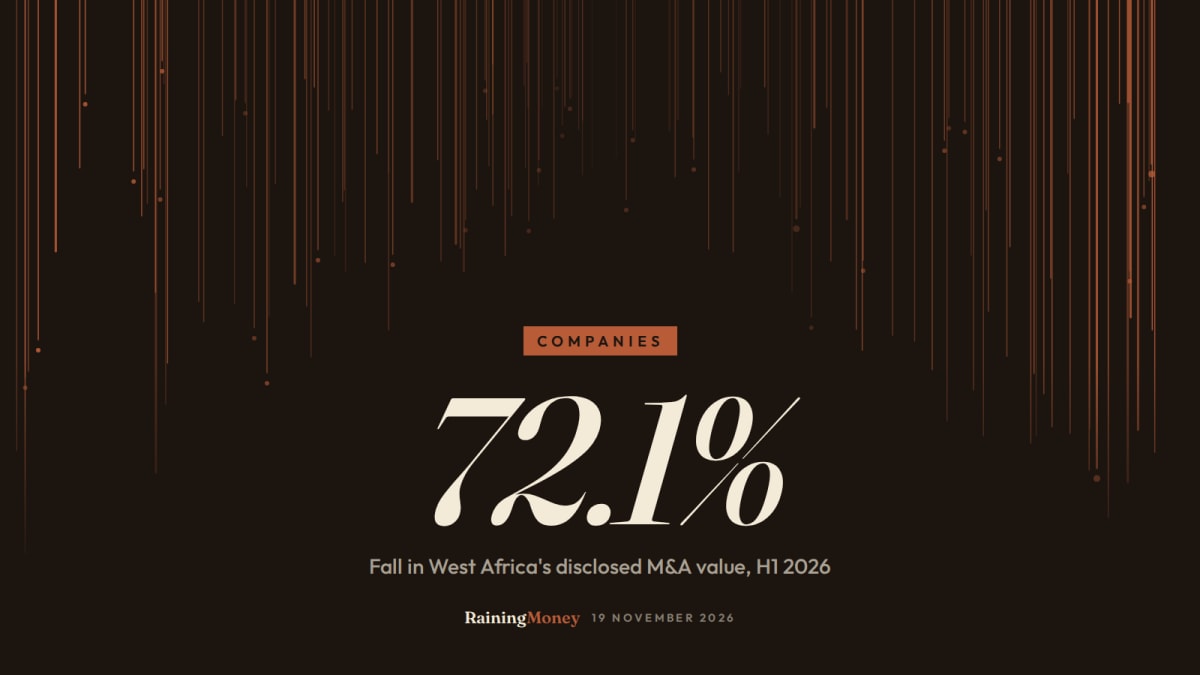
The value of disclosed mergers and acquisitions in West Africa fell 72.1% in the first half of 2026, to $537.61M from $1.927B a year earlier, DealMakers Africa data show. The number of deals barely moved: 55 against 59. Nigeria did most of the deals, 39 of the 55, but they added up to only $105.8M. Ghana, with seven deals, recorded $205M.
So the region is still doing business. What has disappeared is the large cheque. And Nigeria, which led Africa by deal value in the first half of 2025, slipped to ninth place, while Kenya took the top spot.
What are M&A and private equity, in plain terms?
M&A stands for mergers and acquisitions. A merger is two companies combining into one. An acquisition is one company or investor buying all or part of another. When a foreign telecoms group buys a Nigerian tower company, or a bank buys a rival's shares, that is M&A.
Private equity (PE) is money from investment funds that buy stakes in private companies, help them grow for some years, then sell the stake for a profit. That final sale is called an exit. PE deals are counted inside the M&A figures in this data.
Deal value is the price paid. It is "disclosed" value because buyers and sellers often keep the price secret, and a deal with no stated price adds to the count but adds nothing to the value. That matters a great deal for Nigeria, as the numbers below show.
How did Nigeria compare with the rest of West Africa?
| Market | Deals | Disclosed value |
|---|---|---|
| Nigeria | 39 | $105.8M |
| Ghana | 7 | $205M |
| Deals listed as wider West Africa | 2 | $210M |
| Côte d'Ivoire (private equity) | 3 | $15M |
| Senegal | 2 | $1.8M |
| West Africa total | 55 | $537.61M |
Nigeria carried about 71% of the region's deals but only about 20% of its value. Derived: 39 ÷ 55 = 70.9%, and $105.8M ÷ $537.61M = 19.7%. Ghana's seven deals and the two regional deals together made up about 77% of the value.
Spread across Nigeria's 39 deals, $105.8M works out at about $2.7M each (derived: $105.8M ÷ 39). That understates the true average, because deals with undisclosed prices are counted with a value of zero. Even so, it shows how small the typical Nigerian deal with a published price was this year.
Nigeria's value fell 88.9% from $956.6M in the first half of 2025. The data put it at the lowest first-half level since 2018. Its deal count rose, from 31 to 39, the highest of any African country.
Why did Kenya overtake Nigeria?
Kenya's deal value jumped 670.5% to $1.44B from 25 deals, lifting it from sixth place to first. A few big banking transactions did most of the work. The largest was Nedbank's proposed $855M purchase of a 66% stake in NCBA Group, the second-biggest deal announced in Africa in the half. Absa Group also bought a further 16.5% of Absa Kenya for $239M, and investors put $215M into Spiro, a Kenyan electric motorbike company.
Kenya's value was about 13.6 times Nigeria's (derived: $1.44B ÷ $105.8M). East Africa as a whole rose 165.1% to $1.477B, even though its deal count fell from 42 to 39.
The biggest deal on the continent did involve Nigeria's market. MTN Group's offer, announced on 17 February 2026, to buy the roughly 75% of IHS Towers it does not already own is worth about $2.2B. IHS runs about 18,000 of its roughly 29,000 towers in Nigeria. That $2.2B is far larger than Nigeria's entire $105.8M total, so it is plainly not counted in the Nigerian figure. RainingMoney's reading: how a deal is assigned to a country can swing a ranking, and readers should treat country league tables as a rough guide.
What happened to private equity money?
Private equity value in West Africa fell 72.5% to $108.45M across 24 deals, from $397M across 31 deals a year earlier. Nigeria held up better than the region. It recorded 17 PE deals worth about $91.7M, around 84.5% of West Africa's PE value. That is down from $127.4M in the first half of 2025 but above the $52.5M recorded in the first half of 2024.
Across Africa, PE recorded 76 deals worth $789M, with the count down 5% and the value down 3.3%.
Why are investors writing smaller cheques in Nigeria?
The editor of DealMakers Africa, Marylou Greig, said geopolitical developments had made buyers and investors more cautious. Analysts in Lagos pointed to several local reasons as well:
- Tax. The Nigeria Tax Act, in force since 1 January 2026, raised the capital gains tax rate for companies from 10% to 30%. Capital gains tax is charged on the profit made when an asset, such as a stake in a company, is sold. A higher rate cuts what a PE fund keeps from an exit.
- The naira and getting money out. Abiodun Keripe, managing director of Afrinvest Consulting, cited foreign exchange swings and uncertainty over repatriation, meaning the ability of foreign investors to convert naira profits into dollars and send them home.
- Price gaps and politics. Mr Keripe also pointed to gaps between what buyers will pay and what sellers will accept. Ayokunle Olubunmi, head of financial institutions ratings at Agusto & Co, cited investor attention on the 2027 general election.
Mr Olubunmi said the tax is one factor among several and not the main driver. His reasoning: PE's share of activity did not fall far enough to explain the overall drop.
Why do other reports show billions flowing into Nigeria?
A different report, on a different basis, tells what looks like the opposite story. A private capital report covering Africa in the second quarter of 2026 put West Africa's disclosed value at $8.9B, with Nigeria accounting for $8.0B of it across 63 transactions.
The two are measuring different things. The DealMakers Africa figures cover M&A and PE deals in the first half of the year. The private capital report covers all private capital in one quarter, which includes loans, private debt and infrastructure financing as well as M&A. One example it lists is a $600M Africa Finance Corporation loan to Dangote Group's Greenview Fertiliser. A large loan to a Nigerian company counts there but is not a purchase of a business, so it does not appear in the M&A data. In that report, M&A was only 14% of recorded deals in the quarter.
RainingMoney's reading: money is still reaching Nigerian companies, but more of it is arriving as debt than as buyers paying for ownership.
Why should a non-investor care?
Large acquisitions usually bring dollars into the country when a foreign buyer pays for a Nigerian business. Fewer and smaller deals mean fewer of those inflows, which is one of the supports the naira relies on.
Deals also fund growth. A company that sells a stake to a PE fund often uses the money to build factories, open branches or hire staff. When the cheques shrink, expansion plans can wait.
And M&A is a signal. Big buyers do months of checking before they commit hundreds of millions of dollars. When they hold back, it tells you how they rate the risk of doing business in a country, and other investors watch that signal closely.
What should readers watch next?
Watch the second-half and full-year figures. TotalEnergies completed its $800M sale of a 10% interest in the Renaissance joint venture's oil licences to Vaaris Energy on 27 October 2026, and MTN Nigeria has announced a ₦152.06bn sale of 60% of its fintech businesses to MTN Group, which still needs regulatory approval. How deals like these are counted will show whether the first half was a pause or a trend. Across Africa, disclosed M&A value fell 10.3% to $5.58B, and deals fell from 190 to 166, a figure that excludes South Africa. West Africa's fall was far steeper than the continent's.
Sources & Verification
- Sources: Nairametrics
- Editorial note: This explainer is an original RainingMoney adaptation of the report, RainingMoney has added explanatory context.

Founder and Editor-in-ChiefAbuja
Betini Udom
Founder and Editor-in-Chief of RainingMoney. Covers Nigerian, pan-African and global markets, finance and economic policy.
Author profile & archive →The Money Print
Market intelligence before the market opens.
Pan-African capital flows and the stories behind the numbers, on weekday mornings.