
EnergyMedium
Nigeria Opens Bidding for 40 Oil and Gas Blocks: What's Next
Nigeria's oil regulator opened registration for its 2026 licensing round on 20 November, offering 40 onshore and offshore blocks; sign-up runs to 15 January.
By Betini Udom Published 5 min read Editorial Policy Report a correction
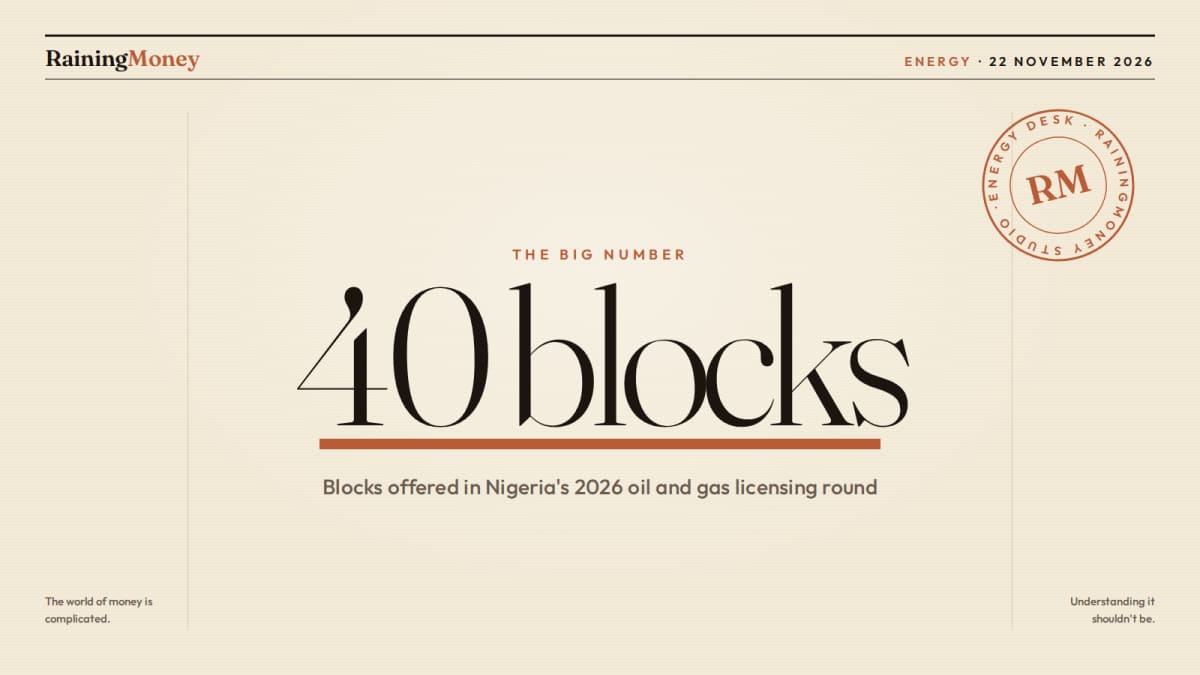
Nigeria's upstream oil regulator has opened registration for its 2026 licensing round, putting 40 oil and gas blocks up for bids. The Nigerian Upstream Petroleum Regulatory Commission (NUPRC) said in a public notice on Saturday, 21 November, that the bid portal went live on 20 November 2026. Companies have until 15 January 2027 to register.
What exactly is on offer?
A block is an area of land or sea where a company may look for oil and gas, and produce them if it finds enough. The 40 blocks in this round are spread across three kinds of terrain:
| Terrain | Number of blocks |
|---|---|
| Onshore (on land) | 17 |
| Shallow water (near the coast) | 14 |
| Deep offshore (far out at sea) | 9 |
| Total | 40 |
The onshore and shallow-water blocks carry names beginning "PPL 2A", and the deep offshore ones names such as "PPL 303 – DO". PPL stands for petroleum prospecting licence, the permit that lets a company explore an area before it applies to produce from it.
The round was announced in early October after President Bola Ahmed Tinubu, who is also the Minister of Petroleum Resources, gave the approval the law requires. The regulator says it followed the Petroleum Industry Act (PIA) of 2021, the law that reorganised how Nigeria's oil sector is run, including publishing notices in local and international media.
How does the bidding work?
The round runs in five stages:
- Registration and prequalification. Companies sign up on the portal and show they have the money and technical skill to qualify.
- Data access. Qualified bidders can study the geological data the regulator holds on each block.
- Technical and commercial bids. Companies submit their plans for each block and what they will pay.
- Technical evaluation. The regulator scores the plans.
- Final commercial conference. The commercial offers are opened and winners are chosen.
A pre-bid conference is set for Lagos on 16 December 2026, where the regulator is expected to explain its technical and fiscal terms to local and foreign investors. Updates will appear on the portal and the commission's official channels.
Why is Nigeria selling more blocks so soon?
This round comes less than three months after the 2025 round finished. The commission's chief executive, Oritsemeyiwa Eyesan, said at an industry conference in Abu Dhabi on 2 November that the regulator has run at least four licensing rounds between 2021 and 2026. Before the PIA, rounds were rare.
She argued that Nigeria is an attractive place to invest despite uncertainty in global energy markets, pointing to the PIA, executive orders signed by the president, the fiscal terms on offer and improved security. She said the fiscal framework and incentives are meant to help investors manage costs and reduce their risks, and that the government is working on the problems investors worry about most: delays, high costs and regulatory uncertainty.
RainingMoney's reading: frequent rounds keep acreage moving to companies that will work it. Blocks that sit idle earn the country nothing, so a regular calendar gives investors a steady pipeline and gives the government a chance to re-offer blocks that failed to attract bids before.
How did the last round go?
The 2025 round offered 50 blocks. About 200 bids came in from 143 companies, covering 37 of the blocks; 13 drew no bids at all. In the end, 31 companies won the 37 blocks. The blocks on offer spanned the Niger Delta on land and at sea, and frontier basins such as the Benue Trough and the Chad, Anambra and Benin basins, which the regulator said drew unusually strong interest.
After that round, the commission said it planned to restore more than 788,000 barrels per day of crude production that had been shut in, meaning wells that could produce but were not, and to push offshore projects worth an estimated $30B to $50B towards a final investment decision. A final investment decision is the point at which a company commits the money to build a project.
Activity on existing fields is also rising. The regulator approved 145 new drilling operations and 595 well re-entries for 2026, one report says. A re-entry means going back into an old well to repair it or drill deeper.
What about gas?
Gas is a large part of the pitch. Nigeria holds an estimated 215 trillion cubic feet of gas reserves but produces only about 7 billion cubic feet a day, the regulator says. Two long-planned pipelines, the Nigeria-Morocco Atlantic Gas Pipeline and the Trans-Sahara Gas Pipeline, are meant to carry Nigerian gas to the region and to Europe, though both are still at the planning stage.
What does this mean for ordinary Nigerians?
Very little in the short term. A licensing round is the first step in a long chain: winning a block, exploring it, finding oil or gas, building facilities and then producing. That can take years, and many blocks never produce at all.
Over time, though, the stakes are high. Oil and gas sales bring in most of Nigeria's foreign currency, so more production can mean more dollars flowing into the economy, which supports the naira, and more revenue for federal, state and local governments. Gas also matters at home: it fuels power plants, so more gas reaching those plants can mean more electricity.
Bids also bring money up front. Companies typically pay fees and bonuses to the government when they win a block, though the terms for this round have not yet been published.
What should we watch?
- How many companies register by 15 January. The 2025 round's 143 bidders is the benchmark.
- The terms at the December conference. Investors will want to see what the government expects to be paid, and how quickly licences turn into permission to produce.
- Whether deep offshore blocks attract the large firms. Those blocks cost the most to develop and usually need international companies with deep pockets.
The round is a bet that steady, rules-based sales will bring more investment into Nigerian oil and gas. Its success will be measured in barrels produced years from now, not in the number of blocks on offer today.
Sources & Verification
- Sources: BusinessDay
- Editorial note: This explainer is an original RainingMoney adaptation of the report, RainingMoney has added explanatory context.

Founder and Editor-in-ChiefAbuja
Betini Udom
Founder and Editor-in-Chief of RainingMoney. Covers Nigerian, pan-African and global markets, finance and economic policy.
Author profile & archive →The Money Print
Market intelligence before the market opens.
Pan-African capital flows and the stories behind the numbers, on weekday mornings.