EnergyMedium
Grid Load Falls to 948MW as Four Lines Trip: What Happened
Four transmission lines tripped on Friday and grid load fell to 948MW from over 3,000MW. NISO says it was not a grid collapse and lines were back by 2:49pm.
By Janefrances Neche Published 4 min read Editorial Policy Report a correction
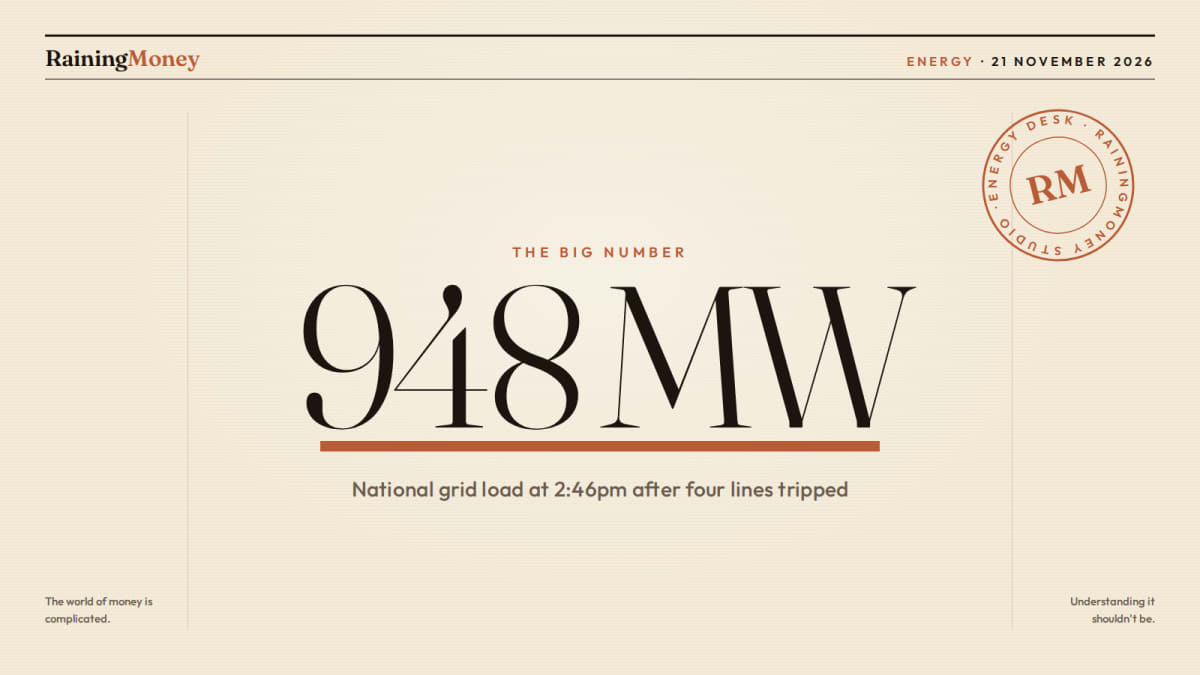
Electricity supply dropped across parts of Nigeria on Friday afternoon, 20 November 2026, after four high-voltage transmission lines tripped within 16 minutes. The Nigerian Independent System Operator (NISO), which runs the national grid, said there was no grid collapse and that all four lines were back in service by 2:49pm. At the worst point, the power flowing through the grid fell to about 948 megawatts (MW), against an average of more than 3,000 MW.
What happened on Friday?
NISO gave this timeline in a statement:
- 12:34pm: the Omotosho–Ikeja West line tripped, cutting a large amount of supply to the Lagos area.
- 12:50pm: three more lines tripped: Ihovbor–Oshogbo, Benin–Egbin and Ihovbor–Ajaokuta. That caused power losses in other parts of the country.
- 2:49pm: all four lines were restored to normal operation, after NISO's teams and the Transmission Company of Nigeria (TCN) took emergency steps to steady the grid.
"Tripped" means the line switched itself off. Lines are built to cut out automatically when something goes wrong, such as a fault, an overload or a sudden swing in power, to protect the equipment.
What is the difference between a line trip and a grid collapse?
The national grid is the network of power stations, high-voltage lines and substations that carries electricity from where it is made to the distribution companies (DisCos) that supply homes and businesses.
A grid collapse is when the whole system shuts down at once and has to be restarted, a process that can take hours or days. A line disturbance, which NISO says this was, is when parts of the network drop out but the system as a whole keeps running. Customers in affected areas still lose power, but the rest of the grid stays up and the lost sections can be reconnected faster.
NISO stressed the difference and told the public to rely on its official channels for information about the grid.
How big was the drop?
At 2:46pm, total load on the national grid was 948 MW. Load is the amount of electricity actually being delivered at a moment. The grid usually carries more than 3,000 MW. By RainingMoney's working (derived: 948 ÷ 3,000), Friday's load at that point was less than a third of normal.
| Distribution company | Load (MW) |
|---|---|
| Ikeja Electric | 133 |
| Eko Disco | 132 |
| Ibadan Disco | 119 |
| Abuja Disco | 109 |
Those low figures reflect heavy load shedding, where DisCos cut supply to some areas in turn because there is not enough power to go round.
Who does what on the grid?
Three groups share the work. Power stations generate the electricity. The Transmission Company of Nigeria owns and maintains the high-voltage lines and substations that carry it across the country. NISO, the system operator, decides minute by minute how much power flows where, so that supply and demand stay in balance. The DisCos then take power off the grid and deliver it to homes and businesses on their own lower-voltage networks.
A megawatt is a measure of how much electricity is flowing at a given moment. A fall from more than 3,000 MW to 948 MW means that for a time, far less power was reaching the DisCos than usual, and they had to ration what they had.
Why did Lagos feel it first?
The first line to trip, Omotosho–Ikeja West, feeds what NISO calls the Lagos complex, the cluster of substations that supply the city. When it dropped, a large share of the power meant for Lagos was lost at once. The three lines that tripped 16 minutes later spread the losses to other parts of the country.
Is this part of a bigger problem?
Friday's trip came during weeks of weak supply. On 5 November, NISO blamed lower generation on gas shortages at gas-fired power stations and on lower water levels at the hydro dams. NNPC Limited disputed that a few days later, saying its gas output had grown about 10% this year and its pipeline arm had no transport problems affecting deliveries to power plants. It called for a joint review with gas suppliers, generators and NISO.
There has also been a dispute between the TCN and Ikeja Electric over who is to blame for outages on the DisCo's feeders. For interruptions on 1 and 2 November, the TCN said 68% were caused by low generation, 26% by the DisCo and 6% by the TCN's own maintenance and line limits.
Friday's event was a transmission fault, not a generation problem, but it hit a grid already short of power.
What does this mean for my money?
Every hour without grid power pushes homes and businesses onto generators, which run on petrol or diesel. Diesel imports rose sharply in October and the naira has weakened this month, so running a generator is getting more expensive. For a small shop, a salon or a cold-room operator, a two-hour outage in the middle of the afternoon means either lost sales or extra fuel spending.
What isn't known yet?
NISO did not say what caused the first line to trip, or how many customers lost power and for how long. It also did not say how much electricity was lost in total over the two hours. Those details would show whether this was a one-off fault or a sign of strain on the lines serving Lagos.
Sources & Verification
- Sources: Nairametrics
- Editorial note: This explainer is an original RainingMoney adaptation of the report, RainingMoney has added explanatory context.

Correspondent, AbujaAbuja
Janefrances Neche
Janefrances is a finance correspondent specializing in emerging markets, consumer economics, and policy analysis. Most recently reporting for regional business desks, she has tracked shifting…
Author profile & archive →The Money Print
Market intelligence before the market opens.
Pan-African capital flows and the stories behind the numbers, on weekday mornings.