MarketsMedium
Naira Hits Nine-Month Low as Dollar Trading Dries Up by 82%
The naira closed at ₦1,396.50/$ on 24 November, its weakest in nearly nine months, as interbank dollar trading fell 82%. What is behind it and what it means.
By Betini Udom Published 4 min read Editorial Policy Report a correction
The naira closed at ₦1,396.50 to the dollar in the official market on Tuesday, 24 November 2026, its weakest close in nearly nine months, as dollar trading between banks dried up. Turnover in the interbank market, where banks buy and sell dollars with each other, fell 82% in a day to $164.28M from $931.23M on Monday. The last time the naira closed weaker was on 6 March, at ₦1,398.
The fall comes in the run-up to the general election on 16 January 2027, during the year-end season when demand for dollars usually rises, and on the same day the Central Bank of Nigeria (CBN) held its main interest rate at 23%.
How far has the naira fallen this month?
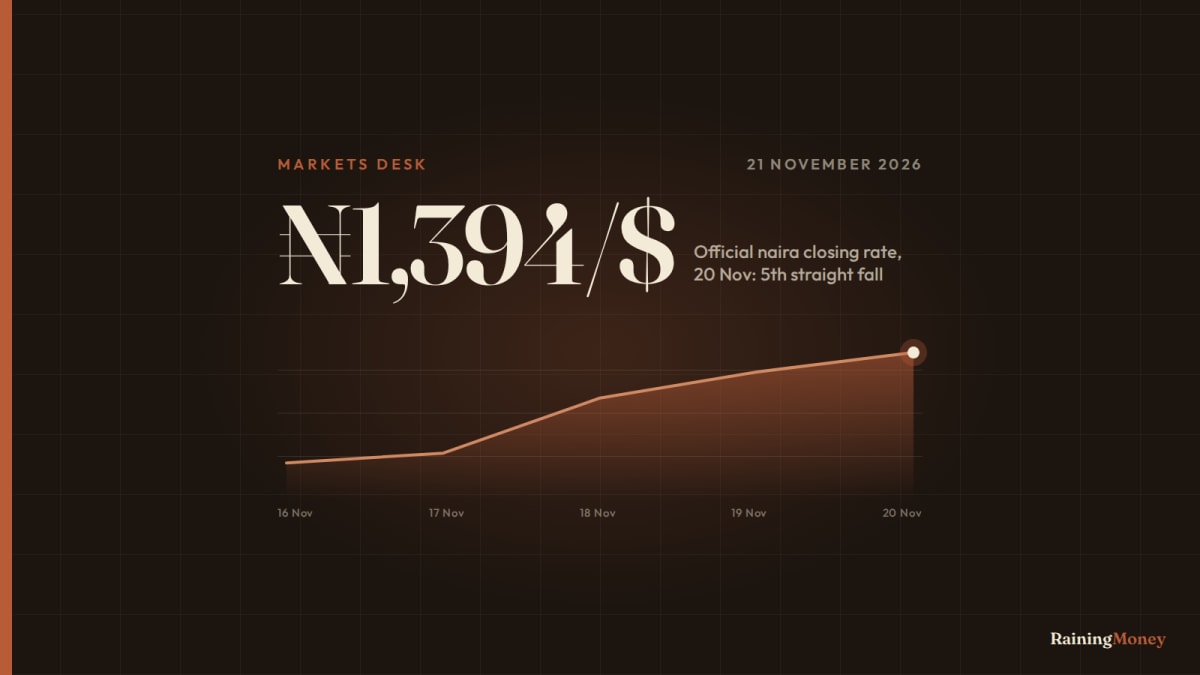
The naira started November at ₦1,346.01 on 2 November. By 24 November it was ₦50.49 weaker, a fall of about 3.75%. It slid in steps: ₦1,353.50 on 10 November, ₦1,364 on 11 November, ₦1,379.99 on 18 November and ₦1,394 on 20 November. On Monday, 23 November, it weakened as far as ₦1,403.50 during trading before the CBN stepped in and it recovered some ground.
| Date | Close |
|---|---|
| 2 Nov | 1,346.01 |
| 10 Nov | 1,353.50 |
| 11 Nov | 1,364.00 |
| 18 Nov | 1,379.99 |
| 20 Nov | 1,394.00 |
| 23 Nov | 1,393.00 |
| 24 Nov | 1,396.50 |
Official figures differ slightly by measure. The interbank close was ₦1,396.50. The closing rate in the Nigerian Foreign Exchange Market (NFEM), the official window as a whole, was ₦1,394.12, almost unchanged from ₦1,394.01 on Monday. Both point the same way. On the street, or parallel market, a dollar cost between ₦1,445 and ₦1,450.
For perspective, the naira is still stronger than at the start of the year. It closed at ₦1,431 on 2 January 2026, so it remains about 2.4% stronger than that level.
Why did trading volume collapse?
The 82% drop in interbank turnover looks dramatic, but a quiet day does not mean demand for dollars has gone away. It can mean banks are holding on to dollars and waiting. Monday had been very busy: turnover across the whole official window hit a record $1.97bn. Tuesday also brought the CBN's rate decision, and traders often sit on their hands around such announcements. RainingMoney's reading: thin trading makes the rate easier to push around, so small orders can move the price more than usual. Wednesday's and Thursday's figures will show whether this is a pause or a trend.
What is driving the pressure?
CBN Governor Olayemi Cardoso said on Tuesday that the pressure on the naira and the dip in reserves are largely seasonal. He listed four causes:
- Foreign portfolio investors, who buy Nigerian bonds and shares, rearranging their holdings at the end of the year.
- Higher demand for dollars at home, including from companies and families preparing for the new year.
- Hedging, where businesses buy dollars now to protect themselves against a weaker naira later.
- Spending linked to the elections.
Investors' caution about the election is a recurring theme. Foreign investors have slowed new money into Nigeria and some have taken money out, according to analysts. Razia Khan, chief economist for Africa and the Middle East at Standard Chartered, also called the pressure largely seasonal and said the recent agreement between the CBN and the Nigerian National Petroleum Company (NNPC) on oil dollars should help inflows.
How much firepower does the CBN have?
Nigeria's external reserves, the dollars the CBN holds to defend the naira and pay for imports, stood at $54.36bn on 23 November. That is about $900M lower than a week earlier and below this year's peak of $55.26bn on 27 October, but still about 22% higher than a year ago. Mr Cardoso said reserves of around $54bn to $55bn cover about 10 months of imports.
There is also a new step to put more dollars on the street. One report says the CBN has told banks by email that, from Wednesday, 25 November, they may sell up to $1M in cash to each bureau de change (BDC), the licensed money changers where many people buy dollars for travel or school fees. Under the old rules, a bank could sell a BDC at most $150,000 a week, and only a quarter of that, $37,500, in physical cash. The CBN has not published the change, so it is unconfirmed.
What does this mean for me?
- Imported goods: a weaker naira raises the cost of anything priced in dollars, from phones to some medicines and spare parts, though shops usually pass this on with a delay.
- School fees and travel abroad: dollars cost more now than at the start of November. A $1,000 payment that cost about ₦1,346,010 on 2 November cost about ₦1,396,500 on 24 November (derived from the official closes).
- Savers and borrowers: the CBN chose to keep its rate at 23% on Tuesday, partly to protect the naira, so interest rates on loans and deposits are unlikely to fall soon.
What isn't known yet?
Whether the pressure eases after the holidays, as the CBN expects, depends on how quickly foreign investors return after the election and whether the oil-dollar agreement with NNPC brings in more money. The size and timing of the CBN's interventions are not published day by day, and the BDC cash change has not been confirmed in an official circular.
Sources & Verification
- Sources: BusinessDay
- Editorial note: This explainer is an original RainingMoney adaptation of the report, RainingMoney has added explanatory context.

Founder and Editor-in-ChiefAbuja
Betini Udom
Founder and Editor-in-Chief of RainingMoney. Covers Nigerian, pan-African and global markets, finance and economic policy.
Author profile & archive →The Money Print
Market intelligence before the market opens.
Pan-African capital flows and the stories behind the numbers, on weekday mornings.