EconomyLow
Nine in 10 Nigerian Founders Start With Their Own Savings
A study of 24,000 young Nigerian businesses finds most began with about ₦500,000 of family money and just 3% have investors. What it means for new businesses.
By Betini Udom Published 4 min read Editorial Policy Report a correction
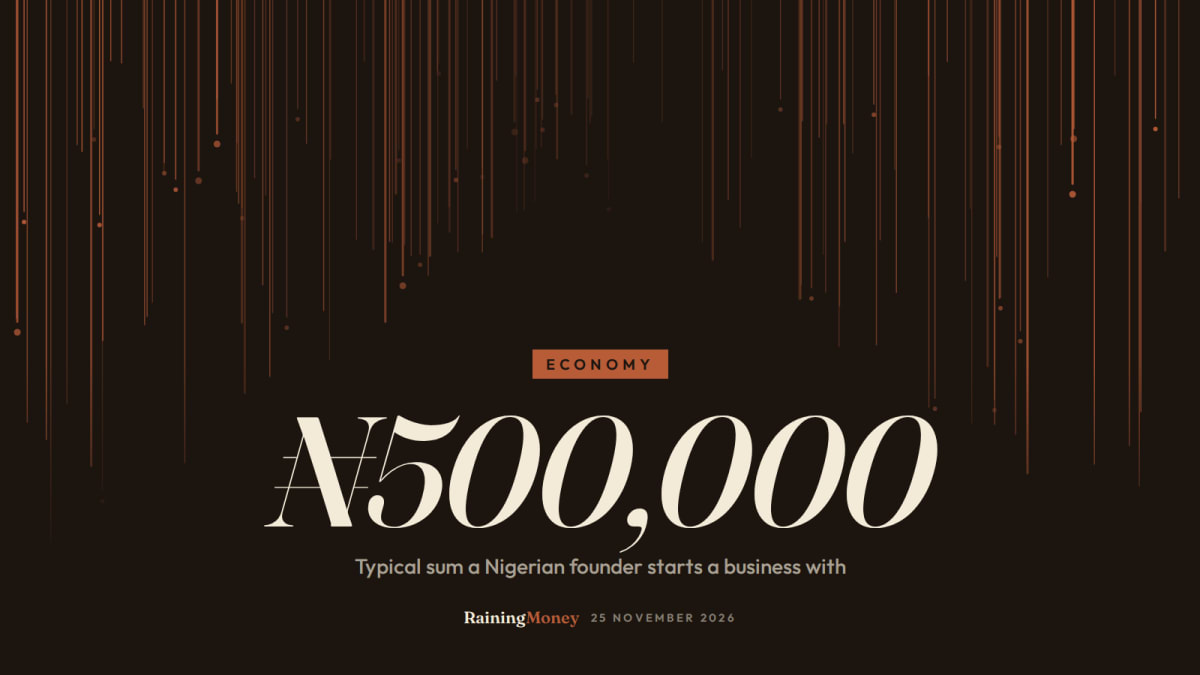
Nine in ten Nigerian founders started their businesses with their own money or their family's, typically about ₦500,000, according to a study of more than 24,000 early-stage businesses across all 36 states and the Federal Capital Territory. Only 3% had raised money from equity investors, people who buy a share of a business in return for cash.
The report, The State of Early-Stage Venture in Nigeria, was published this week by Magna Collective, a firm that runs programmes for young businesses. It draws on applications to those programmes between 2021 and 2026.
Who is the typical Nigerian founder?
According to the study, the typical founder is 28 years old, works on the business full time and put in about ₦500,000 to start. Fewer than one in four businesses had raised any money from outside sources, and most of those that did got it from family members or grant programmes rather than banks or investors.
| Finding | Figure |
|---|---|
| Started with personal or family savings | 9 in 10 |
| Typical starting capital | about ₦500,000 |
| Have equity investors | 3% |
| Raised any outside money | fewer than 1 in 4 |
| Based outside Lagos and Abuja | 72% |
| "Operators" (farms, clinics, schools) | 57% |
| Have not yet made a first sale | half |
Why don't founders just borrow from a bank?
Because it is very expensive. The study cites Central Bank of Nigeria (CBN) data showing the average maximum lending rate, the top rate banks charge borrowers, at 32.6% in September 2026.
To see what that means, take the typical starting sum. Borrowing ₦500,000 for a year at 32.6% would cost about ₦163,000 in interest alone (derived: ₦500,000 × 0.326). A new business that has not yet made a sale, as half of those in the study had not, would struggle to carry that. Banks also usually ask for collateral and a track record that a new business does not have.
Where is the investor money going?
Very little of it reaches small, young businesses. Nigerian startups raised $635M in the first nine months of 2026, according to figures from the Africa: The Big Deal tracker cited in the study, but four companies took 69% of that. RainingMoney's reading: venture capital in Nigeria flows mostly to a handful of large technology firms, while the businesses that employ most people grow on savings.
Are most founders in Lagos?
No. About 72% of the businesses in the study are outside Lagos and Abuja. Kano, Katsina and Kaduna each had more founders than any southern state except Lagos.
Earnings are another story. A typical business with paying customers in Lagos makes about ₦498,000 a month, roughly five times the ₦100,000 a month of similar businesses outside Lagos and Abuja. In plain terms, building outside the big cities is common, but earning is harder there, probably because customers have less to spend.
What kinds of businesses are these?
The study sorts businesses into four types. The biggest group, 57%, are what it calls "Operators": businesses such as farms, clinics and schools that win and serve customers face to face. Outside Lagos and Abuja the share rises to 64%.
One finding stands out for those businesses. Operators that built their own simple software, such as an ordering or booking system, were three times as likely to earn at least ₦1M a month as similar businesses at the same stage.
What is the real bottleneck?
Customers, the study argues. Femi Awoniyi, Magna Collective's managing partner, said Nigeria has no shortage of founders but a shortage of first customers. The numbers back him up. Half the businesses surveyed had not yet made a first sale. The top 10% of businesses accounted for 86% of all revenue. And 88% of the businesses shortlisted for funding already had paying customers, against 47% of other applicants.
Women-led businesses were more likely to have made sales, 51% against 44% for men-led ones, but earned less: a median of ₦81,700 a month against ₦120,000. The median is the middle figure when all are lined up from lowest to highest.
The report recommends that founders focus on winning customers before chasing investment, and look for funding that suits the stage and type of their business. It also urges support programmes to move away from pitch competitions and towards helping businesses find paying customers.
What does this mean for someone starting a business?
RainingMoney's reading: the study describes how most Nigerian businesses actually begin, with modest family savings and no outside help. It suggests that the first goal is a paying customer rather than a big funding round, and that simple tools that keep customers coming back can make a real difference to earnings. It is a description of what has happened, not advice on how to invest.
What should we keep in mind about the study?
The businesses in it all applied to Magna Collective's programmes, mostly online, so they may not represent every Nigerian business. Those who never apply, or have no internet access, are missing. The report was also paid for by Magna Collective itself. Even so, at more than 24,000 businesses across every state, it is one of the larger pictures available of how young Nigerian businesses are funded.
Sources & Verification
- Sources: Nairametrics
- Editorial note: This explainer is an original RainingMoney adaptation of the report, RainingMoney has added explanatory context.

Founder and Editor-in-ChiefAbuja
Betini Udom
Founder and Editor-in-Chief of RainingMoney. Covers Nigerian, pan-African and global markets, finance and economic policy.
Author profile & archive →The Money Print
Market intelligence before the market opens.
Pan-African capital flows and the stories behind the numbers, on weekday mornings.