EconomyHigh
Tinubu Cuts 2026 Budget to ₦65.18tn but Keeps Borrowing
President Tinubu wants to cut the 2026 budget by ₦3.15tn to ₦65.18tn, yet the ₦31.46tn deficit and borrowing plan stay. What the revision means for you.
By Betini Udom Published 6 min read Editorial Policy Report a correction
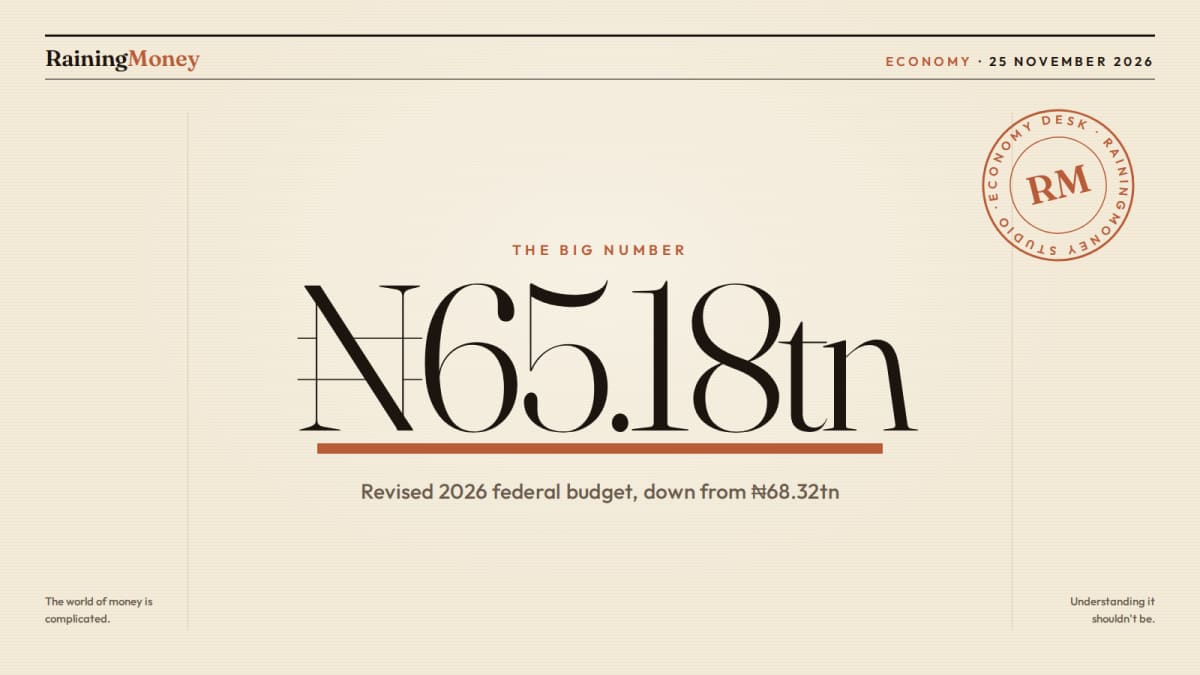
President Bola Tinubu has asked the House of Representatives to shrink Nigeria's 2026 federal budget from ₦68.32tn to ₦65.18tn, a cut of about ₦3.15tn. His request, in a letter dated 20 November 2026, was read on the floor of the House on Tuesday, 24 November, by the Speaker, Tajudeen Abbas, who sent it to the House Committee on Appropriation for further work.
The request comes as a bill to repeal and re-enact the 2026 Appropriation Act, the law that authorises the government's spending for the year. In plain terms, the government wants to tear up the budget law it signed in April and pass a new version with smaller totals, with just over five weeks of the year left. The size of the deficit, the gap the government fills by borrowing, stays exactly where it was.
The Big Number: how much is being cut?
Total spending would fall to ₦65.176tn from the ₦68.323tn the National Assembly approved on 31 March 2026. The difference is ₦3.147tn, or about 4.6% of the approved budget (derived: ₦3.147tn divided by ₦68.323tn).
| Item | Approved (March 2026) | Revised request (November 2026) |
|---|---|---|
| Total spending | ₦68.323tn | ₦65.176tn |
| Capital spending | ₦32.2tn | ₦26.232tn |
| Projected revenue, including government-owned enterprises | Not restated | ₦33.720tn |
| Deficit | ₦31.457tn | ₦31.457tn (5.64% of GDP) |
| New borrowing | ₦29.218tn | ₦29.218tn |
The budget has now moved three times in a year. Mr Tinubu first presented a ₦58.18tn plan to a joint session of the National Assembly on 19 December 2025. It was raised in March 2026 at his request to cover outstanding capital commitments and priority projects, approved at ₦68.323tn, and signed into law on 17 April 2026.
What changed in the new numbers?
According to the president's letter, the revision does four things:
- It regularises spending by the Nigerian National Petroleum Company Limited (NNPCL) that the company incurred on behalf of the federation. To regularise means to give legal cover, after the fact, to money that has already gone out. The letter gives no amount.
- It covers debt service that was underprovided, meaning the original budget set aside too little to pay interest and repayments on the government's loans.
- It recognises capital warrants already issued and supplementary commitments. A warrant is the formal approval that lets a ministry actually spend its capital allocation.
- It provides refunds to ministries, departments and agencies (MDAs) and special accounts. No amount was given for these either.
Most of the capital lines in the revised budget are amounts that have already been warranted, the letter says. A small number of new capital and overhead lines were added for what it calls priority interventions: finishing critical roads, protecting farm production, cutting production costs, improving farm yields and access to markets, and dealing with water shortages.
Why does the deficit stay the same if spending falls?
The deficit is the gap between what the government expects to collect and what it plans to spend. It stays at ₦31.457tn, which the letter puts at 5.64% of gross domestic product (GDP), the total value of everything the economy produces in a year. Planned new borrowing also stays at ₦29.218tn, split into ₦18.428tn from local lenders and ₦10.790tn from abroad.
If spending falls by ₦3.15tn and the deficit does not move, the expected revenue must have been lowered by roughly the same amount. RainingMoney's reading: the cut looks less like a decision to spend less and more like an admission that less money is coming in than the March budget assumed. Projected revenue in the new framework is ₦33.720tn. Set against spending of ₦65.176tn, borrowing still pays for close to half of the budget (derived: ₦31.457tn divided by ₦65.176tn is about 48%).
What caught our attention?
Two things stand out. The first is capital spending, the money for things that last, such as roads, power lines and school buildings. The revised framework puts it at ₦26.232tn. The budget signed in April carried about ₦32.2tn for capital projects. On the face of it that is a fall of about ₦6tn (derived: ₦32.2tn minus ₦26.232tn), almost twice the size of the overall cut. The two figures may not be counted in exactly the same way, so the full bill will be needed to see which projects lose money. Even so, when budgets are squeezed, capital projects are usually where the knife falls first.
The second is foreign borrowing. The letter says external loans of $7.7bn will fund the foreign borrowing line, worth about ₦10.368tn at an exchange rate of ₦1,346.50 to the dollar, and that this does not enlarge the overall borrowing envelope. The naira has weakened since that rate was set: it closed at ₦1,396.50 on 24 November. At that rate the same $7.7bn would be worth about ₦10.75tn in naira terms (derived: $7.7bn multiplied by ₦1,396.50). A weaker naira makes dollar debt more expensive to repay in naira.
Finance Speak → Human Speak: what is a "repeal and re-enactment"?
Normally a government changes a budget in the middle of the year with a supplementary budget, which adds money. Here the government is asking lawmakers to cancel the 2026 budget law and pass a replacement. Mr Tinubu asked the House to move quickly on the bill so the revised budget can be carried out in an orderly way and existing obligations can be settled.
It fits a wider clean-up. Last week the finance ministry said whatever is left of the 2026 capital budget will roll into 2027, as part of a push to end the practice of running more than one federal budget at the same time.
What does this mean for my money?
Directly, very little changes overnight for households. The budget is the plan for how the federal government spends, so the effects come through slowly:
- Contractors and suppliers owed money by ministries may benefit if the revision clears the way to pay bills already incurred, which is one of its stated aims.
- Road users and farmers are named in the priority list, but the letter gives no figures for those new lines.
- Savers and investors should note that borrowing is unchanged. The government still plans to raise ₦18.428tn at home, mostly by selling bonds and Treasury bills to banks, pension funds and individuals. Heavy government borrowing tends to keep interest rates on those instruments high.
What isn't known yet?
The letter leaves several gaps. It does not say how much goes to the NNPCL items, how much to refunds or how much extra goes to debt service. It does not give revised totals for salaries and running costs or for statutory transfers, the money the law sets aside for bodies such as the National Assembly and the judiciary. There is no date yet for the Appropriation Committee's report or a vote, and the Senate must also pass the bill.
The Bottom Line
Nigeria's 2026 budget is being cut by about ₦3.15tn, to ₦65.18tn, but the borrowing behind it is not. The revision mostly tidies up money already spent or already promised, and it suggests the government expects to collect less than it planned. The details in the bill will show which projects carry the cost.
Sources & Verification
- Sources: BusinessDay
- Editorial note: This explainer is an original RainingMoney adaptation of the report, RainingMoney has added explanatory context.

Founder and Editor-in-ChiefAbuja
Betini Udom
Founder and Editor-in-Chief of RainingMoney. Covers Nigerian, pan-African and global markets, finance and economic policy.
Author profile & archive →The Money Print
Market intelligence before the market opens.
Pan-African capital flows and the stories behind the numbers, on weekday mornings.