
EnergyMedium
Kenya Starts Drilling for First Oil, Due on 1 December 2026
Kenya has started drilling at its South Lokichar oil fields and aims to begin pumping more than 20,000 barrels a day on 1 December, trucking crude to Mombasa.
By Janefrances Neche Published 4 min read Editorial Policy Report a correction
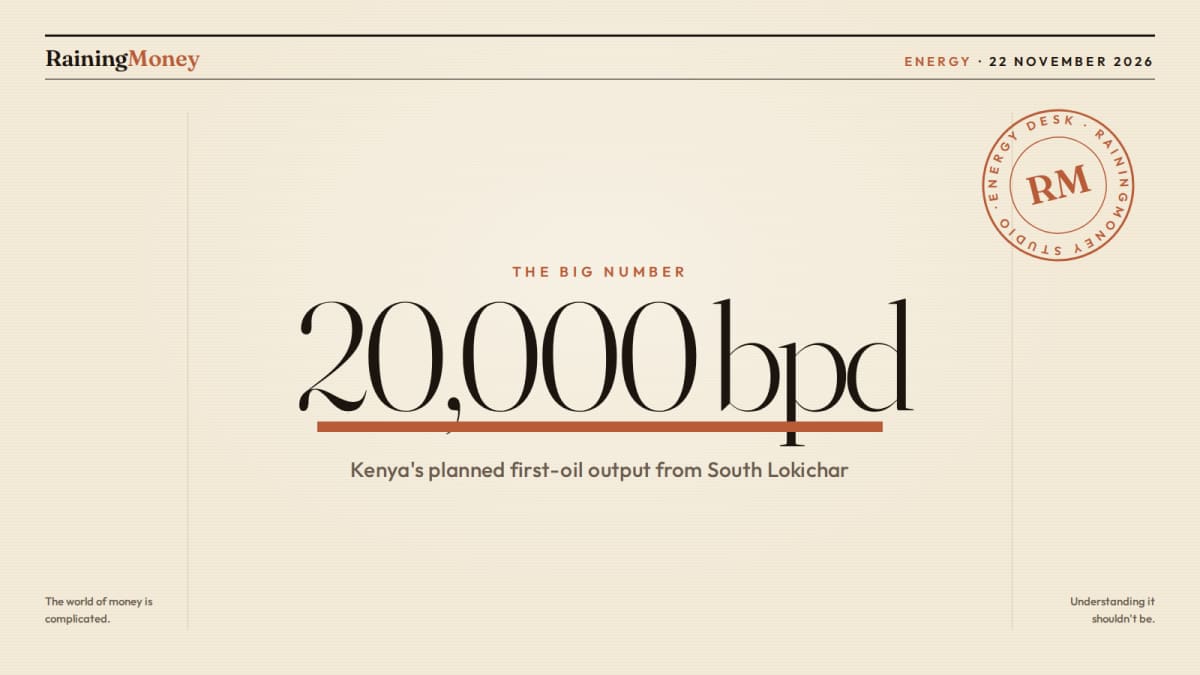
Kenya has started drilling at its South Lokichar oil fields in Turkana County, in the country's far north-west, and says it will begin commercial production on 1 December 2026. Energy and Petroleum Cabinet Secretary Opiyo Wandayi presided over the start of drilling at the Amosing 1 well pad on Friday, 20 November. The first phase is expected to produce more than 20,000 barrels of oil a day.
What happened on Friday?
Oil people call the start of drilling a new well "spudding". At Amosing, a GW70 onshore rig leased from Great Wall Drilling Company was set up and commissioned before drilling began. Mr Wandayi described the moment as a historic step ahead of first oil.
The operator is Gulf Energy, a Kenyan company, through its unit Gulf Energy E&P BV SEZ. It is developing two blocks, known as T6 and T7, under a field development plan that Kenya's parliament has ratified. A field development plan sets out how a company will turn a discovery into a producing oilfield: how many wells, what facilities, what timetable.
How much oil, and where will it go?
The first phase covers four fields: Ngamia, Amosing, Twiga and Ekales. From 1 December, the first 20,000 barrels a day are to be carried by road to the port city of Mombasa and stored in tanks run by Kenya Petroleum Refineries Limited. A second phase is expected to raise output to 50,000 barrels a day.
Gulf Energy estimates the fields hold about 326 million barrels that can be recovered over its 25-year contract. Two global oil service firms are involved: Baker Hughes will provide well services, and SLB will deliver the early production facility, the equipment that separates and treats crude at the field before it is moved.
| Item | Figure |
|---|---|
| Target start of production | 1 December 2026 |
| Phase one output | More than 20,000 barrels a day |
| Phase two output | 50,000 barrels a day |
| Recoverable resources (company estimate) | 326 million barrels over 25 years |
| Government spend on roads and other infrastructure in the area | More than $184.6M |
Why has this taken so long?
The South Lokichar discoveries were made by the British company Tullow Oil, and plans to produce from them kept slipping. In 2025, Tullow agreed to sell its Kenyan discoveries to Gulf Energy for $120M. Gulf Energy said in November 2025 that it planned to start production in 2026.
A month later, Kenya agreed an amended production sharing agreement that exempts Gulf Energy from value-added tax, withholding taxes and import levies on goods and services used to develop the basin. A production sharing agreement is the contract that sets how oil revenue is split between a government and the company that produces it.
Why trucks, and not a pipeline?
South Lokichar is far from the coast, and there is no pipeline. Trucking crude is costly and slow, which is why the first phase is small. In March 2026, a parliamentary report on Gulf Energy's development plan said Kenya was considering a 640-kilometre railway from the Rift Valley city of Nakuru to South Lokichar, costing about 220 billion Kenyan shillings, or $1.7B, to carry crude by 2030.
Transport Cabinet Secretary Davis Chirchir said the government is spending more than $184.6M on roads and other infrastructure in the oil-field region. Gulf Energy's managing director, Paul Limoh, said the company is keeping to its delivery schedule and is targeting six discoveries across its two blocks.
How does this compare with Nigeria?
For scale: Kenya's first phase of 20,000 barrels a day is a small fraction of what Nigeria pumps, and it will not move world oil prices. For a country that has never produced oil commercially, though, any local crude is a gain.
RainingMoney's reading: the more useful comparison for Nigeria is about investment. Kenya has offered tax breaks and a fast timetable to get a small project moving. Nigeria, by contrast, is selling 40 new oil and gas blocks in its 2026 licensing round, which opened for registration on 20 November. Both are competing for the same pool of oil-industry money, and both are trying to show investors that projects can move from discovery to production without years of delay.
Inland exploration in Nigeria has been slower. The Nigerian National Petroleum Company began drilling at the Ebenyi-1 well in Nasarawa State in 2023 and planned in 2025 to restart work at the Kolmani field in the north-east, which had been idle for nearly two years.
What does this mean for East Africa?
If production starts on time, Kenya would earn revenue from crude sales and could in time cut some of the dollars it spends on fuel, easing pressure on its currency (RainingMoney's reading). How much depends on the price it gets for its crude and the cost of moving it.
What should we watch?
- Whether oil actually flows on 1 December. South Lokichar has missed earlier deadlines.
- How much the trucking costs. High transport costs could eat into the money Kenya and Gulf Energy earn per barrel.
- The rail decision. A railway would be needed to move the larger phase two volumes cheaply.
For now, Kenya has a well being drilled and a date on the calendar. The first trucks leaving Turkana for Mombasa will show whether the timetable holds.
Sources & Verification
- Sources: Nairametrics
- Editorial note: This explainer is an original RainingMoney adaptation of the report, RainingMoney has added explanatory context.

Correspondent, AbujaAbuja
Janefrances Neche
Janefrances is a finance correspondent specializing in emerging markets, consumer economics, and policy analysis. Most recently reporting for regional business desks, she has tracked shifting…
Author profile & archive →The Money Print
Market intelligence before the market opens.
Pan-African capital flows and the stories behind the numbers, on weekday mornings.