MarketsHigh
Naira Slips to 18-Day Low as Festive Dollar Demand Builds
The naira closed at ₦1,363.23/$, its weakest in 18 days, as reserves eased to $54.76B and the dollar firmed. Why, and what it means for festive prices.
By Chiamaka Prudence Published 7 min read Editorial Policy Report a correction
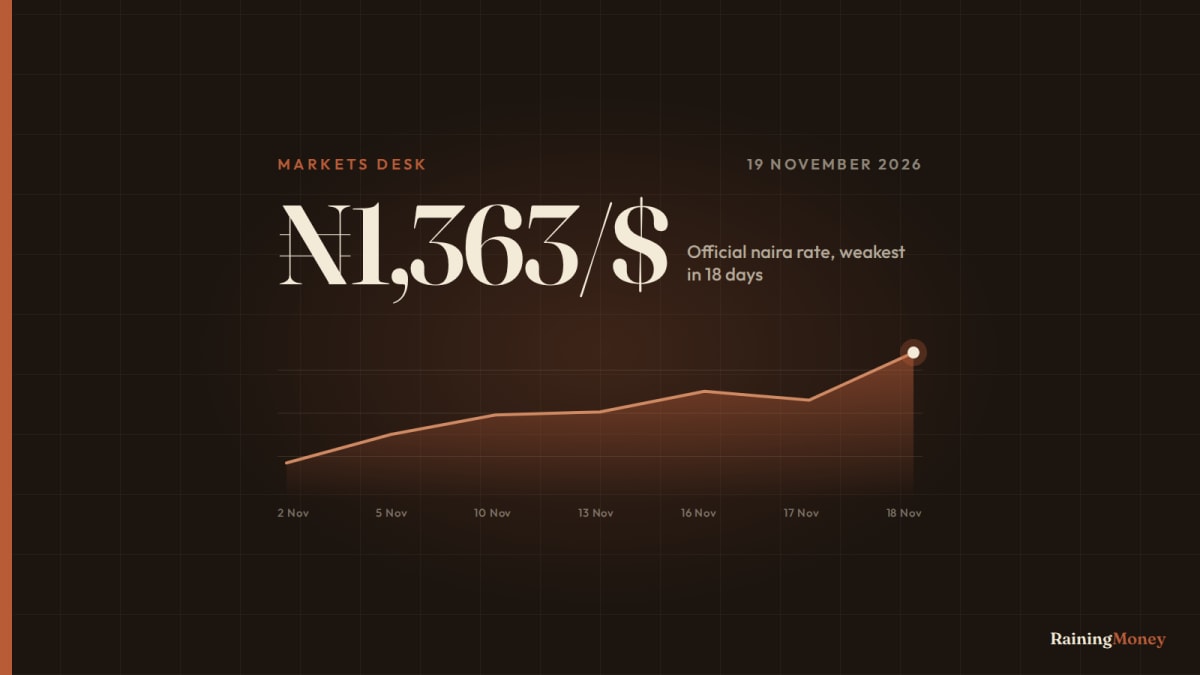
The naira closed at ₦1,363.23 per dollar in the official market on Wednesday, 18 November 2026, its weakest level in 18 days. That was a fall of 0.55% from ₦1,355.80 on Tuesday. On the street, dealers quoted rates between about ₦1,439 and ₦1,460. The slide came as the country's external reserves dipped to $54.76B and as a stronger dollar knocked emerging-market currencies around the world, led by the South African rand.
The move is small in a single day. What matters is the direction. The naira has now weakened in the official market through most of November, and it is doing so just as families and businesses start buying dollars for the festive season.
The Big Number: how much weaker is the naira this month?
₦17.22. That is how much more a dollar cost in the official market on 18 November than on 2 November, when it closed at ₦1,346.01 (derived: ₦1,363.23 minus ₦1,346.01). In percentage terms the naira has lost about 1.3% in just over two weeks (derived: ₦17.22 divided by ₦1,346.01).
| Date | Official close |
|---|---|
| Monday, 2 November | ₦1,346.01 |
| Thursday, 5 November | ₦1,350.45 |
| Tuesday, 10 November | ₦1,353.50 |
| Friday, 13 November | ₦1,353.97 |
| Monday, 16 November | ₦1,357.19 |
| Tuesday, 17 November | ₦1,355.80 |
| Wednesday, 18 November | ₦1,363.23 |
The official market here is the Nigerian Foreign Exchange Market (NFEM), where banks and the Central Bank of Nigeria (CBN) trade dollars at a rate set by buyers and sellers. During Wednesday's trading, some deals were reported as high as ₦1,380 per dollar before the market settled at its close. For context, the naira averaged ₦1,338.99 in October, when it lost 0.87% even though the CBN sold more than $3B into the market.
What changed on Wednesday?
Three things moved together. First, trading picked up. Turnover, the total value of dollars traded in the official market, rose 38.71% to $502.88M across 148 deals, from $362.55M on Tuesday. More dollars changing hands at a weaker rate usually means buyers are keen and willing to pay more.
Second, the gap with the street widened. Reports of the parallel, or street, rate differ. One set of quotes put the dollar at ₦1,460 on Wednesday, up ₦15 from ₦1,445, which leaves a gap of about ₦97 over the official rate, or 7.12%. Another put the average at ₦1,439, with dealers quoting between ₦1,435 and ₦1,445. Either way, the street rate sits well above the official one. In October, that gap averaged just ₦40.20.
Third, the reserves kept slipping. Gross external reserves, the stock of foreign money the CBN holds to pay for imports, service foreign debt and support the naira, stood at $54.76B on 17 November. That is $500M below the October peak of $55.26B. The reserves are still 24.54% higher than a year earlier, when they were $43.97B.
Why is the naira slipping now?
The pressure comes from inside and outside Nigeria at the same time.
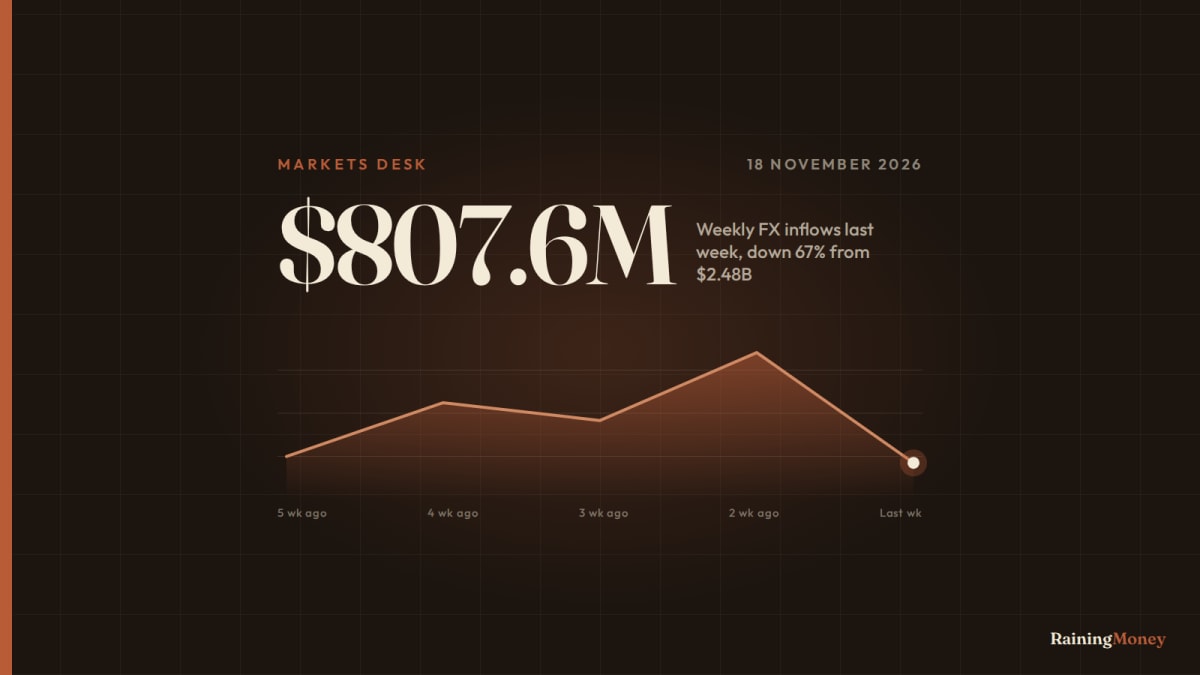
At home, fewer dollars are coming in. Total inflows into the official market fell to $807.6M last week from $2.48B the week before, figures from Coronation Merchant Bank show. That is the lowest weekly total in at least five weeks. The CBN itself supplied $235.1M of that, close to three in every ten dollars. Analysts also point to seasonal demand for dollars ahead of the festive season and to money leaving the country before the 2027 elections.
Abroad, the dollar is getting stronger. Officials at the United States Federal Reserve (the Fed), America's central bank, have been making the case for more interest-rate rises to bring inflation down. Higher US rates make dollar savings and US government bonds more rewarding, so investors pull money out of riskier markets such as Nigeria, South Africa and others. The Financial Markets Dealers Association (FMDA) said high yields in rich economies had made emerging-market assets less attractive and pushed foreign portfolio investors out of riskier currencies. The FMDA also said, citing its own sources, that these investors hold more than $20B in Open Market Operation (OMO) bills, short-term CBN debt that foreign funds buy for its high returns.
What Caught Our Attention: why does the rand matter to Nigerians?
On the same Wednesday, the South African rand fell as much as 1.9% to its weakest level against the dollar since March. Gold, one of South Africa's main exports, dropped below $3,800 an ounce for the first time since September 2025, and bets on a Fed rate rise grew. South Africa's own inflation also jumped to 5.2% in October from 4.5% a month earlier.
RainingMoney's reading: when Africa's most traded currency falls this hard on a global shift, it suggests some of the naira's weakness comes from a global shift that reaches well beyond Nigeria. The same foreign investors who hold South African bonds also hold Nigerian OMO bills. If they decide to cut their exposure to emerging markets, Nigeria's $20B-plus of foreign-held short-term debt becomes a source of dollar demand, which is the kind of exit the CBN would need its reserves to meet.
Finance Speak → Human Speak: what does "the premium widened" mean for me?
Finance speak: "The parallel-market premium widened to 7.12% as seasonal FX demand built up."
Human speak: Suppose you need $1,000 for a child's school fees abroad. At Tuesday's official close it would cost ₦1,355,800. At Wednesday's close it costs ₦1,363,230, or ₦7,430 more in one day (derived: $1,000 multiplied by each rate). If you cannot get the dollars from your bank and go to the street at ₦1,460, you pay ₦1,460,000, about ₦96,770 more than the official rate implies. The bigger that gap, the more people want dollars the official market is not supplying.
What does this mean for prices heading into Christmas?
A weaker naira makes anything bought in dollars dearer once it reaches Nigeria: petrol and diesel, medicines, phones, spare parts, and the raw materials local factories import. Traders often reprice their stock when they restock, so the effect reaches shop shelves with a delay of weeks or months.
The timing is awkward. Inflation, the rate at which prices rise, slowed to 14.06% in October from 14.63% in September, the National Bureau of Statistics (NBS) said. Food inflation eased to 19.13% from 19.59%. A steady naira has helped. But prices still rose 0.43% in October alone, faster than the 0.06% rise in September. A naira that keeps sliding through December would push against the slowdown just when spending on food, travel and gifts peaks.
- If you earn and save in naira, imported goods and anything priced off the dollar take a bigger share of your income.
- If you hold dollars, they are worth more naira than a fortnight ago.
- If you run a business that imports, your restocking bill for the festive season has gone up.
None of this is a reason to buy, sell or hold any currency. It explains the forces at work.
What isn't known yet?
- How many dollars the CBN is willing to sell before the festive season ends, and how far it will let the rate move.
- Whether last week's slump in inflows is a one-off or the start of a trend.
- Whether foreign investors holding OMO bills will stay put if the Fed does raise rates.
- Which figure for Wednesday's street rate is closer to what most people actually paid.
The Bottom Line: should I be worried about the naira?
The naira's fall so far is gradual. A 0.55% move in a day and about 1.3% in a month are modest by the standards of recent years, and reserves of $54.76B are still far above last year's level. What has changed is that several pressures now push the same way: fewer dollars coming in, festive and pre-election demand, a wider street gap and a stronger dollar worldwide. The CBN is holding the line by selling dollars, and the reserves are paying for it. Watch two numbers in the coming weeks: the weekly reserves figure and the gap between the official and street rates. If both keep moving the wrong way, the pressure on prices this Christmas will grow.
Sources & Verification
- Sources: BusinessDay
- Editorial note: This explainer is an original RainingMoney adaptation of the report, RainingMoney has added explanatory context.

Correspondent, OnitshaOnitsha
Chiamaka Prudence
I am a technology and finance enthusiast with a keen interest in digital innovation, emerging financial trends, and the evolving ways technology is shaping businesses and everyday life. I enjoy…
Author profile & archive →The Money Print
Market intelligence before the market opens.
Pan-African capital flows and the stories behind the numbers, on weekday mornings.