CompaniesMedium
From Banks to Pipelines: Nigerian Firms Push Into Kenya
NGX Group now owns 10% of Nairobi's exchange and Dangote a quarter of Kenya's fuel pipeline. Who has bought what in Kenya, and what it means for Nigerians.
By Betini Udom Published 4 min read Editorial Policy Report a correction
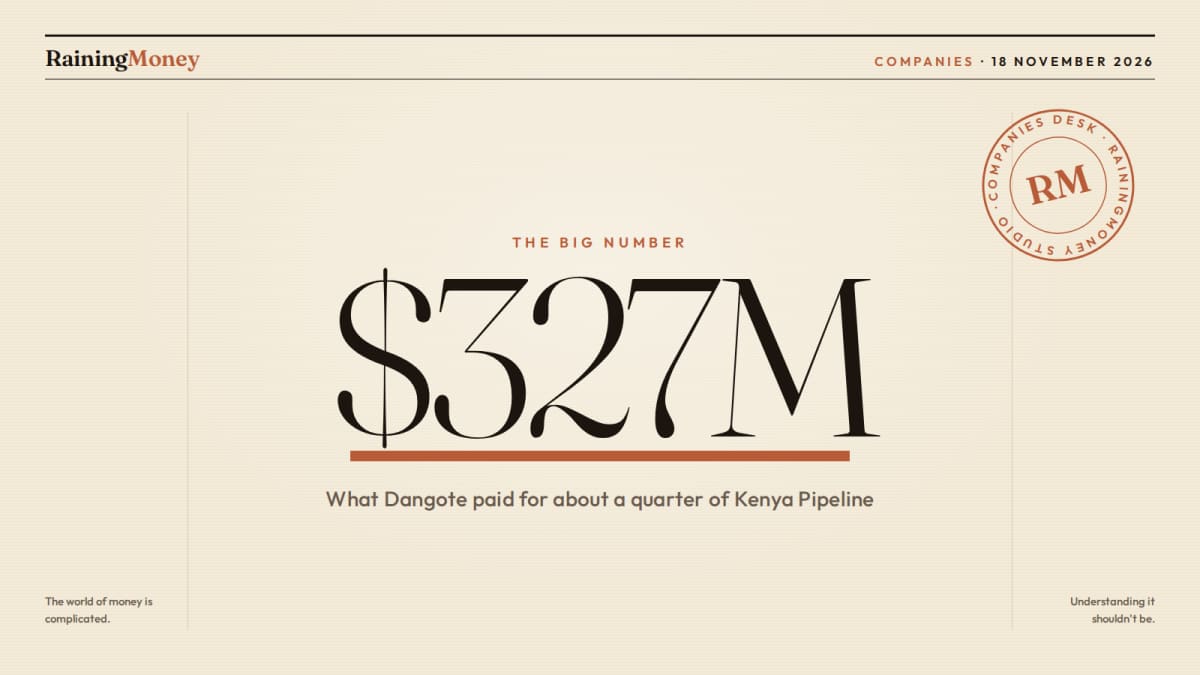
Nigerian companies are building a serious presence in Kenya, East Africa's financial hub. This week NGX Group, which owns the Nigerian Exchange, said it had bought 10% of the Nairobi Securities Exchange. A Nigerian-founded payments company, Payaza, has just won a licence from the Central Bank of Kenya. They join Dangote Group, which bought about a quarter of Kenya's state-linked fuel pipeline company last month for about $327M, and Nigerian banks and fintechs that have bought Kenyan lenders over the past two years.
Taken together, the deals show Nigerian money moving east across the continent, from bank branches to fuel pipelines to stock exchanges. They also show the limits: most of these are small or minority stakes, and some have hit resistance.
Who has bought what in Kenya?
| Company | Kenyan asset | Stake | When |
|---|---|---|---|
| Access Bank | National Bank of Kenya | Full takeover from KCB Group | Completed May 2025 |
| Moniepoint | Sumac Microfinance Bank | 78% | March 2026 |
| Zenith Bank | Paramount Bank Kenya | 100% | Announced April 2026 |
| Dangote Group | Kenya Pipeline Company | About 24.76% | 19 October 2026 |
| Payaza | Payment gateway licence | Licence, not a stake | 5 November 2026 |
| NGX Group | Nairobi Securities Exchange | 10% | 16 November 2026 |
What is the Dangote pipeline deal?
Kenya Pipeline Company (KPC) runs the pipeline that carries refined petroleum products, such as petrol and diesel, from the port of Mombasa to towns and depots inland. On 19 October 2026, about 4.5 billion KPC shares changed hands in a single block trade on the Nairobi Securities Exchange. The value was 42.5 billion Kenyan shillings, about $327M, for roughly 24.76% of the company. The shares were sold by state-linked pension funds and agencies.
Aliko Dangote announced the purchase at a London event on 21 October but did not say which company in his group made it. After the sale, the Kenyan government holds 35% of KPC, the National Social Security Fund about 22.2% and the Uganda National Oil Company 20.15%. KPC shares rose 9.96% to a record 13.80 shillings in the days that followed.
Kenya's President William Ruto welcomed the sale as a sign of confidence in the country's capital markets. Opposition politician Ndindi Nyoro criticised it and called for more disclosure. Reports say Mr Dangote plans to invest a further $1.5B to expand the network, though funding and timing have not been disclosed.
The pipeline stake sits beside a much larger plan. On 30 September, work began on a Dangote-backed refinery at Lamu designed to process 700,000 barrels of crude oil a day. Kenyan officials have put its cost at $17B and Mr Dangote at $20B. The group has offered East African governments a combined 30% stake; Kenya's proposed 10% is valued at about $500M.
Why are Nigerian banks and fintechs going to Kenya?
Kenya is one of Africa's most developed markets for digital money and a gateway to East Africa. Access Bank bought Transnational Bank in 2020, then took over National Bank of Kenya from KCB Group in a deal KCB valued at 15.8 billion shillings. Its Kenyan business now has more than 100 branches. Zenith Bank bought all of Paramount Bank Kenya; Kenya's competition regulator approved the deal on condition that all 78 Paramount staff keep their jobs for at least 12 months.
Moniepoint bought 78% of Sumac Microfinance Bank in March 2026, which gives it a licensed, deposit-taking lender to serve small businesses. It had earlier tried and failed to enter Kenya through the payments company Kopo Kopo.
Payaza's new licence, issued on 5 November under Kenya's National Payment System Act, lets it process online checkout payments by card, mobile money and bank transfer. It does not let it take deposits or hold customer wallets. The company says it operates in more than 27 countries and that Nigeria provides about 35% of its revenue.
What does the exchange stake add?
NGX Group did not disclose what it paid for its 10% of the Nairobi bourse. It already has an investment in the Ethiopian Securities Exchange. Group chief executive Temi Popoola described Kenya as an important part of East Africa's financial system. Any cooperation, such as shared trading technology, cross-listed products or cross-border share trading, will depend on future commercial deals and on regulators in both countries.
What does this mean for Nigerians?
For shareholders of these Nigerian companies, Kenyan earnings are a way to spread risk. Income earned in Kenyan shillings is not tied to the naira, which can help when the naira weakens. Zenith Bank's foreign subsidiaries alone made ₦166bn before tax in H1 2026.
The risks are real too. Moniepoint will compete with Safaricom's M-Pesa and Equity Group, which dominate Kenyan payments and banking. Owning part of a pipeline does not by itself guarantee Dangote space in it or better terms for its fuel. The Lamu refinery faces financing, crude supply, infrastructure and environmental hurdles. RainingMoney's reading: these are footholds, not conquests, and their value will show only in the years ahead.
What isn't known yet?
- What NGX Group paid for its Nairobi stake.
- Which Dangote company owns the KPC shares, and how the further $1.5B would be funded.
- The final cost and ownership of the Lamu refinery; official and company estimates differ by $3B.
- How large Kenya is among Nigerian companies' foreign investments. There is no comparable country-by-country data to say it is the biggest.
Sources & Verification
- Sources: BusinessDay
- Editorial note: This explainer is an original RainingMoney adaptation of the report, RainingMoney has added explanatory context.

Founder and Editor-in-ChiefAbuja
Betini Udom
Founder and Editor-in-Chief of RainingMoney. Covers Nigerian, pan-African and global markets, finance and economic policy.
Author profile & archive →The Money Print
Market intelligence before the market opens.
Pan-African capital flows and the stories behind the numbers, on weekday mornings.