CompaniesMedium
Nigerian Banks Cut Bad-Loan Charges by Nearly Half in 2026
Eight big Nigerian banks set aside about 47% less for bad loans in nine months, lifting profits. What changed after forbearance ended and what it means for you.
By Betini Udom Published 6 min read Editorial Policy Report a correction
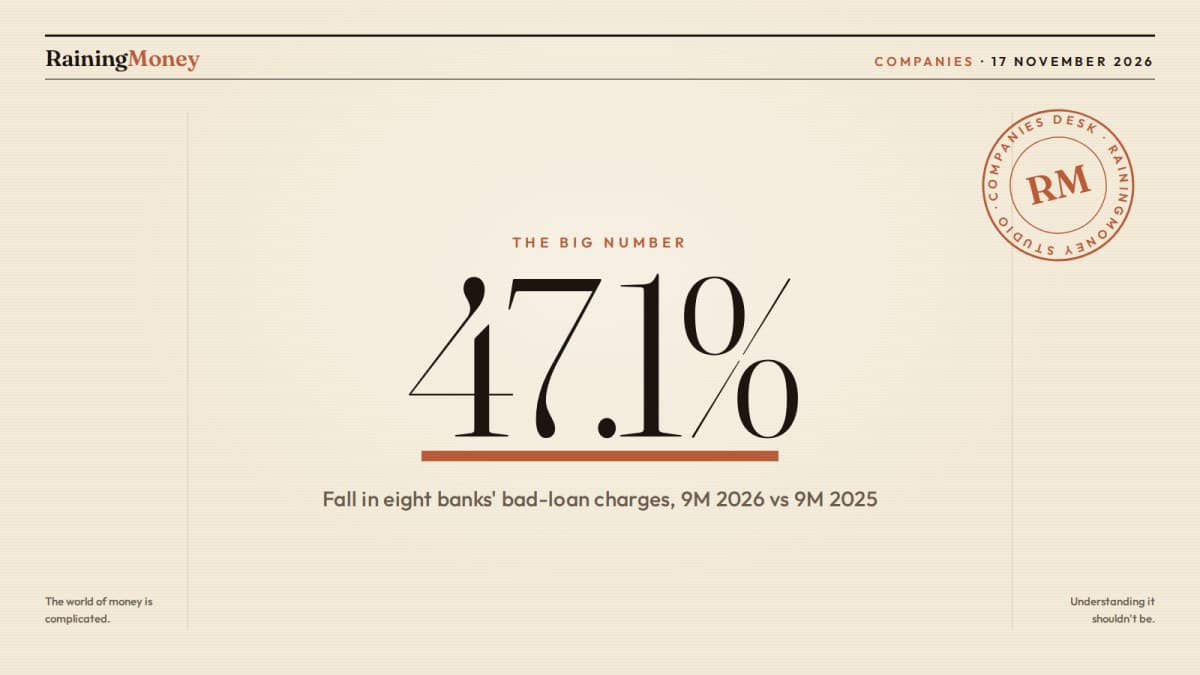
Nigeria's biggest banks set aside far less money for bad loans in the first nine months of 2026, and that saving did much of the work behind their higher profits. Eight listed banking groups cut their impairment charges by about 47% to 48% compared with the same period of 2025, according to two separate counts of their results for the nine months to 30 September. One tally puts the charges at ₦1.01tn, down 47.1% from ₦1.92tn. The other puts them at ₦977bn, down 48.1% from ₦1.88tn. Either way, the banks booked roughly ₦900bn less in loan-loss costs than a year earlier.
The fall follows a painful 2025, when lenders had to recognise loans that had gone sour once the Central Bank of Nigeria (CBN) ended the special relief it gave banks during the COVID-19 pandemic. With much of that clean-up done, the charges have dropped back. The question for customers and shareholders is whether the improvement reflects healthier loans or simply the end of a one-off hit.
What is an impairment charge?
When a bank lends money, there is always a chance some borrowers will not pay it back. Accounting rules require the bank to estimate that likely loss and set money aside for it in advance. That provision is the impairment charge, often called a loan-loss charge. It is deducted from the bank's income, so a bigger charge means a smaller profit, even if no money has yet been lost.
Think of a trader who sells goods on credit. If she suspects two customers will never pay, a careful trader writes those debts off her books before counting her profit for the month. Banks do the same, only on a much larger scale.
How big was the fall at each bank?
The relief was concentrated in two lenders. Zenith Bank and Access Holdings together accounted for about ₦809bn of the drop (derived: Zenith's fall of about ₦552bn plus Access's fall of about ₦257bn).
| Bank | 2025 | 2026 | Change |
|---|---|---|---|
| Zenith Bank | 782.76 | 230.77 | -70.5% |
| Access Holdings | 350.0 | 92.91 | -73.5% |
| GTCO | 69.79 | 29.02 | -58.4% |
| First HoldCo | 288.9 | 207.1 | -28.3% |
| Stanbic IBTC | 11.6 | 0.507 | -95.6% (derived) |
| Ecobank | 393.6 | 393.8 | flat |
| Sterling Financial | 8.08 | 40.3 | higher |
| Wema Bank | 11.01 | 18.5 | higher |
Not every bank shared in the relief. Ecobank's charge was almost unchanged at about ₦393.8bn. Sterling Financial Holdings and Wema Bank both set aside more than a year earlier, with Sterling's charge rising to ₦40.3bn from ₦8.08bn and Wema's to ₦18.5bn from ₦11.01bn. Both of those lenders grew their lending income strongly, which helps explain the bigger provisions.
Why did banks set aside so much in 2025?
In 2020, to soften the blow of the pandemic, the CBN allowed banks to restructure loans to struggling borrowers and delay recognising them as problem loans. This relief is known as forbearance. On 20 June 2025 the central bank issued a circular ending the COVID-19 forbearance and related waivers on single-obligor limits, the cap on how much a bank can lend to one borrower, with effect from 30 June 2025. Banks then had to recognise the true state of those loans and provide for them.
The CBN also temporarily dropped its rule that a fully provisioned loan must wait a year before being written off, so banks could clear bad loans from their books faster. A written-off loan can still be chased for repayment. The result was a heavy provisioning year in 2025, and that high base is why the 2026 figures look so much lower.
How much did lower charges lift profits?
A great deal. On one count, combined profit before tax at the eight groups rose 14.2% to ₦5.29tn, an increase of ₦659bn. The fall in impairment charges, about ₦906bn on the same count, was larger than that whole increase. On the other count, combined profit after tax rose 9.5% to ₦3.88tn from ₦3.54tn.
RainingMoney's reading: without the lower loan-loss charges, the group's combined pre-tax profit would probably have fallen this year, because the core lending business weakened. Combined net interest income, the gap between what banks earn on loans and investments and what they pay depositors, fell 1.8% to ₦7.88tn. Interest expense rose 5.1% to ₦4.95tn while interest income barely moved, and operating expenses rose 6.4% to ₦5.39tn.
Did every bank turn the saving into higher profit?
No, and the exceptions are telling.
- Zenith Bank cut its charge by 70.5%, yet pre-tax profit rose only 1.24% to ₦928.80bn. A trading gain of ₦277.65bn a year earlier turned into a ₦229.19bn loss, and its tax bill rose 65.12% to ₦252.97bn. Profit after tax fell 11.56% to ₦675.83bn.
- GTCO also set aside less, but pre-tax profit slipped 2.3% to ₦879.90bn as interest expense climbed to ₦356bn from ₦278.73bn and operating costs rose. Profit after tax fell to ₦614.57bn from ₦699.64bn.
- Access Holdings saw pre-tax profit rise 8.3% to ₦667.36bn, even though net interest income grew only 2.7%. Much of the improvement came from the smaller provision.
- First HoldCo posted the biggest jump in profit among the eight, with pre-tax profit up 60.8% to ₦911.24bn, helped by about ₦190bn more in trading and fair-value income.
- Wema Bank and Stanbic IBTC also reported strong gains, with Wema's pre-tax profit up 76.6% to ₦258.64bn and Stanbic's up about 35% to ₦531.88bn.
Does this mean bad loans are no longer a problem?
Not necessarily. Lower charges mean banks expect fewer new losses than they did last year. They do not, by themselves, show that the stock of bad loans has shrunk. The CBN's Financial Stability Report for December 2025 put the industry's non-performing loan (NPL) ratio, the share of loans that borrowers have stopped repaying, at 7.51%. That is above the 5% ceiling the regulator expects banks to stay under, and up from 4.5% in 2024 and 4.07% in 2023. The central bank linked the rise to the adjustments that followed the end of forbearance.
The banks have also just been through a recapitalisation programme, which required them to raise fresh capital and closed on 31 March 2026. Thicker capital buffers give lenders more room to absorb future loan losses without hurting depositors.
What does this mean for my money?
For depositors, stronger bank profits and fresh capital are a sign of a sturdier system, which matters because banks hold most of the country's savings. For borrowers, banks that are no longer nursing heavy loan losses may be more willing to lend, though the CBN's lending rules and the level of interest rates matter more for the price of a loan.
For the millions of Nigerians who own bank shares directly or through pension and mutual funds, the figures are a reminder to look beneath the headline profit. A profit that rises because provisions fell can repeat only if loans keep performing. A profit built on growing lending income is usually more durable.
What isn't known yet?
The fourth quarter can still change the picture. Banks often review their loan books at year-end, and auditors may ask for more provisions. The two counts of the results also differ slightly, on the size of the 2025 base and the 2026 total, so the full-year figures in early 2027 will give a cleaner comparison. How the NPL ratio has moved since December 2025 is the number to watch when the CBN next reports on financial stability.
Sources & Verification
- Sources: BusinessDay
- Editorial note: This explainer is an original RainingMoney adaptation of the report, RainingMoney has added explanatory context.

Founder and Editor-in-ChiefAbuja
Betini Udom
Founder and Editor-in-Chief of RainingMoney. Covers Nigerian, pan-African and global markets, finance and economic policy.
Author profile & archive →The Money Print
Market intelligence before the market opens.
Pan-African capital flows and the stories behind the numbers, on weekday mornings.