EconomyHigh
Nigeria's Inflation Slows to 14.06%, but Prices Rose Faster
Headline inflation fell to 14.06% in October, a fifth monthly fall, yet prices rose faster within the month. What it means before next week's CBN rate decision.
By Betini Udom Published 5 min read Editorial Policy Report a correction
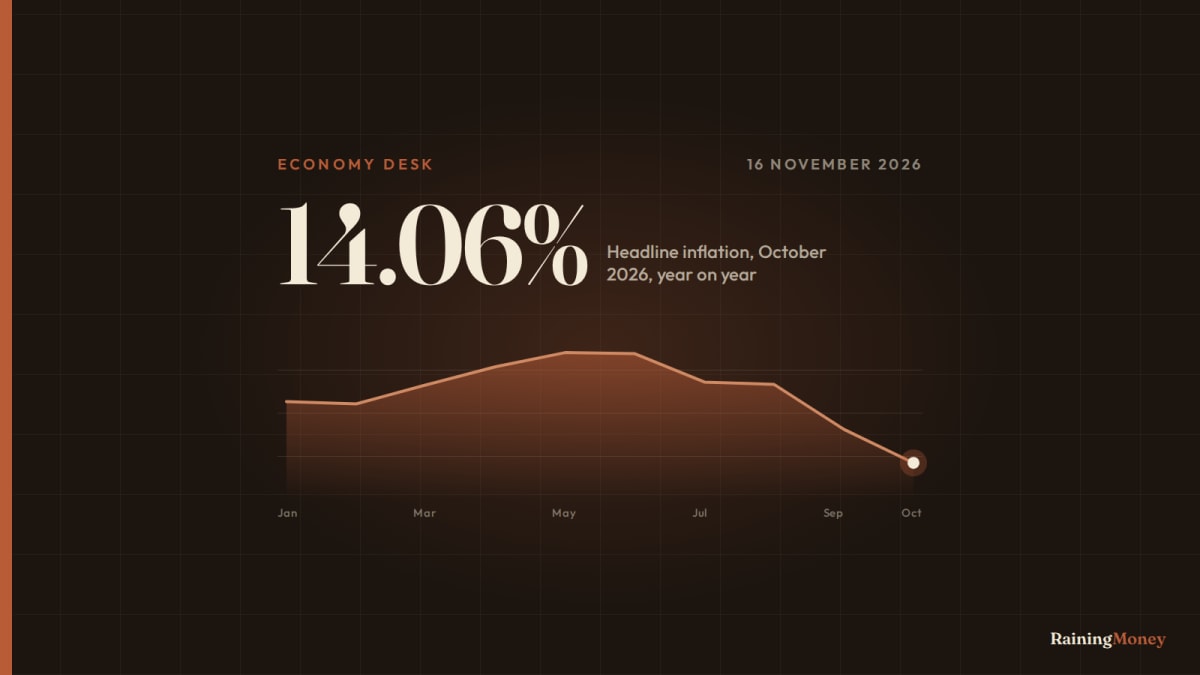
Nigeria's inflation rate fell again in October 2026. Headline inflation eased to 14.06%, down from 14.63% in September, the National Bureau of Statistics (NBS) said on Monday, 16 November. It is the lowest reading of 2026 so far and the fifth monthly fall in a row.
There is a catch inside the good news. Prices rose faster during October itself than they did in September. The month-on-month rate, which compares prices with the month before, climbed to 0.43% from 0.06%. The figures land a week before the Central Bank of Nigeria (CBN) decides on interest rates on 23 and 24 November.
What did the statistics office report?
Inflation measures how fast the prices of everyday goods and services rise. The annual (year-on-year) rate compares prices with the same month a year earlier. A rate of 14.06% means a basket of goods and services that cost ₦10,000 in October 2025 cost about ₦11,406 in October 2026 (derived: ₦10,000 × 1.1406).
| Measure | September | October |
|---|---|---|
| Headline, year-on-year | 14.63% | 14.06% |
| Headline, month-on-month | 0.06% | 0.43% |
| Food, year-on-year | 19.59% | 19.13% |
| Food, month-on-month | -1.55% | -0.75% |
| Core, month-on-month | 1.11% | -0.53% |
Core inflation, which strips out farm produce and energy because their prices jump around, stood at 10.78% year-on-year in October. Urban inflation was 14.84% and rural inflation 12.17%. The consumer price index, the number the NBS uses to track the cost of its basket, reached 147.0 points, up 0.6 points from September.
How has inflation moved this year?
The October figure continues a slide that started in the middle of the year. Headline inflation rose from 15.10% in January to a peak of 15.93% in May, then turned down: 15.91% in June, 15.43% in July, 15.39% in August, 14.63% in September and now 14.06%. That is a fall of 1.87 percentage points from the May peak (derived: 15.93 minus 14.06).
A year ago the picture was very different. Annual inflation stood at 18.97% in October 2025, so the rate is now 4.91 points lower than it was 12 months ago.
If inflation is falling, why did prices rise faster in October?
This looks like a contradiction, so it helps to separate the two measures. The annual rate tells you how much higher prices are than a year ago. The monthly rate tells you how much they rose in the last 30 days or so.
In September, prices barely moved: they rose 0.06% on the month. In October they rose 0.43%. Put in money terms, a ₦10,000 basket went up by about ₦6 in September and by about ₦43 in October (derived). Both are small, and both are far below the monthly increases of earlier in the year (1.66% in June and 1.57% in July). The annual rate still fell because October 2026's monthly rise was smaller than the one recorded in October 2025, which drops out of the 12-month comparison.
RainingMoney's reading: the faster monthly rise is an early warning worth watching. One month of quicker price growth does not reverse a five-month decline, but if monthly increases keep creeping up, the annual rate will stop falling.
What is happening to food prices?
Food is still the sore point. Food inflation eased to 19.13% in October from 19.59% in September, but it remains well above headline inflation, and higher than the 16.30% recorded in October 2025. On a monthly basis, food prices fell for a second month, by 0.75%, after a 1.55% drop in September. That suggests harvest supplies are still helping, but the fall is slowing.
The gap between states is wide. Food inflation over the year was highest in Ondo (31.74%), Lagos (31.43%) and Imo (29.75%), and lowest in Nasarawa (3.70%), Bayelsa (7.11%) and Kano (7.13%). Lagos also recorded the biggest monthly food price fall, 5.93%.
Food and non-alcoholic drinks contributed 5.63 percentage points of the 14.06% headline rate, the largest share of any group. Restaurants and accommodation added 1.82 points and transport 1.50 points.
Does this make a rate cut more likely?
The CBN's Monetary Policy Committee (MPC), the group that sets the benchmark interest rate, meets on 23 and 24 November, its last meeting of 2026. In September it cut the Monetary Policy Rate (MPR) by 3.5 percentage points, from 26.5% to 23%. The MPR is the anchor for what banks charge on loans and pay on deposits.
With inflation at 14.06%, the policy rate is 8.94 points above inflation (derived: 23 minus 14.06). Economists call this gap the real interest rate. A wide positive gap gives the central bank room to cut again without letting savers lose money to inflation, and the slowdown in October adds to that room. Against that, the faster monthly price rise and stubborn food inflation give the committee reasons for caution. The CBN has said its medium-term aim is single-digit inflation, below 10%.
What does this mean for my money?
Slower inflation means your naira loses value more slowly. It does not mean prices are falling. Prices are still about 14% higher than a year ago on average, and food is about 19% higher.
- For savers: deposit and savings rates follow the MPR. If the CBN cuts next week, the interest banks pay on savings may drift lower in the months after.
- For borrowers: a cut would, over time, ease what banks charge businesses and households, though loan rates usually adjust slowly.
- For workers: a salary that has not risen by 14% since October 2025 buys less than it did a year ago.
What isn't known yet?
The NBS rebased its index this year, using 2024 as the base year, so long comparisons with older figures need care. It is also too early to tell whether October's faster monthly rise came from fuel, transport or something passing. November's figures, due in mid-December, will show whether the pickup holds. The more immediate answer comes on 24 November, when the MPC announces its decision.
Sources & Verification
- Source: BusinessDay
- Editorial note: This explainer is an original RainingMoney adaptation of the report, RainingMoney has added explanatory context.

Founder and Editor-in-ChiefAbuja
Betini Udom
Founder and Editor-in-Chief of RainingMoney. Covers Nigerian, pan-African and global markets, finance and economic policy.
Author profile & archive →The Money Print
Market intelligence before the market opens.
Pan-African capital flows and the stories behind the numbers, on weekday mornings.