EconomyMedium
Nigeria's Reserves Pause Below Record: What the Gap Means
Gross reserves slipped to $54.93bn on 9 November from a record $55.26bn, while net reserves hit $46bn. Here is what drives them and what it means for you.
By Chiamaka Prudence Published 7 min read Editorial Policy Report a correction
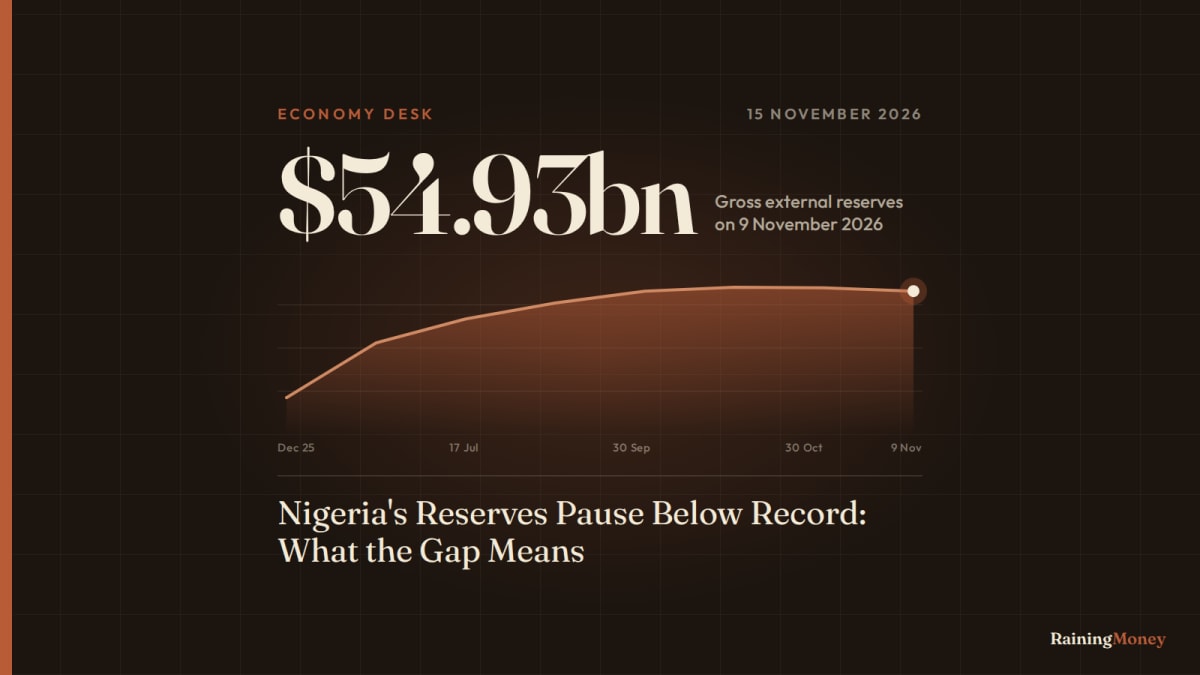
Nigeria's gross external reserves, the stock of foreign currency and other foreign assets held by the Central Bank of Nigeria (CBN), have stopped climbing for now. They stood at $54.93bn on 9 November 2026, according to the central bank's data, down $330M from a record of $55.26bn on 27 October. That peak was the highest level in more than 18 years.
The dip is small, about 0.59%, and reserves are still 26.65% higher than a year earlier, when they were $43.37bn. The more striking figure is a different one: CBN Governor Olayemi Cardoso says the country's net reserves, the money left after short-term obligations are taken out, have reached a record $46bn. Together, the two numbers tell a fuller story about Nigeria's dollar position than either does alone.
What exactly are external reserves?
Think of external reserves as the country's savings account in foreign money, held by the central bank. Most of it is in US dollars. The CBN uses these savings to pay for the country's foreign obligations, to settle debts, and to supply dollars to the foreign exchange (FX) market when demand outruns supply.
A common way to judge whether reserves are enough is "import cover": how many months of imports the reserves could pay for if no new dollars came in. In July 2026, when reserves were $52.52bn, the CBN said they covered about 11 months of imports of goods and services. The usual international benchmark is three months.
How fast did the reserves grow this year?
The rise has been steady for most of 2026. Reserves ended 2025 at $45.71bn, crossed $46bn in January for the first time in about eight years, and reached $50.45bn by 16 February. That was already close to the CBN's own forecast of $51.04bn for the whole of 2026, a target the reserves later passed.
February brought the biggest single monthly gain of the year, $3.41bn. Reserves then fell in March and April, by $455.52M and $874.45M, before growing again every month from May. August added $1.88bn and September $1.12bn. October added only $295.35M, the slowest positive monthly gain of the year.
| Date | Gross reserves |
|---|---|
| 16 February | $50.45bn |
| 17 July | $52.52bn |
| 1 September | $53.90bn |
| 30 September | $54.93bn |
| 27 October (record) | $55.26bn |
| 30 October | $55.22bn |
| 9 November (latest) | $54.93bn |
The 9 November reading is the same as the end-September figure. In other words, the gains made over October have been given back, at least for now.
What has been pushing the reserves up?
Oil is the main engine. Nigeria earns most of its dollars by selling crude, so a higher oil price and more barrels both lift inflows. Bonny Light, Nigeria's main crude grade, was trading at about $115 a barrel at the start of November. Oil output has also reached a four-year high of more than 1.53 million barrels per day, helped by better security in the Niger Delta and fewer attacks on pipelines.
Analysts at Quest Merchant Bank point to the same mix: high crude prices, improving production, steady remittances from Nigerians abroad, and continued external financing. In July, the CBN said the growth in reserves came mainly from crude-oil-related tax receipts and other inflows into the economy. Cardoso has also argued that the reserves are being rebuilt from real inflows rather than borrowing.
Less money going out helps too. Petrol refined at home, including at the Dangote refinery, means the country needs fewer dollars to import fuel.
So why have they stopped rising?
The central bank has not given a reason for the pause, and the reports on its data don't name one either. The background points to more dollars leaving the system in recent weeks. Foreign portfolio investors, the people who buy Nigerian bonds and shares from abroad, pulled money out in October. Demand for dollars usually builds ahead of the festive season, when importers stock up and families travel, and analysts say spending ahead of the 2027 elections could add to it.
RainingMoney's reading: when inflows slow and demand for dollars rises, the CBN may sell some of its dollars into the market to keep the naira from falling too fast, and that shows up as a pause in reserves. The official exchange rate weakened from ₦1,329.50/$ to ₦1,346/$ over October and closed at ₦1,358.50/$ on 12 November, which fits that picture. The central bank has not said how much, if anything, it has sold.
A $330M dip is small next to the roughly $11bn the reserves have gained since a year ago (derived: $54.93bn minus $43.37bn is $11.56bn).
What is the difference between gross and net reserves?
Gross reserves are everything the central bank holds in foreign assets. Net reserves take away what it already owes in the near term. The biggest of those obligations are FX swaps and forward contracts: deals in which the CBN borrowed dollars, or promised to deliver dollars, and must pay them back on a set date. Some of the gross figure, in other words, is borrowed money with a return date attached.
Speaking at the Nigeria-Asia Connectivity Dialogue in October, Cardoso put gross reserves at about $55bn and net reserves at $46bn. The gap between the two, roughly $9bn (derived), is the money that is spoken for. Net reserves have risen by about $11bn from $34.80bn at the end of 2025. Cardoso said they had fallen to about $3bn in 2023, and below $1bn at the worst point of the currency crisis.
| Year end | Gross | Net | Gap (derived) |
|---|---|---|---|
| 2023 | $33.22bn | $3.99bn | $29.23bn |
| 2024 | $40.19bn | $23.11bn | $17.08bn |
| 2025 | $45.71bn | $34.80bn | $10.91bn |
| October 2026 | about $55bn | $46bn | about $9bn |
The narrowing gap matters more than the headline record. At the end of 2023, almost nine-tenths of the gross reserves were already owed to someone (derived: $29.23bn of $33.22bn). By October 2026, about one-sixth was (derived: $9bn of $55bn). The CBN does not publish net reserves regularly, so these figures come from the governor's statements and cannot be tracked week by week.
Does a bigger reserve pile mean a stronger naira?
It helps, but it guarantees nothing. Strong reserves give the central bank room to calm sudden swings, and they reassure foreign investors that they will be able to take their money out. Over the year to 6 November, the official rate firmed from ₦1,436.74/$ to ₦1,346.79/$.
Yet the naira has slipped in recent weeks even with reserves near record highs. A recent study in the CBN's own research journal, covering 1981 to 2024, found that government budget deficits are a major driver of naira weakness over time. One commentator who reviewed the study argued that bigger reserves cannot make up for persistent deficits. Cardoso, for his part, has said the naira should stay market-driven and competitive rather than be held up artificially.
What does this mean for ordinary Nigerians?
For most households, reserves work like a shock absorber. Cardoso has argued that the buffer protects ordinary people from global shocks, because a steadier naira keeps a lid on the prices of imported food, medicine and fuel. Inflation was 14.63% in September.
RainingMoney's reading: the pause is small and, on its own, gives little cause for alarm. Reserves are still enough to pay for many months of imports, and net reserves are at a record. What it does show is that the strong run of the past year depends on oil prices, oil output and investor appetite, all of which can change.
What should we watch next?
- The CBN's next reserves readings, to see whether the dip deepens through the festive season or recovers.
- Oil prices and output, the biggest source of new dollars.
- Any new figure for net reserves from the CBN, which would show whether the gap with gross reserves is still shrinking.
- Foreign portfolio flows and dollar demand in the run-up to the 2027 elections.
Sources & Verification
- Sources: BusinessDay
- Editorial note: This explainer is an original RainingMoney adaptation of the report, RainingMoney has added explanatory context.

Correspondent, OnitshaOnitsha
Chiamaka Prudence
I am a technology and finance enthusiast with a keen interest in digital innovation, emerging financial trends, and the evolving ways technology is shaping businesses and everyday life. I enjoy…
Author profile & archive →The Money Print
Market intelligence before the market opens.
Pan-African capital flows and the stories behind the numbers, on weekday mornings.