MarketsMedium
Local Investors Drive Record ₦17.13tn NGX Turnover in 2026
Nigerians did 90% of the ₦17.13tn in NGX share trades from January to October 2026, while foreign investors sold more than they bought for ten months running.
By Betini Udom Published 7 min read Editorial Policy Report a correction
Nigerians bought and sold ₦17.13tn worth of shares on the Nigerian Exchange (NGX) between January and October 2026, up about 79% from ₦9.57tn in the same ten months of 2025. Local investors did almost all of it. The exchange's Domestic and Foreign Portfolio Investment Report for October, released on 23 November 2026, shows domestic investors accounted for ₦15.46tn, or 90.29% of all trading. Foreign investors traded ₦1.66tn, down 17.93% from ₦2.03tn a year earlier, and they sold more than they bought in every month of the year so far.
That is a striking split. The stock market is having its busiest year on record by value traded, and the money behind it is overwhelmingly Nigerian. Foreign investors, who handled about a fifth of trading a year ago, are a shrinking presence and are steadily heading for the exit.
What does "turnover" actually measure?
Turnover, which the NGX report calls total transactions, is the naira value of all the shares that changed hands in a period. If you buy ₦100,000 of a bank's shares, that trade adds to the figure. It is a measure of activity. It tells you how busy the market is and who is doing the trading. It does not tell you whether prices went up or down, or whether anyone made money.
The NGX splits the total into two groups. Domestic investors are Nigerians and Nigerian institutions. Foreign investors are those trading from abroad, often called foreign portfolio investors because they buy shares and bonds rather than build factories. The domestic side is split again into institutions (pension funds, insurers, asset managers, banks' investment arms) and retail investors, meaning individuals trading through a stockbroker or an app.
Who is doing the buying and selling?
Domestic institutions are the biggest force. They traded ₦9.86tn in the first ten months, up 114.37% from ₦4.60tn a year earlier, and their share of all trading reached 57.58%. Retail investors traded ₦5.60tn, up 90.32%, which is 32.70% of the total. Put simply, of every ₦100 traded on the exchange this year, about ₦58 came from local institutions, about ₦33 from local individuals and about ₦10 from foreigners.
| Investor group | 2025 | 2026 | Change |
|---|---|---|---|
| Total | ₦9.57tn | ₦17.13tn | +78.95% |
| Domestic (all) | ₦7.54tn | ₦15.46tn | +105% |
| Domestic institutional | ₦4.60tn | ₦9.86tn | +114.37% |
| Domestic retail | about ₦2.94tn (derived) | ₦5.60tn | +90.32% |
| Foreign | ₦2.03tn | ₦1.66tn | −17.93% |
| Foreign share of total | 21.18% | 9.71% | |
| Foreign net position | ₦208.22bn net inflow | ₦289.67bn net outflow | |
The 2025 retail figure is derived: ₦5.60tn divided by 1.9032 (the 90.32% rise) gives about ₦2.94tn, which also matches ₦7.54tn total domestic minus ₦4.60tn institutional. All other figures are from the NGX report as published.
The year has built steadily. Monthly trading opened at ₦861.97bn in January, passed ₦1.5tn in February at ₦1.54tn, peaked at ₦2.37tn in July and closed October at ₦2.07tn. In October alone, total trading rose 13.70% from September to ₦2.065tn, as institutions stepped up their trading by 48.56% to ₦1.493tn while retail trading fell 26.79% to ₦453.75bn. Over the ten months the market averaged about ₦1.71tn a month (derived: ₦17.13tn divided by 10).
Why is local money pouring into shares?
The reports link the institutional surge partly to pension fund reforms and to local fund managers putting more of their money into Nigerian assets. They link the retail jump to easier access to trading through digital platforms and to appetite for shares that pay dividends and for medium and large companies. Rising prices have also drawn people in: the NGX All-Share Index, the main measure of the market, was up as much as 60% for the year at its 2026 peaks, and total market value reached a record ₦165.11tn in October.
RainingMoney's reading: some of the rise in turnover is simply a result of higher share prices. When a share costs twice as much, trading the same number of shares produces twice the naira turnover. So the ₦17.13tn reflects both more trading and more expensive shares, and the report does not separate the two. It is also likely that savers looking for returns above inflation have moved some money from bank deposits into equities while the rally lasted, but the report does not track where the money came from.
Why are foreign investors selling?
Foreigners bought ₦687.08bn of Nigerian shares in the ten months, down 38.53% from a year earlier, and sold ₦976.75bn, up 7.39%. The gap is a net outflow of ₦289.67bn (₦976.75bn minus ₦687.08bn). For comparison, they were net buyers of ₦208.22bn over the same period of 2025. For every ₦1 of shares foreigners bought this year, they sold about ₦1.42 (derived: ₦976.75bn divided by ₦687.08bn).
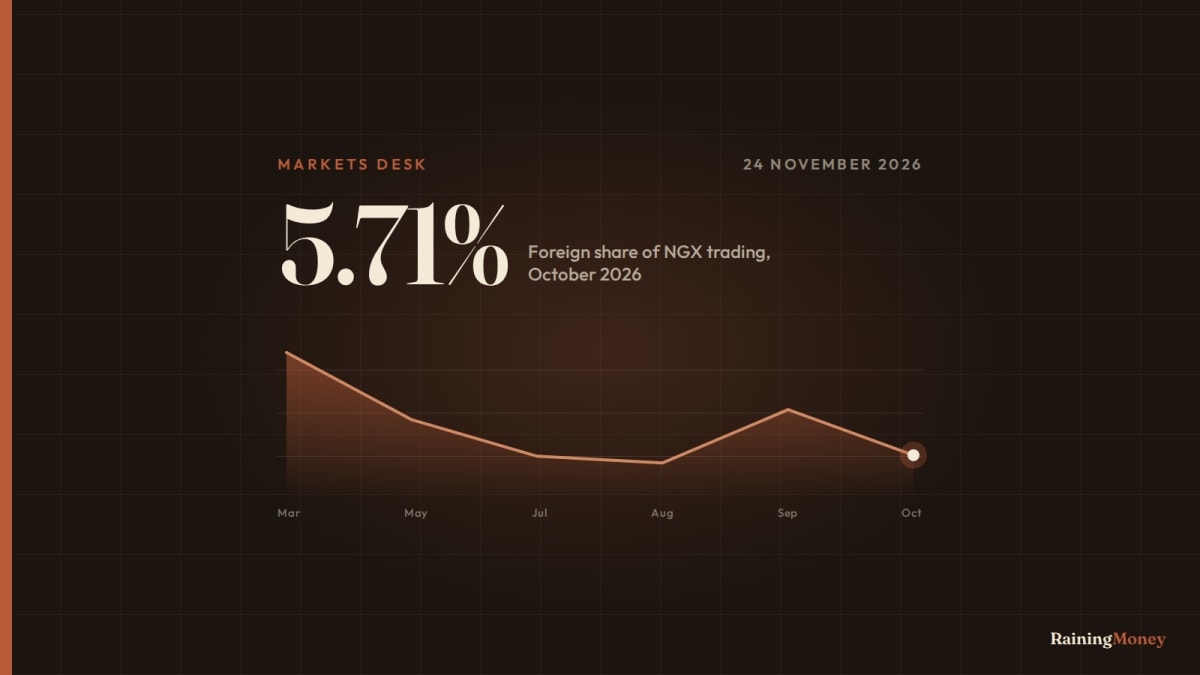
Every month of 2026 has ended with foreigners as net sellers, making October the tenth in a row. The heaviest selling came in March (net ₦74.72bn) and April (net ₦66.10bn). It slowed to ₦6.10bn in September and ₦8.41bn in October, when foreigners bought ₦54.73bn and sold ₦63.14bn. Their share of monthly trading has swung widely: 16.56% in March, 9.45% in May, 5.6% in July, 4.89% in August, a brief recovery to 10.52% in September, then 5.71% in October.
Earlier reporting tied the retreat to uncertainty over settlement, caution ahead of the next general elections, and global fund managers shifting money between countries. RainingMoney's reading: the naira matters a great deal to a foreign investor. A fund in London or New York measures its gains in dollars. If shares rise 50% in naira but the naira loses value, much of the gain can disappear when the money is converted back. Any doubt about how quickly dollars can be bought to take profits home also makes foreigners demand a higher reward or stay away. After a strong rally, some foreign funds may also simply be cashing in.
What does this mean for an ordinary investor or pension saver?
If you have a Retirement Savings Account, part of your pension is managed by an institution of the kind driving this market. RainingMoney's reading: a market led by local institutions tends to be less exposed to sudden foreign exits, which in the past could knock prices down quickly. It also means local pension and insurance money is more tied to the fortunes of Nigerian shares, in good months and bad ones.
For retail investors, the numbers show that individuals are far more active than a year ago. That is a sign of growing participation. It is also a reminder that a rally fuelled by local enthusiasm can cool when that enthusiasm fades, as October's 26.79% fall in retail trading shows. Busy trading is not the same as safe returns. This article is information, not a recommendation to buy or sell any share.
What doesn't the report tell us?
The most common misreading is to treat the ₦289.67bn foreign net selling as dollars leaving Nigeria. The report itself cautions against this. These are values of share trades in naira, not records of foreign currency moving in or out of the country. A foreign seller may keep the naira, reinvest it in bonds or Treasury bills, or convert it later. So the figure cannot be read as an equal drain on the country's dollar reserves.
The report also does not say which shares were bought or sold, whether investors made or lost money, or how much of the higher turnover comes from higher prices rather than more trading. It does not say who the foreign sellers are, or whether the selling is a judgement on Nigeria or on emerging markets in general. And it covers equities only, not government bonds, where foreign investors may be behaving differently.
What should we watch next?
The November report, due in late December, will show whether foreign selling extends to an eleventh month and whether institutional buying holds up after October's jump. Watch the foreign share of trading: September's brief recovery to 10.52% showed it can bounce, but it fell back to 5.71% a month later. Watch the naira too, since a steadier currency would make Nigerian shares easier for foreign funds to hold. And watch retail activity, which slipped in October after months of growth.
Sources & Verification
- Sources: Nairametrics
- Editorial note: This explainer is an original RainingMoney adaptation of the report, RainingMoney has added explanatory context.

Founder and Editor-in-ChiefAbuja
Betini Udom
Founder and Editor-in-Chief of RainingMoney. Covers Nigerian, pan-African and global markets, finance and economic policy.
Author profile & archive →The Money Print
Market intelligence before the market opens.
Pan-African capital flows and the stories behind the numbers, on weekday mornings.