MarketsHigh
Naira Touches ₦1,400 Despite CBN's $1.3B Dollar Sale
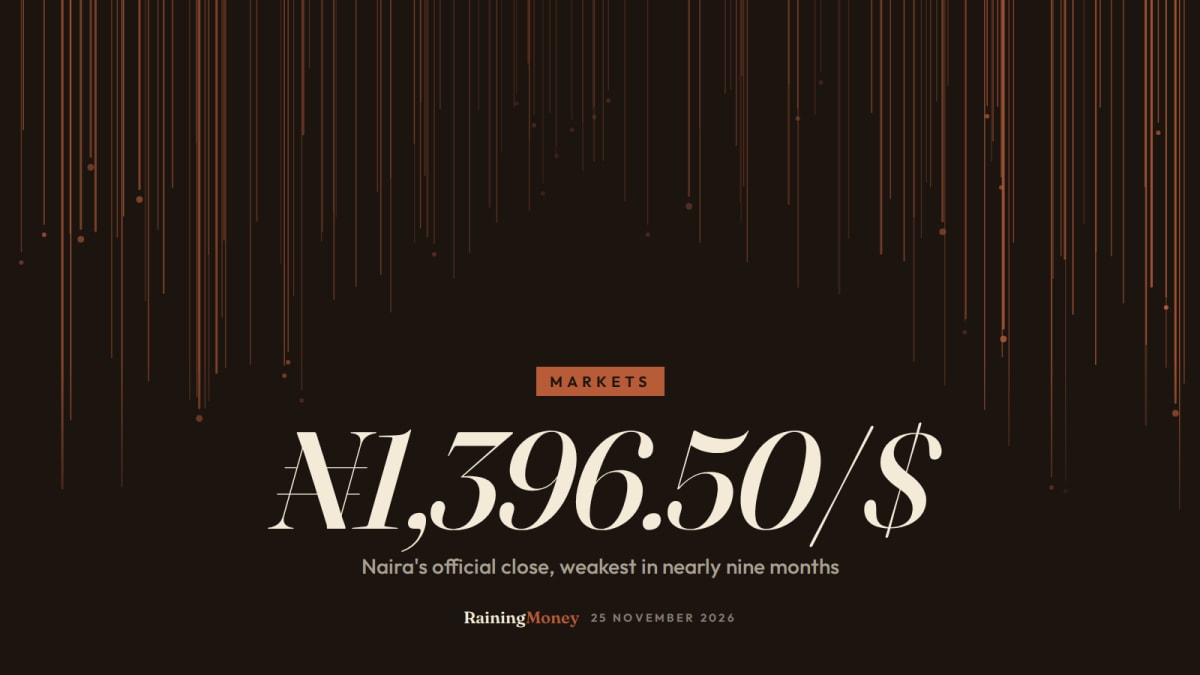
The naira closed the week at ₦1,394/$ after touching ₦1,400, its fifth straight loss, even as the central bank sold $1.30B to banks ahead of next week's MPC.
By Betini Udom Published 6 min read Editorial Policy Report a correction
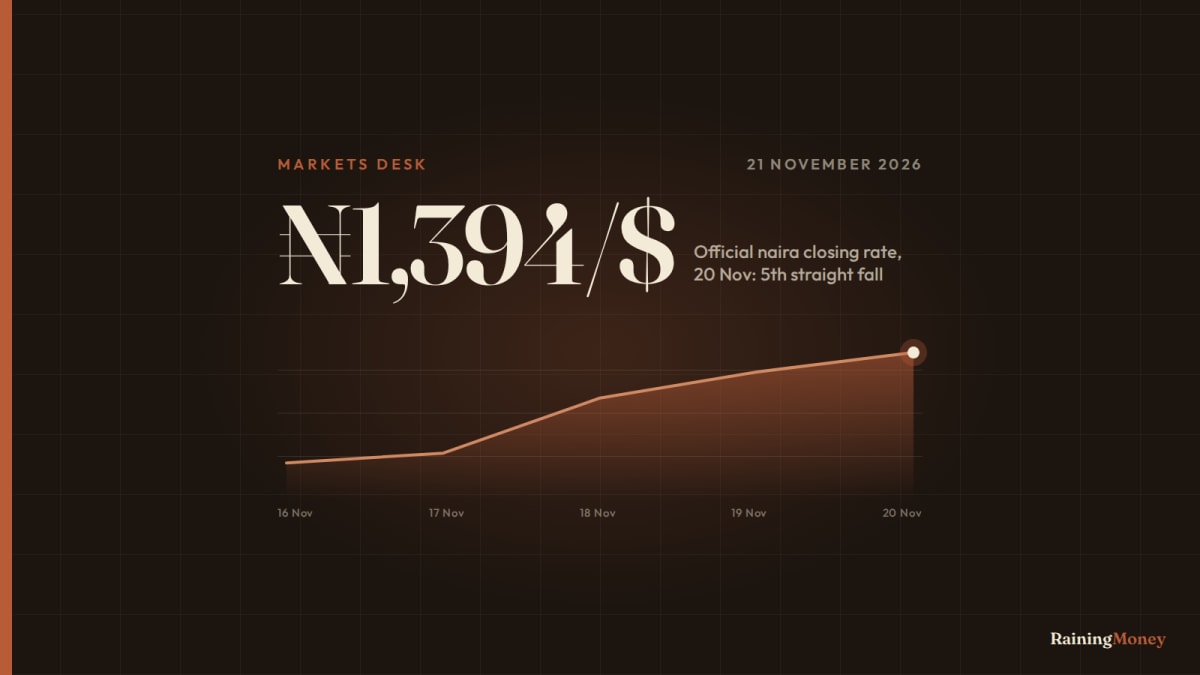
The naira touched ₦1,400 to the dollar on Friday, 20 November 2026, and closed the week at ₦1,394 at the official market, even though the Central Bank of Nigeria (CBN) sold $1.30B to banks during the week to meet demand. It was the fifth straight day the currency lost ground, and its weekly fall of 2.50% leaves it at its weakest since early March, three days before the CBN's rate setters meet.
What happened to the naira this week?
The naira weakened every trading day from Monday to Friday. At the official market, the Nigerian Foreign Exchange Market (NFEM), where banks and large businesses trade dollars, the closing rate moved from ₦1,360 on Monday to ₦1,394 on Friday. That is ₦34 more for every dollar in five days. On Friday the rate swung between ₦1,387.10 and ₦1,400, the first time it reached ₦1,400 in the week.
| Day | Closing rate (₦ per $) | Interbank turnover |
|---|---|---|
| Monday 16 Nov | 1,360.00 | $68.66M |
| Tuesday 17 Nov | 1,363.00 | n/a |
| Wednesday 18 Nov | 1,379.99 | $502.88M |
| Thursday 19 Nov | 1,388.00 | $800.31M |
| Friday 20 Nov | 1,394.00 | $815.57M |
The CBN also publishes a reference rate built from the day's trades, which many contracts and import bills are priced from. That rate moved to ₦1,389.73 on Friday from ₦1,376.58 on Thursday, a loss of ₦13.15, or 0.95%, in one day.
The Big Number: how much did the CBN spend?
The central bank sold $1.30B to the interbank market during the week, trading data show. That is the CBN acting as a seller of last resort: when more people want dollars than are on offer, it releases some of the country's reserves to stop the price jumping too far, too fast.
The scale is growing. CBN dollar sales rose to $2.5B in October from $479M in September, according to market data from FMDQ, the exchange that records these trades. By RainingMoney's working (derived: $1.30B ÷ $2.5B), one week's sales this month came to about half of the whole of October's.
Even so, the naira kept falling. Analysts at Cordros Securities said steady demand for dollars from foreign portfolio investors, the overseas funds that buy Nigerian bonds and shares, was larger than what the central bank put in.
What changed this week?
- Demand for dollars jumped. Interbank turnover, the value of dollars changing hands between banks, rose from $68.66M on Monday to $815.57M on Friday. Over the five days it came to about $2.55B. Turnover alone does not say who was buying and who was selling, but a twelvefold rise in a week shows how busy the market became.
- The street rate stayed far weaker. At the parallel market, where bureaux de change and street traders deal in cash, a dollar cost about ₦1,455 on Friday, slightly better than ₦1,460 on Thursday. Because the official rate fell and the street rate held, the gap between them narrowed to ₦66 from ₦97.
- Reserves are slipping. Nigeria's gross external reserves, the dollars the CBN holds to defend the naira and pay for imports, stood at $54.65B on 19 November. That is about $610M below their peak of $55.26B on 27 October, though still 23.87% above the $44.12B of a year earlier.
What Caught Our Attention: what do traders expect next?
The forward market, where businesses lock in a dollar price today for a future date, shows traders expect more weakness. Every forward contract weakened this week.
| Contract | Rate (₦ per $) | Weekly change |
|---|---|---|
| One month | 1,414.99 | −2.7% |
| Three months | 1,451.81 | −2.7% |
| Six months | 1,495.98 | −2.1% |
| One year | 1,597.57 | −2.0% |
A forward rate is not a forecast. It mostly reflects the gap between interest rates in naira and in dollars. But a one-year price near ₦1,600 tells an importer what it would cost today to be certain of next year's dollars.
Why is the naira under so much pressure now?
Analysts point to three things at once. First, December demand: importers stock up for the festive season, families pay school fees abroad and people travel. Second, election spending ahead of 2027, which analysts say is adding to demand for cash dollars. The parallel market this month recorded its steepest fall in more than two years. Third, foreign investors are holding back. Analysts at Quest Merchant Bank said foreign portfolio investors have taken a wait-and-see stance and some have taken money out of the country, which slows the dollars coming in.
Quest Merchant Bank's figures show how quickly the pace changed. The naira lost 1.2% in October, ending the month at ₦1,346. In November so far it has lost about 3%. Over the same period the premium on the street rate widened to ₦82 from ₦42 at the end of October.
Finance Speak → Human Speak
"The CBN intervened in the FX market." The central bank sold some of its dollars to banks so that people and businesses who need them can buy them without the price shooting up.
"Foreign portfolio investors are repatriating capital." Overseas funds that bought Nigerian bonds or shares are selling and changing their naira back into dollars to take home. That adds to the queue for dollars.
"Reserve buffers are adequate." The central bank still has enough dollars saved to keep selling for a while. It does not mean it can sell without limit.
What does this mean for my money?
A weaker naira works its way into everyday prices. Anything priced in dollars, from imported medicine and spare parts to flights and foreign school fees, costs more in naira. Businesses that import raw materials may pass higher costs on to shoppers in the weeks before Christmas, when demand is already high.
For savers, a naira that loses value against the dollar erodes what naira savings can buy abroad. For borrowers and businesses, the question is whether the central bank responds with higher interest rates, which would make loans dearer.
What happens next?
The CBN's Monetary Policy Committee (MPC), the group that sets the benchmark interest rate, meets on 23 and 24 November. Cordros Securities expects pressure on the naira to persist through the rest of the year, but believes the central bank's reserves are large enough for it to keep intervening. Cowry Asset Management also expects continued pressure before the festive season, though it said more dollar supply could slow the fall.
RainingMoney's reading: a falling naira makes a rate cut at next week's meeting harder to justify, because cheaper borrowing could add to dollar demand. The committee may weigh that against inflation, which has been easing. What isn't known yet is how much more the CBN is willing to spend from its reserves before the end of the year.
The Bottom Line
The central bank spent $1.30B in a week and the naira still fell 2.50% to touch ₦1,400. Festive demand, election spending and cautious foreign investors are pulling the same way, and the forward market prices in more weakness. Next week's rate decision is the next signal of how hard the CBN intends to defend the currency.
Sources & Verification
- Sources: Nairametrics
- Editorial note: This explainer is an original RainingMoney adaptation of the report, RainingMoney has added explanatory context.

Founder and Editor-in-ChiefAbuja
Betini Udom
Founder and Editor-in-Chief of RainingMoney. Covers Nigerian, pan-African and global markets, finance and economic policy.
Author profile & archive →The Money Print
Market intelligence before the market opens.
Pan-African capital flows and the stories behind the numbers, on weekday mornings.