CompaniesMedium
Tax Bills at 41 Listed Firms Jump 71% Under New Tax Rules
Income-tax charges at 41 NGX-listed companies rose 71% to ₦4.52tn in nine months, twice as fast as profit, as the new tax act and an oil deal lifted the bills.
By Betini Udom Published 4 min read Editorial Policy Report a correction
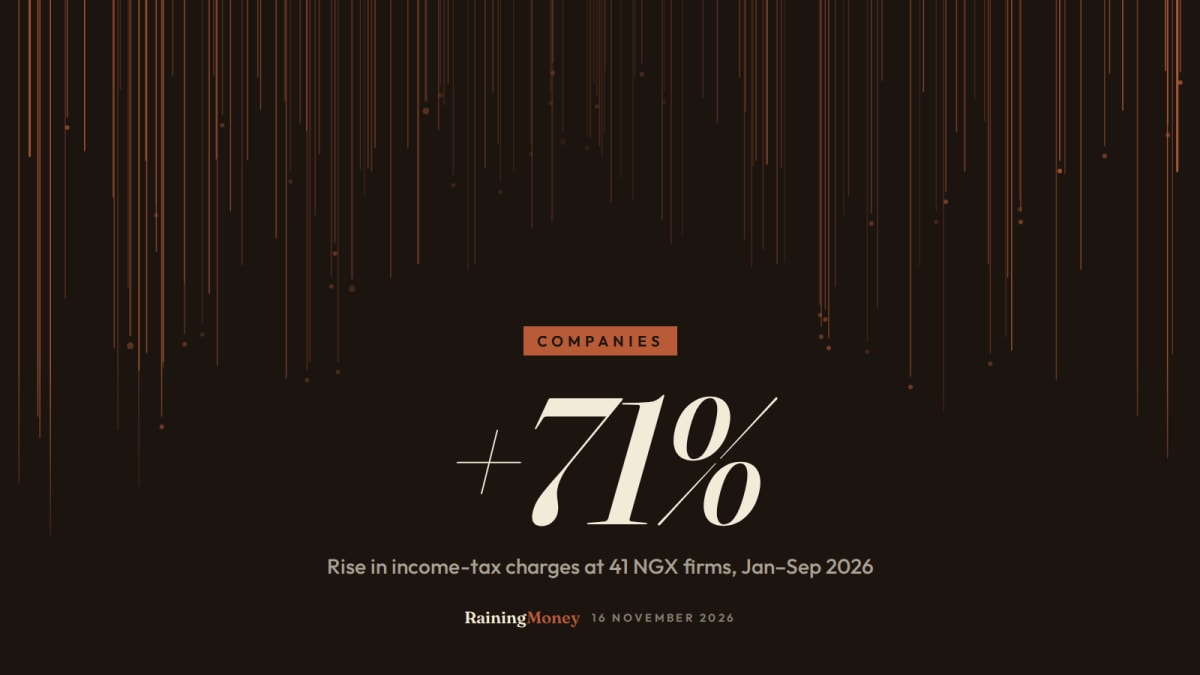
Nigeria's biggest listed companies are paying much more tax. Income-tax charges at 41 companies on the Nigerian Exchange (NGX) rose 71% to ₦4.52tn in the nine months to September 2026, up from ₦2.65tn a year earlier, an analysis of their unaudited results shows. Their combined profit before tax grew 36% to ₦11.88tn over the same period, so the tax bill grew about twice as fast as profit.
Two things drove the jump: the Nigeria Tax Act 2025, which took effect on 1 January 2026, and one oil producer's acquisition. The rest came from companies simply earning more.
What exactly rose, and by how much?
An income-tax charge is the amount a company sets aside from its profit for tax. It shows up in the results before the cash is actually paid. The share of profit that goes to tax is called the effective tax rate.
| Measure | 9M 2025 | 9M 2026 |
|---|---|---|
| Income-tax charge | ₦2.65tn | ₦4.52tn |
| Effective tax rate | 30.3% | 38.1% |
| Profit before tax | n/a | ₦11.88tn (up 36%) |
The increase is about ₦1.87tn. Roughly ₦947bn of it is explained by higher profits: a company that earns more pays more tax at the same rate. The other ₦923bn or so (derived: ₦1.87tn minus ₦947bn) came from higher tax rates, much of it tied to a single oil producer rather than to the new law.
A separate tally of Nigeria's biggest firms, using a different group of companies, found their income-tax payments up 73.31% to ₦3.412tn, from ₦1.968tn. The two figures measure different samples and are not directly comparable, but they point the same way.
What changed in the tax law?
The Nigeria Tax Act kept the headline company income tax rate at 30%. What it changed is how much tax large companies can avoid through exemptions and reliefs.
- A 15% floor. Large companies must now pay an effective tax rate of at least 15% of profit. If exemptions push their bill below that, they pay a top-up.
- A single 4% development levy. A 4% charge on assessable profit replaces several older earmarked levies, including the 3% tertiary education tax.
- No more turnover-based minimum tax. The old minimum tax worked out on sales was abolished.
In everyday terms: before, a bank that earned a lot of tax-free interest on some government securities could report a low tax rate. The floor now limits how far that income can pull the rate down.
Which companies paid the most?
Aradel Holdings added the most to the total. Its tax charge rose to ₦721.4bn from ₦55.6bn after it began consolidating ND Western and Renaissance Africa Energy, whose onshore oil assets pay hydrocarbon tax. Its revenue grew more than sevenfold to ₦3.95tn. That is a change in the size of the business, unrelated to the tax act.
Seplat Energy was the largest single taxpayer, with a ₦987.1bn charge, up from ₦732.4bn. Its effective rate actually fell, to 74% from 83%, because most of its onshore assets moved to the 60% hydrocarbon tax under the Petroleum Industry Act, the company said. MTN Nigeria's charge rose 68% to ₦630.5bn on 59% higher pre-tax profit, and Dangote Cement's rose 67% to ₦497.7bn.
Leave out the three oil producers and the picture is calmer. Tax at the other 38 companies rose 51% to ₦2.82tn on 29% profit growth. Their effective rate climbed to 28.8% from 24.6%.
How are the banks affected?
Banks feel the 15% floor most because they earn a lot of tax-exempt income. Six lenders and holding companies charged ₦1.06tn in tax, up 40.5%, while their pre-tax profit rose 15.9%. Their effective rate rose to 26.4% from 21.8%.
Zenith Bank shows the effect clearly. Its pre-tax profit rose 1.2% to ₦928.8bn, but its tax charge rose 65% to ₦253bn, and net profit fell 11.6% to ₦675.8bn. The charge includes ₦65.9bn of minimum tax under the new floor, ₦9.9bn of development levy and ₦89.9bn to cover tax under-provided in an earlier period. GTCO's tax rose 32% to ₦265.3bn while its pre-tax profit slipped 2.3%; its net profit fell 12.2% to ₦614.6bn.
Why does this matter to me?
For shareholders, tax is paid before dividends. When more of a company's profit goes to the government, less is left to share out or reinvest, as the falls in net profit at Zenith Bank and GTCO show.
For the government, it is a sign the new law is raising money from large companies. The 30 companies that reported cash taxes for both periods paid ₦3.02tn in the nine months, up 85% from ₦1.64tn. Most of that cash settles 2025 bills under the old law, so the full cash effect of the new act is still to come.
RainingMoney's reading: higher company taxes can also reach customers. Firms facing bigger bills may try to protect margins through prices or fees, though the results do not show that yet.
What isn't known yet?
These are nine-month, unaudited figures. Companies estimate interim tax using the rate they expect for the full year, so the charges can change when audited December accounts come out. Some filings also do not explain how the 15% floor applies to them, and one-off items such as prior-year top-ups inflate a few of this year's bills. The full-year results, due in the first quarter of 2027, will give the clearer picture.
Sources & Verification
- Source:BusinessDay
- Editorial note: This explainer is an original RainingMoney adaptation of the report, RainingMoney has added explanatory context.

Founder and Editor-in-ChiefAbuja
Betini Udom
Founder and Editor-in-Chief of RainingMoney. Covers Nigerian, pan-African and global markets, finance and economic policy.
Author profile & archive →The Money Print
Market intelligence before the market opens.
Pan-African capital flows and the stories behind the numbers, on weekday mornings.