EconomyHigh
Lagos Food Prices Jump Ahead of October Inflation Data
Maize rose 37.5% and onions 10% in Lagos markets in October after inflation fell to 14.63% in September. What it means for Christmas budgets and the CBN rate.
By Betini Udom Published 7 min read Editorial Policy Report a correction
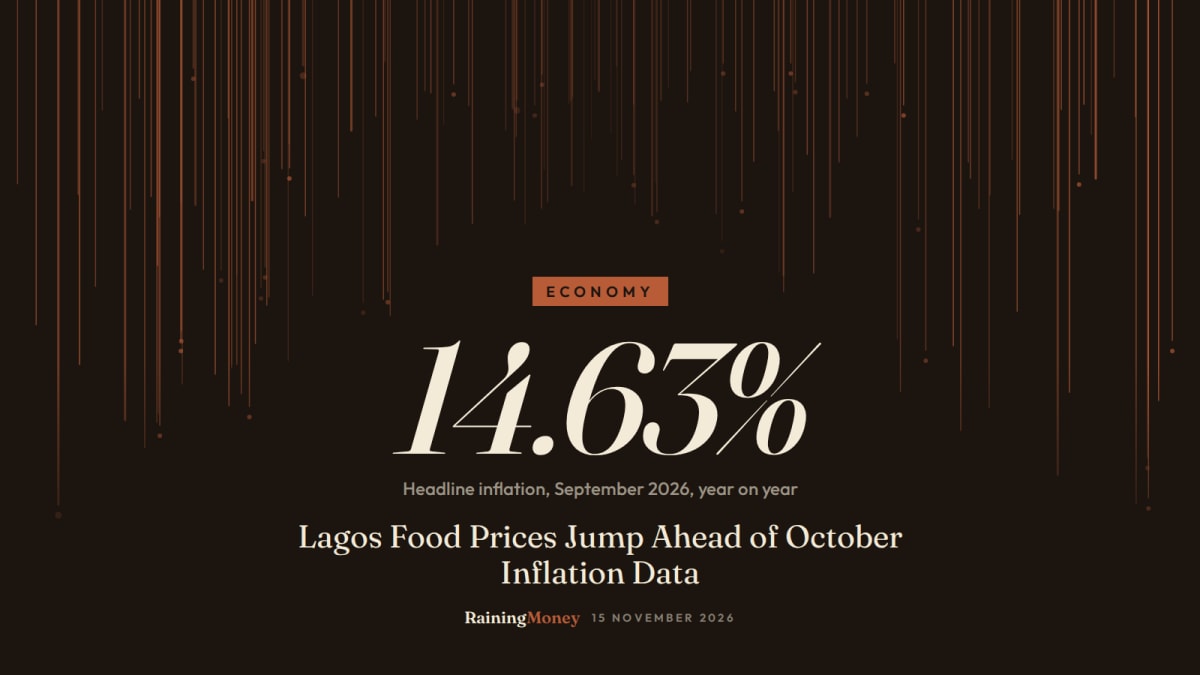
Prices of several food staples rose sharply in Lagos markets in October, just as Nigerians wait for the National Bureau of Statistics (NBS) to publish October's inflation figures. A bag of maize went up by 37.5% in a month, and onions and garri also climbed. As of Sunday, 15 November 2026, the October report had not been published. The last official reading showed headline inflation at 14.63% in September, the fourth fall in a row.
The timing matters. The Central Bank of Nigeria (CBN) holds its Monetary Policy Committee (MPC) meeting on 23 and 24 November, with its benchmark interest rate at 23%. Market analysts polled ahead of the meeting mostly expect the rate to stay where it is. For households, the question is simpler: will food get cheaper or dearer before Christmas?
The Big Number: how far has inflation fallen?
Headline inflation, the yearly rise in the average price of a basket of goods and services, was 14.63% in September 2026. That was down from 15.39% in August and from 20.98% in September 2025. In plain terms, something that cost ₦10,000 in September 2025 cost about ₦11,463 a year later, on average.
The slowdown has been steady since early summer. Inflation was 15.93% in May, 15.91% in June, 15.43% in July and 15.39% in August before the larger drop in September. Over a single month, prices barely moved in September: the month-on-month rate was 0.06%, down from 0.71% in August.
| Month | Rate |
|---|---|
| September 2025 | 20.98% |
| October 2025 | 18.97% |
| May 2026 | 15.93% |
| June 2026 | 15.91% |
| July 2026 | 15.43% |
| August 2026 | 15.39% |
| September 2026 | 14.63% |
What changed in the markets in October?
A survey of 67 food items in four Lagos markets (Mushin, Daleko, Mile 12 and Oyingbo) found that 31 items got more expensive in October, up from 17 in September. Twenty items got cheaper, against 35 the month before, and 16 were unchanged. The balance tipped clearly towards rising prices.
| Item | September | October | Change |
|---|---|---|---|
| Maize, 50kg bag | ₦40,000 | ₦55,000 | +37.5% |
| Yellow garri, 50kg bag | ₦18,000 | ₦23,000 | +27.78% |
| Frozen chicken, carton | ₦48,000 | ₦55,000 | +14.58% |
| Dry onions, bag | ₦200,000 | ₦220,000 | +10% |
| Brown beans, 50kg | ₦105,000 | ₦110,000 | +4.76% |
| Short-grain rice, 50kg | ₦49,000 | ₦48,000 | −2.04% |
| Round tomatoes, big basket | ₦45,000 | ₦35,000 | −22.22% |
Traders gave several reasons. A grain merchant said poultry farms and feed millers were buying maize aggressively, competing with households for the same bags. Another trader said some suppliers were holding back stock because they expect prices to rise towards the end of the year. An onion dealer said fewer trucks were arriving from the north, and onions are traded largely by the truckload.
Onions were already expensive. In mid-September, a bag sold in Lagos for ₦150,000 to ₦250,000 depending on size, compared with ₦50,000 to ₦70,000 in May. Onion growers' representatives blamed floods across several northern states, including Sokoto, Kebbi and Kano, along with costly seed. Moving one bag from the north to Lagos had risen to ₦30,000.
Not everything rose. Tomatoes fell as more supply arrived from northern and central farms, and pepper got cheaper after a good harvest. The branded rice in the survey slipped by ₦1,000 a bag. Another market survey published this month reported much bigger jumps in onion, maize and imported rice prices, so the size of the October increase depends on which market, grade and bag size you look at.
What caught our attention?
September's fall in inflation came almost entirely from food. Food prices dropped 1.55% in the month as the harvest arrived, after rising 1.02% in August. Yet the yearly food inflation rate barely moved, at 19.59%, against 19.57% in August. Food is still the fastest-rising part of the basket.
Meanwhile core inflation, which strips out farm produce and energy because their prices jump around, went the other way. Core prices rose 1.11% in September alone, after a 0.06% dip in August. The yearly core rate was 12.95%.
Derived: if core prices kept rising at 1.11% a month for a year, the yearly rate would be about 14.2% (1.0111 multiplied by itself 12 times, minus 1). That is above the published 12.95%, which suggests underlying price pressure was building even as the headline figure fell.
Energy is the other worry. Energy inflation more than doubled to 10.85% in September from 4.69% in August, with energy prices up 5.38% in that one month. Petrol sold for ₦1,400 to ₦1,430 a litre in Lagos in September, and crude oil was above $100 a barrel in mid-October.
There is also a gap between town and country. Urban prices rose 0.53% in September while rural prices fell 0.89%. Yearly urban inflation was 15.64%, against 12.46% in rural areas. Most of the harvest relief showed up in villages; city dwellers felt less of it.
Will October's figure go up or down?
Nobody knows yet. One published forecast puts October headline inflation at 13.99%, which would be a fifth monthly fall. That forecast has not been confirmed by the NBS and should be treated as an estimate.
Two things can be true at once. The yearly headline rate compares October 2026 prices with October 2025, when inflation was 18.97%. RainingMoney's reading: because prices were already high a year ago, the yearly rate can keep falling even if food prices rise in October. The month-on-month food and core figures are better guides to what is happening to shoppers right now. One financial planner has argued that a core monthly reading below 1% in October would point to genuine easing, while a reading above 1% would suggest September's drop was mostly a harvest effect.
Finance speak, human speak: what do these terms mean?
- Monetary Policy Rate (MPR): the CBN's benchmark interest rate. Banks price loans and deposits around it. It is now 23%, cut from 26.5% in September.
- Hold, cut or hike: the MPC can leave the rate unchanged, lower it to make borrowing cheaper, or raise it to cool spending and prices.
- Cash Reserve Requirement (CRR): the share of customer deposits banks must leave with the CBN instead of lending out. It is 45%.
- Corridor: the range around the MPR at which banks can borrow from or deposit with the CBN overnight. It is set at 0.5 percentage points above and 3 percentage points below the MPR.
- Real interest rate: an interest rate minus inflation. It shows whether savers are gaining or losing purchasing power.
What will the central bank do on 23 and 24 November?
The MPC has 12 members, led by the CBN governor, and decides by majority vote after studying inflation, the naira, growth, liquidity, reserves and global factors such as oil prices. The central bank has said its next decisions will depend on the data.
Five market analysts asked ahead of the meeting all named a hold at 23% as the most likely outcome. They pointed to falling headline inflation and a steadier foreign exchange market on one side, and on the other to the large cut made only in September and the rise in monthly core inflation. One of them said a small cut could not be ruled out.
Derived: with the policy rate at 23% and inflation at 14.63%, the gap is 8.37 percentage points. The 364-day Treasury bill, a one-year government loan, was sold at 15.90% at the 14 October auction, just 1.27 points above September inflation (derived: 15.90 minus 14.63). A jump in October's food prices would narrow those gaps, which is one reason analysts see little room for another cut this month.
The Bottom Line: what does this mean for my money?
For household budgets, the official figure and the market stall may tell different stories over the next few weeks. Even if October's yearly inflation rate falls, the price of maize, garri, onions and frozen chicken in Lagos rose in October, and traders expect year-end demand to keep pressure on. Families planning Christmas shopping may find staples cost more than they did in September, while tomatoes and pepper are cheaper for now.
For borrowers, a hold at 23% would mean loan rates stay roughly where they are after September's cut. For savers, interest on deposits and Treasury bills is still above the September inflation rate, though only narrowly for the one-year bill. This is not advice to buy, sell or hold any investment.
What should we watch next?
- The NBS October inflation report, especially month-on-month food and core inflation.
- The MPC decision at the end of its 23 to 24 November meeting.
- Petrol prices, which feed into transport and food costs.
- Market prices for onions, maize and rice in the run-up to Christmas.
Sources & Verification
- Sources: BusinessDay
- Editorial note: This explainer is an original RainingMoney adaptation of the report, RainingMoney has added explanatory context.

Founder and Editor-in-ChiefAbuja
Betini Udom
Founder and Editor-in-Chief of RainingMoney. Covers Nigerian, pan-African and global markets, finance and economic policy.
Author profile & archive →The Money Print
Market intelligence before the market opens.
Pan-African capital flows and the stories behind the numbers, on weekday mornings.