EconomyMedium
Ghana Inflation Hits 11-Month High on Transport Costs
Ghana's inflation rose to 5.5% in October, an 11-month high, as transport and services costs climbed. What it means for rates in Accra and for Nigerian readers.
By Chiamaka Prudence Published 6 min read Editorial Policy Report a correction
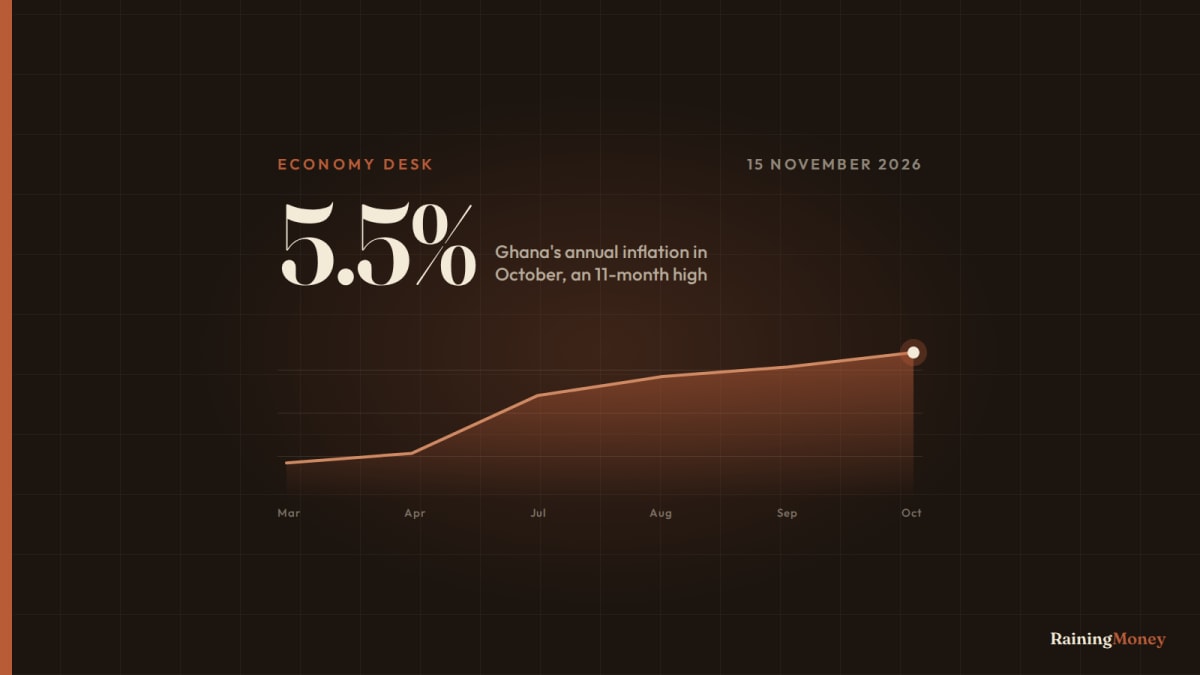
Prices in Ghana rose faster in October 2026. Annual inflation climbed to 5.5%, up from 5.2% in September, the Ghana Statistical Service said. That is the highest rate in 11 months and the second monthly rise in a row. The push came from transport and other services, while food prices cooled.
The figure lands two weeks before the Bank of Ghana's next interest rate decision on 18 November, and about a week before Nigeria's own Monetary Policy Committee (MPC) meets on 23 and 24 November. Both central banks are watching the same kind of pressure: the cost of moving people and goods.
What exactly did Ghana's statistics office report?
Inflation measures how fast the prices of everyday goods and services rise over a year. A rate of 5.5% means that, on average, a basket of items that cost GH¢100 in October 2025 cost about GH¢105.50 in October 2026.
The main October figures were:
- Headline inflation: 5.5%, up from 5.2% in September.
- Non-food inflation: 7.9%, up from 6.2%.
- Food inflation: 2.8%, down from 4.0%.
- Services inflation: 11.5%, up from 8.3%.
- Transport prices: up 8.0% in October alone, compared with September.
Government Statistician Alhassan Iddrisu said the figures showed non-food items playing a growing part in overall inflation. He put it in simple terms: of every GH¢1 of price increase in October, about 76 pesewas came from non-food items and 24 pesewas from food.
Why did inflation rise when prices fell during the month?
This looks like a contradiction, so it helps to separate two measures. Annual inflation compares prices with the same month a year earlier. Monthly inflation compares them with the month before.
On a monthly basis, consumer prices in Ghana actually fell by 0.1% in October, after rising 1.1% in September. Food prices dropped 2.0% in the month, which pulled the average down. But transport and other services became more expensive, and compared with October 2025 the overall price level was 5.5% higher. The annual rate rose because the increase over the past 12 months was bigger than the increase over the 12 months measured a month earlier.
Food tells a mixed story. Some staples are much cheaper than a year ago: maize is down 27.2% and local rice down 14.3%. Fresh tomatoes went the other way, up 119.3%.
How does this compare with earlier in the year?
| Month | Inflation |
|---|---|
| March | 3.2 |
| April | 3.4 |
| July | 4.6 |
| August | 5.0 |
| September | 5.2 |
| October | 5.5 |
March's 3.2% was Ghana's lowest rate since 2021. Since then inflation has risen by 2.3 percentage points (derived: 5.5 minus 3.2). Even so, it is still well below the 8.0% recorded in October 2025, and below the Bank of Ghana's target. That target is 8%, with room of 2 percentage points either side, so anything from 6% to 10% counts as on target. At 5.5%, inflation sits just under the bottom of that range.
Where in Ghana are prices rising fastest?
The pressure is uneven. Ashanti Region recorded the highest inflation, at 9.7%, while Northern Region saw prices fall, with inflation of minus 0.5%. Ashanti and Greater Accra together made up 60.2% of national inflation.
Most of the pressure is home-grown. Locally produced items rose 6.9% over the year and accounted for 86.4% of total inflation. Imported items rose only 2.4%.
RainingMoney's reading: with imported goods fairly calm and local services rising fast, the story in Ghana is mainly about domestic costs such as transport fares, rent and school fees. A weak currency feeding through to import prices plays a smaller part for now.
What does the cedi have to do with it?
The cedi, Ghana's currency, has weakened by about 10% against the US dollar so far this year, and a weaker currency makes fuel and imported goods dearer. It did recover a little in October, gaining 0.60% as it moved from GH¢11.71 per dollar at the end of September to GH¢11.64 at the end of October. On 10 November, the average buying rate was about GH¢11.84 per dollar.
Ghana's central bank has also flagged pressure on fuel and fertiliser supplies linked to the war involving Iran, which can lift transport and farming costs.
Will the Bank of Ghana change interest rates?
The Bank of Ghana's policy rate is 14%. The policy rate is the benchmark that guides what banks charge borrowers and pay savers. The bank cut rates five times in a row before pausing in May, and it held at 14% again in September, a third straight hold. Governor Johnson Asiama's committee said then that risks were broadly balanced but pointed to housing, transport and services costs.
A faster inflation rate gives the bank a reason to keep rates where they are on 18 November rather than resume cuts. With inflation at 5.5%, the gap between the policy rate and inflation is about 8.5 percentage points (derived: 14 minus 5.5). That gap, often called the real interest rate, is what savers earn above inflation and what borrowers pay on top of it.
Why should a Nigerian reader care?
Ghana is a West African neighbour whose economy has followed a similar path to Nigeria's this year: inflation falling, a currency under pressure and a central bank weighing when to cut. Nigerian firms and families with ties to Ghana feel its price trends directly.
The bigger lesson is about policy. Nigeria's headline inflation fell to 14.63% in September 2026, its fourth monthly decline, and the Central Bank of Nigeria (CBN) cut its Monetary Policy Rate from 26.5% to 23% that month. Nigeria's real interest rate is therefore about 8.4 percentage points (derived: 23 minus 14.63), close to Ghana's.
RainingMoney's reading: Ghana shows that inflation can turn up again after a long fall, and that transport costs can do it even when food is getting cheaper. Fuel and transport costs also feed into what Nigerians pay for food, since goods have to be moved to market. The CBN's committee will weigh October's Nigerian inflation figures alongside the same global fuel risks when it meets later this month.
For households, Ghana's figures are a reminder that the easing seen this year can stall if fuel and fares climb. A rise next door is no forecast for Nigeria's own October figure.
What should we watch next?
- The Bank of Ghana's decision on 18 November, and what it says about transport and services prices.
- Nigeria's October inflation figures, due before the CBN's committee meets.
- The CBN's decision on 23 and 24 November, after its cut to 23% in September.
- The cedi and the naira, since a weaker currency raises the cost of fuel and imports in both countries.
Sources & Verification
- Sources: BusinessDay
- Editorial note: This explainer is an original RainingMoney adaptation of the report, RainingMoney has added explanatory context.

Correspondent, OnitshaOnitsha
Chiamaka Prudence
I am a technology and finance enthusiast with a keen interest in digital innovation, emerging financial trends, and the evolving ways technology is shaping businesses and everyday life. I enjoy…
Author profile & archive →The Money Print
Market intelligence before the market opens.
Pan-African capital flows and the stories behind the numbers, on weekday mornings.