CompaniesMedium
Dangote Spends ₦3.3tn on Nigeria's Roads: Why It Matters
Aliko Dangote says his businesses are spending ₦3.3tn on Nigerian roads. Here is why bad roads lift prices and what the end of the road tax credit scheme means.
By Chiamaka Prudence Published 6 min read Editorial Policy Report a correction
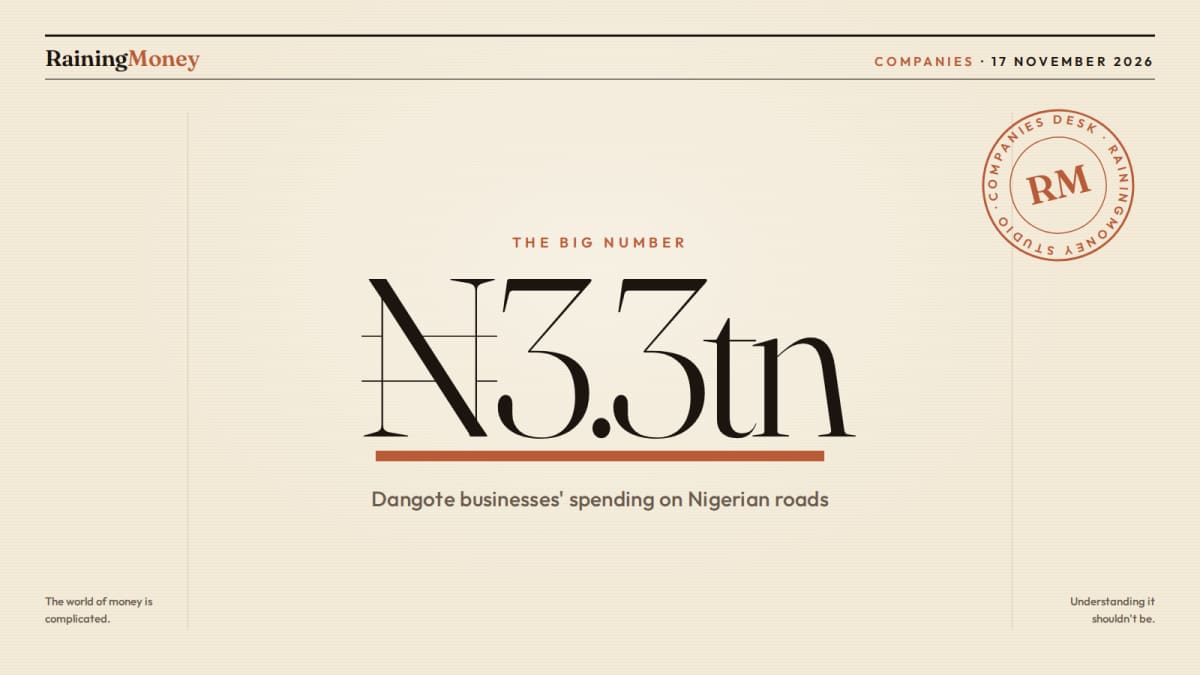
Aliko Dangote says his businesses are spending ₦3.3tn to upgrade roads in Nigeria, a sum reported as about $2.2bn. Africa's richest man gave the figure in Accra, where he was attending a summit with Ghana's President John Mahama. His reason is practical: the Dangote Group moves cement, sugar, fuel and food in about 14,000 trucks across Nigeria, and bad roads make every one of those journeys slower and dearer.
In the same remarks he proposed a 1,000km road linking Nigeria, Ghana and Côte d'Ivoire to make cross-border trade easier, and said he would engage President Mahama and other leaders in the region to give the project priority. No cost or timetable for that road has been reported.
How much money is ₦3.3tn?
The reported dollar figure of $2.2bn implies an exchange rate of about ₦1,500 to the dollar (derived: ₦3.3tn divided by $2.2bn). Dangote did not say, in the remarks reported so far, over how many years the money is being spent, which roads it covers, or how much has already been paid out. Those details matter for judging the size of the programme, and they are still missing.
For comparison, the Federal Executive Council (FEC), the President's cabinet, approved five road contracts for Dangote Industries worth ₦309.9bn in July 2021. Those roads covered about 275km in Borno, Kaduna, Lagos and Ogun states. The new figure is more than ten times that single approval (derived: ₦3.3tn divided by ₦309.9bn is about 10.6). It is not clear whether the ₦3.3tn includes those earlier contracts.
| Item | Figure | When |
|---|---|---|
| Road spending Dangote now cites | ₦3.3tn (about $2.2bn) | November 2026 |
| FEC approval for five Dangote roads | ₦309.9bn, about 275km | July 2021 |
| Trucks the group runs in Nigeria | About 14,000 | November 2026 |
| Proposed road linking Nigeria, Ghana and Côte d'Ivoire | 1,000km, cost not given | November 2026 |
Why would a company pay to fix public roads?
Because its profits depend on them. The World Bank estimates that more than 90% of passenger and freight movement in Nigeria goes by road, and that about 80% of roads are in poor condition. Potholes, washed-out stretches and long detours raise fuel and repair bills, slow deliveries between factories, ports and buyers, and wear out trucks faster. The burden is heaviest on firms that ship bulky goods in large volumes, which describes most of Dangote's businesses.
The group runs Africa's biggest oil refinery and its biggest cement maker, the largest sugar-processing plant in sub-Saharan Africa, and has interests in food, vehicles, shipping, power and property. A modern refinery or cement plant can be built to a high standard, yet its output still has to travel on public roads to reach customers. Spending on those roads protects the much larger sums already sunk into the factories.
What is the road tax credit scheme?
Much of Dangote's earlier road building ran through a federal programme called the Road Infrastructure Development and Refurbishment Investment Tax Credit Scheme. It was set up under Executive Order 007, signed in 2019, and was meant to run for ten years.
The idea is simple. A company pays upfront to build or repair a federal road. In return, the government lets it subtract that cost from the company income tax it would otherwise owe. A tax credit is exactly that: an amount knocked off a tax bill. The government gets a road without paying cash from the budget at the time, and the company gets a road it needs while recovering its outlay through lower tax.
The 2021 approval worked this way. Dangote Industries funds the construction and nets the cost against its tax bill, and a committee chaired by the finance minister caps how much tax relief can be granted each year. Other large firms joined in, including BUA Group, MTN Nigeria and Nigeria LNG, and the state oil company NNPC financed more than 21 road projects covering over 1,800km.
Why did the scheme come under scrutiny?
In February 2026 Zacch Adedeji, executive chairman of the Nigeria Revenue Service (NRS), said the government had stopped using company tax credits to pay for roads. He argued that the tax agency's job is to assess and collect tax, not to decide how public money is spent. Letting firms swap tax for roads, in his view, amounted to spending public funds without approval through the budget process run by the National Assembly. He also said the agency lacked the technical knowledge to judge how roads are built.
Future federal road projects are meant to be paid for through the budget. NNPC had already pulled back from direct funding of its tax credit roads in 2025, leaving about ₦3tn of road projects without funding, and the Works Minister, David Umahi, said the government was looking at public-private partnerships to finish them.
This matters for the ₦3.3tn because the reports do not say how Dangote's current spending is being paid for. RainingMoney's reading: if the spending no longer earns tax credits, the group is carrying the cost itself; if some of it began under the old scheme, part of the bill may still come back to the government as tax it does not collect. Neither the group nor the government has said which applies.
How do bad roads show up in the prices I pay?
Transport is part of the price of almost everything sold in a Nigerian market. When a truck of cement or sugar takes two days instead of one, burns more diesel and needs new tyres sooner, the producer, the distributor or the retailer has to recover that cost somewhere, and the usual place is the price the buyer pays.
RainingMoney's reading: smoother roads on the routes Dangote's trucks use could, over time, lower the cost of getting goods such as cement, sugar and fuel to market. Whether buyers see that in lower prices depends on many other things, including the exchange rate, energy costs, competition and how much of any saving companies choose to pass on.
What does the 1,000km regional road mean?
The proposed road from Nigeria through Ghana to Côte d'Ivoire is about trade across West Africa. Dangote said poor transport links are a major barrier to trade between the region's countries. He has also linked more production across West Africa to making a common currency for the Economic Community of West African States (ECOWAS) easier to introduce, and said Côte d'Ivoire, Ghana and Nigeria should lead.
For now it is a proposal. No one has said who would pay, how long it would take, or whether governments have agreed to it.
What isn't known yet?
- Over what period the ₦3.3tn is being spent, and how much has been spent so far.
- Which roads it covers, and whether it includes the ₦309.9bn of contracts approved in 2021.
- Whether any of the spending still earns tax credits after the February 2026 decision.
- What the proposed 1,000km regional road would cost and who would fund it.
The spending fits a wider push by the group. Days before the Accra remarks, Dangote raised his planned investment across Africa to a target of $70bn by the end of the decade. Roads are a small part of that next to refineries, but they decide how cheaply everything the group makes reaches the people who buy it.
Sources & Verification
- Sources: BusinessDay
- Editorial note: This explainer is an original RainingMoney adaptation of the report, RainingMoney has added explanatory context.

Correspondent, OnitshaOnitsha
Chiamaka Prudence
I am a technology and finance enthusiast with a keen interest in digital innovation, emerging financial trends, and the evolving ways technology is shaping businesses and everyday life. I enjoy…
Author profile & archive →The Money Print
Market intelligence before the market opens.
Pan-African capital flows and the stories behind the numbers, on weekday mornings.