CompaniesHigh
UBA's Nine-Month Profit Falls 13% as Bad-Loan Charges Jump
UBA's profit before tax fell 13.1% to ₦502.98bn in the nine months to September as charges for loans that may not be repaid rose almost fivefold to ₦272.12bn.
By Betini Udom Published 7 min read Editorial Policy Report a correction
United Bank for Africa (UBA) made a profit before tax of ₦502.98bn in the nine months to 30 September 2026, down 13.1% from ₦578.60bn a year earlier, its unaudited results filed with the Nigerian Exchange (NGX) on Friday, 20 November, show. The main reason was a sharp rise in the money the bank set aside for loans that may not be repaid: these charges climbed to ₦272.12bn from ₦56.89bn. After tax, profit fell 25.3% to ₦401.60bn.
What did UBA report?
UBA is one of Nigeria's largest banks, with operations in several other African countries. It released its half-year accounts and its nine-month accounts on the same day, later than most of its peers. The bank linked the delay to approval it was waiting for from the Central Bank of Nigeria (CBN), one report says.
The headline figures, comparing the first nine months of 2026 with the same period of 2025:
| Item | 9M 2026 | 9M 2025 | Change |
|---|---|---|---|
| Gross earnings | ₦2.54tn | ₦2.47tn | +2.8% |
| Net interest income | ₦1.19tn | ₦1.16tn | +2.7% |
| Non-interest income | ₦477.25bn | ₦320.83bn | +48.7% |
| Impairment charges | ₦272.12bn | ₦56.89bn | about +378% |
| Operating expenses | ₦894.33bn | ₦846.15bn | +5.7% |
| Profit before tax | ₦502.98bn | ₦578.60bn | -13.1% |
| Income tax | ₦101.37bn | ₦41.07bn | +146.7% |
| Profit after tax | ₦401.60bn | ₦537.53bn | -25.3% |
| Earnings per share | ₦8.57 | ₦13.56 | -36.8% |
The Big Number: how much more did UBA set aside for bad loans?
The number that explains this result is ₦272.12bn. That is UBA's total impairment charge for the nine months, up from ₦56.89bn a year earlier. Of that, ₦255.09bn related to loans to customers, against ₦46.11bn in the same period of 2025.
An impairment charge is money a bank books as a cost today because it expects some borrowers will not pay back in full. It is an estimate, made under accounting rules, and it reduces profit even if no loan has yet been written off. Put simply, UBA has told its shareholders that it now expects to lose more on its loans than it did a year ago, and it has paid for that expectation out of this year's earnings.
On a rough calculation (derived: ₦502.98bn plus the ₦215.23bn rise in impairment charges), profit before tax would have been about ₦718bn if the charges had stayed at last year's level. That calculation ignores any other changes, but it shows how much of the fall comes from this single line.
What changed from last year?
Most of the bank's business grew. Gross earnings, the total money coming in before any costs, rose 2.8% to ₦2.54tn. Interest income slipped 2.5% to ₦1.93tn, but interest the bank paid to depositors and other lenders fell faster, by 9.9% to ₦738.98bn. That left net interest income, the gap between what a bank earns on loans and investments and what it pays for its money, 2.7% higher at ₦1.19tn.
The strongest growth came from outside lending. Non-interest income rose 48.7% to ₦477.25bn. Within that:
- Net trading and foreign exchange income rose to ₦153.76bn from ₦41.36bn.
- Losses on derivatives, contracts the bank uses to manage currency and interest-rate risk, narrowed to ₦17.78bn from ₦164bn.
- Net fees and commissions rose 10.2% to ₦270.73bn, helped by a 19.3% fall in fee expenses. Gross fees dipped 1.5%, and income from electronic banking fell 3.1% to ₦152.60bn.
Operating income, everything the bank earned after paying interest, rose 12.7% to ₦1.67tn. But once the impairment charges were taken off, net operating income fell 1.9% to ₦1.40tn. Operating expenses then rose 5.7% to ₦894.33bn, with staff costs up 13.2% to ₦306.64bn.
Tax made the fall at the bottom line worse. The income tax charge rose to ₦101.37bn from ₦41.07bn, mainly because of an ₦86.95bn deferred tax charge, against a small deferred tax credit a year earlier. The bank's effective tax rate rose to 20.2% from 7.1%. That is why profit after tax fell by about a quarter while profit before tax fell by about an eighth.
What Caught Our Attention: is the third quarter getting worse?
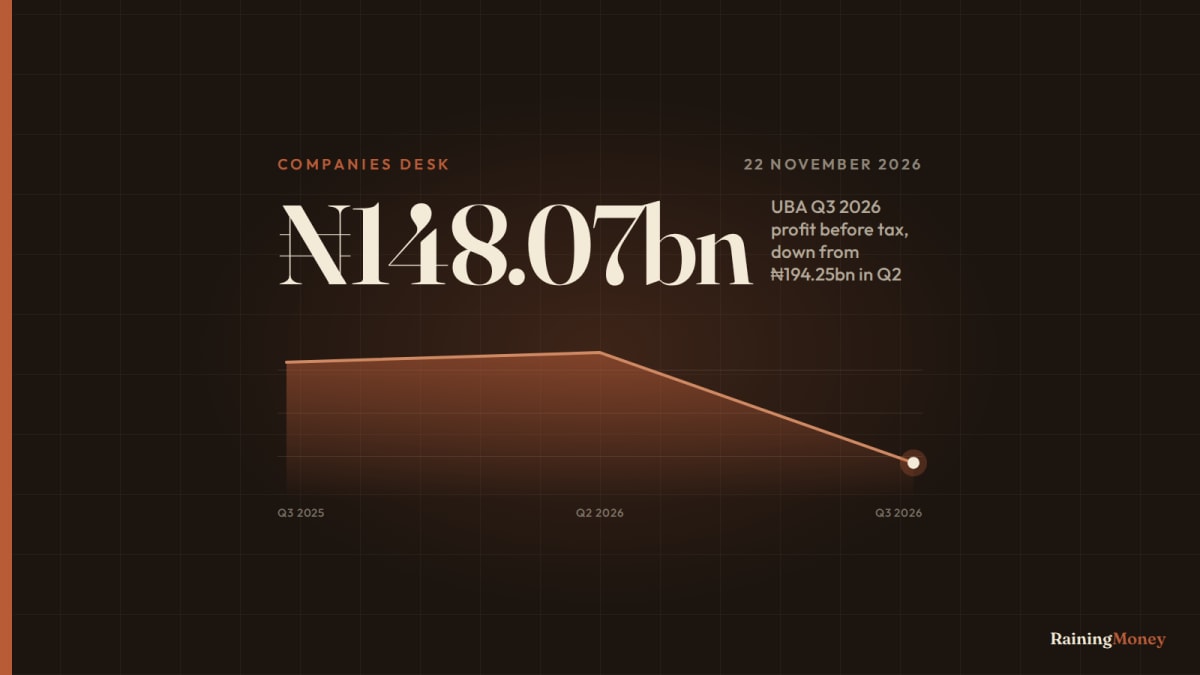
The third quarter on its own was weaker than the rest of the year. UBA made a profit before tax of ₦148.07bn between July and September, down 22.1% from ₦190.18bn in the same quarter of 2025 and down from ₦194.25bn in the second quarter of 2026. For the first half of the year, profit before tax was ₦354.90bn, 8.6% lower than a year earlier.
So the decline sharpened as the year went on. RainingMoney's reading: most of the large impairment charge appears to have been taken in the first half, which suggests the bank did a big clean-up of its loan book before September. If that is right, the coming quarters may show smaller charges. The results themselves do not say this, and the bank's own explanation is limited to a general statement about caution.
UBA's executive director for finance and risk management, Ugo Nwaghodoh, said the lower after-tax profit reflected deliberate, higher provisions meant to protect the loan book against risks in the wider economy. He did not, in the published remarks, name which borrowers or sectors caused the extra charges.
Another figure points the same way: allowances against loans already classed as credit-impaired rose to ₦440.4bn from ₦350.7bn at the end of 2025, one report says.
How big is the bank now?
The balance sheet kept growing. Total assets rose 5.4% in the nine months to ₦34.96tn. Customer deposits rose to ₦24.60tn from ₦23.07tn at the end of December, and loans to customers rose 6.0% to ₦7.44tn. Shareholders' equity, what would be left for owners if all debts were paid, rose 3.3% to ₦4.39tn.
UBA lends out a relatively small share of the money it holds. Loans equal about 30% of deposits (derived: ₦7.44tn divided by ₦24.60tn). Of its ₦9.68tn of cash and bank balances, ₦3.63tn is restricted, mostly the cash the CBN requires banks to keep with it, known as the cash reserve requirement.
Finance Speak → Human Speak
- Impairment charge: the cost a bank books for loans it thinks may not be fully repaid. Higher charges mean the bank expects more borrowers to struggle.
- Net interest income: what a bank earns from lending and investing, minus what it pays depositors and other lenders.
- Deferred tax: tax that relates to this year's accounts but will be paid or saved in later years. It can swing reported profit even when no cash changes hands.
- Earnings per share: profit for shareholders divided by the number of shares. UBA's fell faster than its profit because the bank issued more shares in its 2025 rights issue, so the profit is shared among more owners.
- Cost-to-income ratio: how much of each naira of income goes on running costs. UBA's was 53.57%, so about 54 kobo of every naira earned went on salaries, offices, technology and other expenses.
What does this mean for shareholders and customers?
For shareholders, lower earnings per share means less profit backing each share. UBA's shares closed at ₦38.25 on the day the results came out, down 1% from ₦38.65. They started 2026 at ₦41.65, so they are down 8.16% this year, while the NGX All-Share Index, the main measure of Nigerian share prices, was up 59.15% for the year at the close of 20 November. UBA did not declare an interim dividend with these results, one report says.
For customers, the results change little day to day. Deposits are still growing, and the bank's capital base is larger than it was in December. The larger provisions are a cushion: money set aside now means a future loss on those loans would not come as a fresh hit.
For the wider economy, UBA's numbers matter because of the bank's size. A large lender booking almost five times last year's charge is a sign that at least some of its borrowers are under strain (RainingMoney's reading). The reports on the results do not break the charge down by country or sector, so which borrowers are struggling is not yet known.
What happens next?
UBA's full-year results will show whether the slower pace of charges in the third quarter holds, and whether the bank pays a dividend for 2026. Its audited accounts should also give more detail on which loans the extra provisions cover. Interest rates matter too: any change by the CBN would affect what banks earn on their loans and pay on deposits, and so the net interest income that carried UBA this year.
The Bottom Line
UBA's core business grew in 2026: it earned more from trading, currency deals and fees, and paid less for its deposits. What pulled profit down was a near fivefold rise in the money set aside for loans that may go bad, plus a heavier tax bill. The bank calls this caution. Whether it was a one-off clean-up or the start of a run of loan problems is the question its next results need to answer.
Sources & Verification
- Sources: Nairamterics

Founder and Editor-in-ChiefAbuja
Betini Udom
Founder and Editor-in-Chief of RainingMoney. Covers Nigerian, pan-African and global markets, finance and economic policy.
Author profile & archive →The Money Print
Market intelligence before the market opens.
Pan-African capital flows and the stories behind the numbers, on weekday mornings.