EconomyMedium
S&P Doubts Nigeria Can Reach Investment Grade by 2029
S&P says no country has climbed from single-B to investment grade in three years, casting doubt on Nigeria's 2029 goal. What the rating gap means for you.
By Betini Udom Published 5 min read Editorial Policy Report a correction
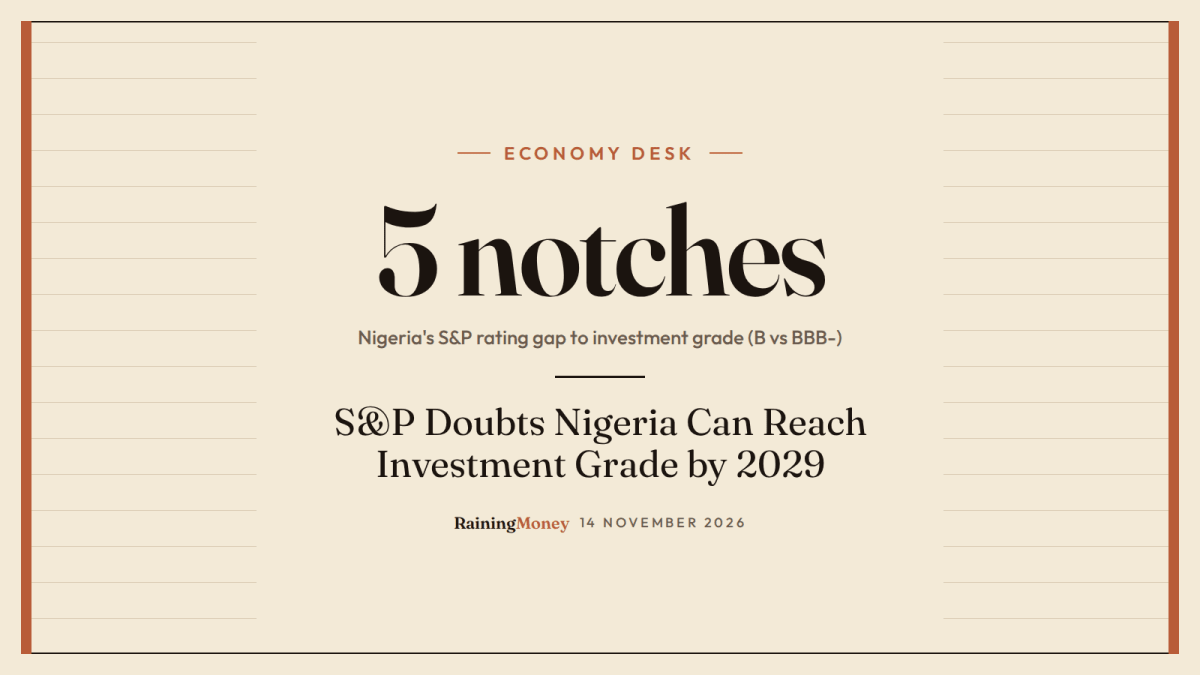
Nigeria's goal of winning an investment-grade credit rating by 2029 is unlikely to be met on that timetable, S&P Global Ratings said on 13 November 2026. Samira Mensah, the agency's Managing Director for Research and Analytics in Africa, said in an interview in Lagos that S&P has never seen a country move from the single-B category to investment grade within three years. Nigeria is currently rated B by S&P, five steps below the investment-grade line.
Her comments followed Finance Minister Taiwo Oyedele's announcement of the 2029 target, which he has described as ambitious but achievable.
What is a credit rating, and why does Nigeria want a better one?
A sovereign credit rating is a grade that agencies such as S&P, Fitch and Moody's give a country to show how likely it is to repay what it borrows. Think of it as a credit score for a government. The higher the grade, the lower the interest lenders demand.
Ratings are split into two broad groups. "Investment grade" (BBB- and above at S&P and Fitch, Baa3 and above at Moody's) signals low risk. Many large pension funds and insurers around the world are only allowed to buy bonds from investment-grade borrowers. Anything below that line is "speculative grade", sometimes called junk. Nigeria sits in that lower group with all three agencies.
| Agency | Rating | Outlook | Steps below investment grade |
|---|---|---|---|
| S&P Global Ratings | B | Stable | 5 |
| Fitch Ratings | B | Positive | 5 |
| Moody's Ratings | B3 | Positive | 6 |
A rating moves one step, or "notch", at a time. To reach BBB- from B, S&P would have to upgrade Nigeria five times: to B+, BB-, BB, BB+ and then BBB- (derived from the agency's rating scale).
What exactly did S&P say?
Ms Mensah's point was historical. "We have never actually seen a sovereign go from a single B to investment grade in three years, historically," she said. She said S&P welcomed the government's ambition and recognised its efforts to improve the economy and public finances. She argued that steady progress matters more than hitting a particular rating by a particular date.
The test, she said, is whether gains in government revenue, the supply of foreign currency, external reserves and debt sustainability can be shown to last over a long period.
What is driving the government's optimism?
S&P raised Nigeria to B from B- in May 2026, its first upgrade of the country since 2012. It cited ongoing economic reforms, higher oil production and prices, and more capacity to refine crude at home.
Mr Oyedele has pointed to three reforms under President Bola Tinubu, in office since May 2023: the removal of petrol subsidies, the freeing of the foreign exchange market so the naira trades more freely, and a broad overhaul of the tax system. He has said the extra interest investors demand to hold Nigeria's dollar bonds (Eurobonds) instead of United States Treasury bonds has fallen from about 900 basis points to about 300. A basis point is one-hundredth of a percentage point, so that is a drop from about 9 percentage points to about 3.
The rating goal is part of a wider plan for the capital market. The government wants Nigeria classified as an "emerging market" by the index provider MSCI, a label that steers more global investment money, and aims to grow the market's total value from about ₦250tn to ₦750tn by 2036.
So who is right?
Both sides agree on the direction. The disagreement is about speed. The government is setting a deadline to signal intent to investors. The agency is pointing out that history offers no example of a country moving that fast from where Nigeria starts.
RainingMoney's reading: rating agencies tend to wait for several years of evidence before upgrading, because reforms can be reversed. Nigeria's recent gains lean heavily on oil prices and output, which can fall as quickly as they rose. Until revenue from other sources, such as taxes, carries more of the load, agencies are likely to move cautiously.
What does this tell us, and what doesn't it?
It tells us S&P is not about to change course on Nigeria in a hurry. It does not tell us the next rating decision is negative. The agency's tone remained supportive of the reforms, and Fitch and Moody's both have Nigeria on a positive outlook, which signals an upgrade is possible in the coming year or two if trends hold.
It also does not mean the 2029 target is pointless. A clear goal can keep reform on track. The risk is that missing a public deadline could dent confidence later.
What does this mean for my money?
- Borrowing costs: a lower rating keeps the government's borrowing costs higher. More of the budget goes to interest, leaving less for roads, schools and hospitals.
- Interest rates at home: when the government pays more to borrow, banks and businesses usually do too, which feeds into loan rates for households and small firms.
- The naira: a better rating would draw more foreign investment into Nigerian bonds and shares, adding dollar supply. A slower climb means that support builds more gradually.
What to watch next
- The next scheduled S&P review of Nigeria's rating.
- Whether Fitch or Moody's act on their positive outlooks.
- Non-oil revenue growth under the new tax laws, which agencies will watch closely.
- The level of external reserves and the stability of the naira through the 2027 election season.
The bottom line: Nigeria's credit story is improving, and the agencies say so. S&P's message is that the climb to investment grade is likely to take longer than three years, and that the evidence needed to get there will have to hold up well beyond a single good oil year.
Sources & Verification
- Sources: BusinessDay
- Editorial note: This explainer is an original RainingMoney adaptation of the report, RainingMoney has added explanatory context.

Founder and Editor-in-ChiefAbuja
Betini Udom
Founder and Editor-in-Chief of RainingMoney. Covers Nigerian, pan-African and global markets, finance and economic policy.
Author profile & archive →The Money Print
Market intelligence before the market opens.
Pan-African capital flows and the stories behind the numbers, on weekday mornings.