EnergyMedium
Nigeria's Oil Output Slips in October: What It Means
Nigeria's oil output fell 1.7% to about 1.69m barrels a day in October, but crude alone met the OPEC quota again. What it means for revenue and the naira.
By Janefrances Neche Published 6 min read Editorial Policy Report a correction
Nigeria pumped a little less oil in October 2026. Output of crude oil and condensate averaged 1,687,710 barrels per day (bpd), about 1.69 million bpd, according to the Nigerian Upstream Petroleum Regulatory Commission (NUPRC), the industry regulator. That was 1.7% lower than in September.
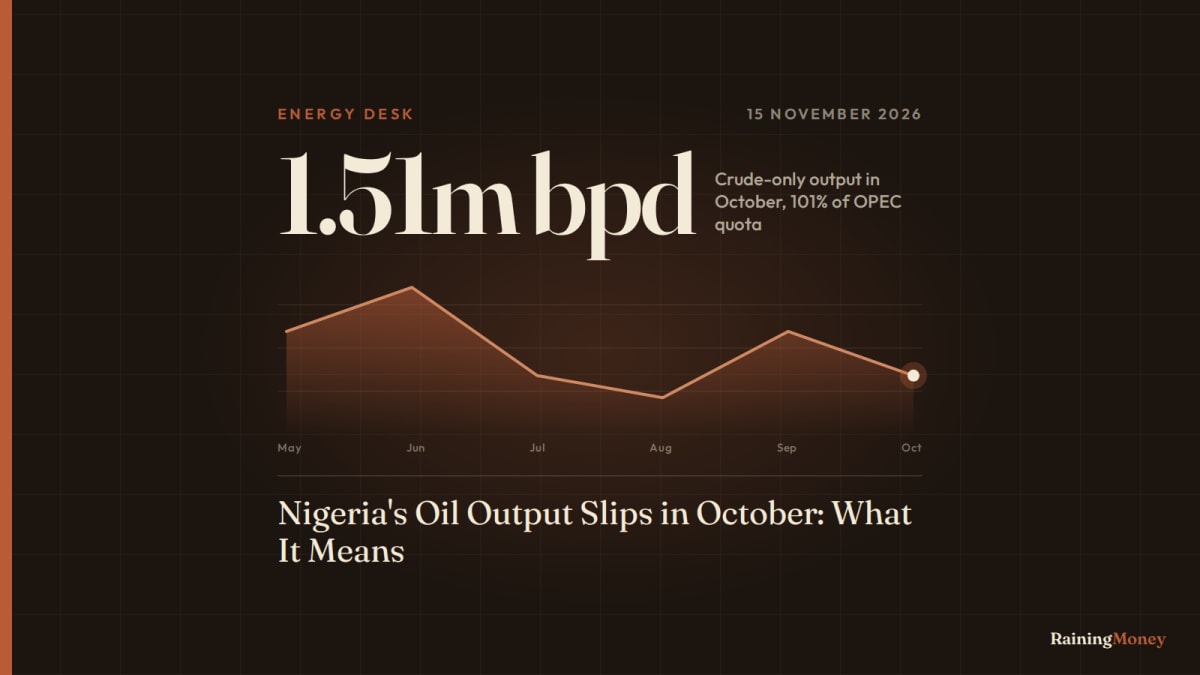
Crude oil on its own averaged about 1.51 million bpd. That is just above the 1.5 million bpd ceiling Nigeria agreed with the Organization of the Petroleum Exporting Countries (OPEC), the producers' group it belongs to. October was the sixth month in a row that Nigeria met that quota, a run that began in May.
So the month brought a small dip in total output and a steady result on the measure OPEC tracks. Below, we answer the questions a reader is likely to ask about what these figures mean for the country and for household money.
What exactly did the regulator report for October?
The NUPRC publishes production data every month. For October it reported:
- Total output, crude plus condensate: 1,687,710 bpd on average, down 1.7% from September.
- Crude only: about 1.51 million bpd, which the regulator put at 101% of the OPEC quota.
- Best day: about 1.79 million barrels.
- Weakest day: about 1.60 million barrels.
The gap between the best and weakest days, about 190,000 barrels (derived: 1.79 million minus 1.60 million), shows how much output can swing within a single month. Pipeline repairs, maintenance at oil fields and problems at export terminals can all cut a day's figure.
The regulator credited the steady performance to better operational stability, more production uptime (the share of time wells and facilities are actually running) and more efficient movement of crude from fields to export terminals.
What is condensate, and why are there two numbers?
Condensate is a very light liquid that comes out of the ground with natural gas. Underground it is a gas; at the surface it cools into a liquid. It can be sold and refined much like crude oil, so it earns money for the country.
OPEC's quotas cover crude oil only, so condensate is left out when Nigeria's compliance is measured. That is why the regulator reports two figures. The total, about 1.69 million bpd, tells you how much oil-type liquid the country produced. The crude-only figure, about 1.51 million bpd, tells you how Nigeria did against its OPEC commitment.
Taking one from the other, condensate came to roughly 180,000 bpd in October (derived: 1.69 million minus 1.51 million; the regulator's crude-only figure is rounded, so this is an estimate).
How does October compare with recent months?
| Month | Crude only | Crude plus condensate |
|---|---|---|
| May | 1.53 | Not compared here |
| June | 1.55 | Not compared here |
| July | 1.51 | Not compared here |
| August | 1.50 | 1.68 |
| September | 1.53 | 1.71 or 1.72 |
| October | 1.51 | 1.69 |
Crude-only output has stayed in a tight band of 1.50 million to 1.55 million bpd since May. August was the closest call, at 1,500,190 bpd, barely at the quota line. October's 1.51 million bpd sits in the middle of the range.
Reports of September's total differ slightly, with one putting it at 1.71 million bpd and another at 1.72 million bpd. Either way, October's 1.69 million bpd was a modest step down.
Where does the oil come from?
Nigeria's oil leaves the country through export terminals, and each terminal collects output from a group of fields. In October, Forcados led with about 318,490 bpd, followed by Bonny at about 311,020 bpd. Qua Iboe handled about 173,970 bpd, Escravos about 134,670 bpd and the offshore Bonga field about 106,650 bpd.
In August the order at the top was reversed: Bonny produced about 320,040 bpd and Forcados about 317,400 bpd. Small shifts like this are common, because a fault or repair at one pipeline or terminal moves the monthly ranking.
Why does oil output matter for government revenue?
Oil remains a major source of money for all three tiers of government. Revenue from oil sales, royalties and taxes goes into the Federation Account. Each month the Federation Account Allocation Committee (FAAC) shares that pool, along with other revenue such as value added tax, among the federal government, the 36 states and the local government councils.
From January to August 2026, the three tiers shared ₦17.12tn through FAAC. The largest single allocation this year, ₦2.76tn, was paid in August from July revenue. More barrels sold at good prices usually mean a bigger pool to share, and fewer barrels mean a smaller one, although taxes, costs and timing also affect what arrives each month.
Your state's salaries, road projects and local services depend partly on these allocations, which is why a few thousand barrels a day matter outside the oil industry.
How does output compare with the budget's target?
The 2026 budget proposal presented in December 2025 assumed production of 1.84 million bpd, a figure that includes condensate. It also assumed an oil price of $64.85 a barrel and an exchange rate of ₦1,400 to the dollar.
October's total of about 1.69 million bpd was roughly 150,000 bpd short of that target, or about 8% below it (derived: 1.84 million minus 1.69 million, divided by 1.84 million). Production has fallen short of the budget assumption in every month from May to October.
Prices have helped make up the gap. In early November, Brent crude, the international benchmark that Nigerian grades are priced against, fell below $90 a barrel for the first time since August, as hopes rose for an end to the Middle East conflict. Even at that level, it was well above the budget's $64.85 assumption.
RainingMoney's reading: higher-than-planned prices have cushioned the shortfall in volume this year, but prices can fall quickly, as early November showed. Hitting the production target would make government revenue less dependent on the price of a barrel.
What does this mean for the naira and the reserves?
Crude oil exports earned Nigeria $31.54B in 2025, according to CBN data, down 14.41% from 2024. Dollars from oil sales build up the external reserves, the foreign currency the Central Bank of Nigeria (CBN) holds, which it can use to steady the naira and pay for imports.
CBN data show reserves rose by about $295.35M in October to $55.22B on 30 October, the smallest monthly increase this year. Over the same month, the naira weakened from ₦1,329.50 to ₦1,346 per dollar. Many things move the currency, including import demand and investor flows, so the oil figures are one part of the picture.
RainingMoney's reading: a small dip in output is unlikely on its own to move the naira much. A long run of lower production, or a sharp fall in prices, would reduce the dollars coming in and could make the currency harder to support.
What do forecasts say about the rest of the year?
The Dangote Group has projected that Nigeria's output could reach 1.72 million bpd in the fourth quarter of 2026 and average 1.62 million bpd for the full year. These are projections, and October's figures will be the first test of the fourth-quarter estimate.
The global backdrop is less supportive. OPEC has cut its forecast for growth in world oil demand in 2026 by more than 70%, from 1.4 million bpd to 400,000 bpd. Weaker demand growth can weigh on prices, which would make each barrel Nigeria produces worth less.
What should we watch next?
- The regulator's November figures, and whether crude-only output stays above the 1.5 million bpd quota for a seventh month.
- Whether total output moves toward the 1.72 million bpd fourth-quarter projection or stays near 1.69 million.
- The next FAAC allocations, which will reflect recent oil revenue.
- Oil prices, after the sharp swings of early November.
Sources & Verification
- Sources: BusinessDay, Nairametrics
- Editorial note: This explainer is an original RainingMoney adaptation of the report, RainingMoney has added explanatory context.

Correspondent, AbujaAbuja
Janefrances Neche
Janefrances is a finance correspondent specializing in emerging markets, consumer economics, and policy analysis. Most recently reporting for regional business desks, she has tracked shifting…
Author profile & archive →The Money Print
Market intelligence before the market opens.
Pan-African capital flows and the stories behind the numbers, on weekday mornings.