TechnologyMedium
Cassava Seeks $1B for Nvidia Chips to Power Africa's AI
Strive Masiyiwa's Cassava wants up to $1B to buy Nvidia chips for African data centres. What it means for Nigerian banks, fintechs and Africa's AI gap.
By Betini Udom Published 5 min read Editorial Policy Report a correction
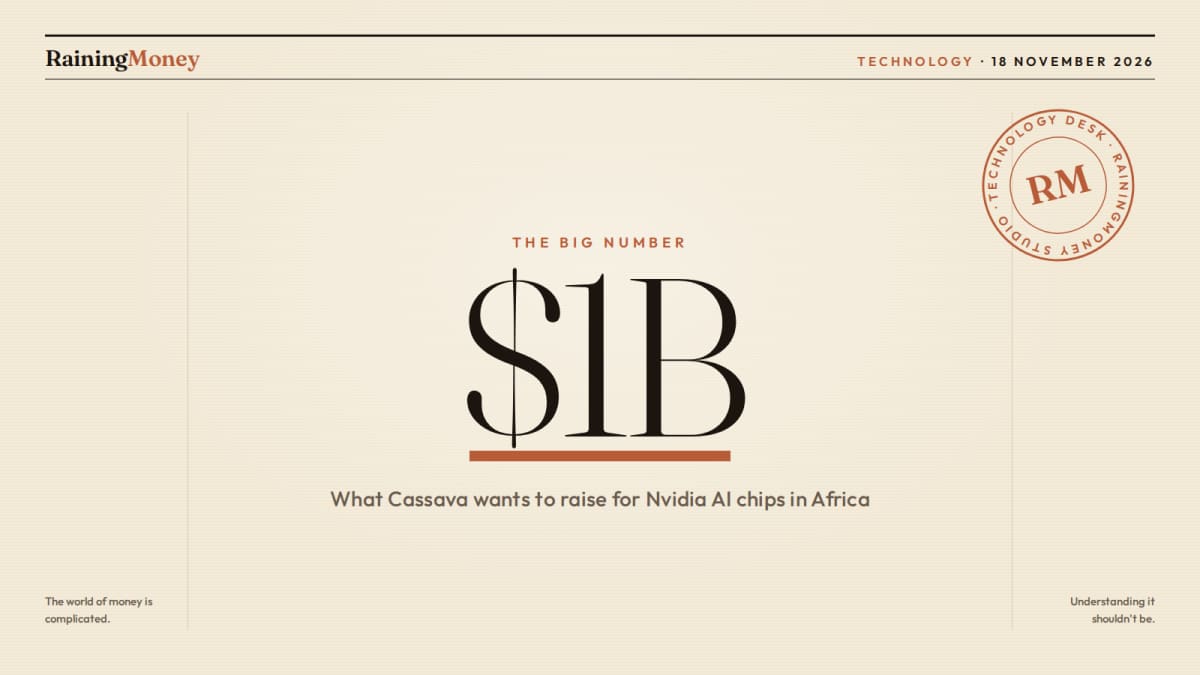
Cassava Technologies, the pan-African technology group founded by Zimbabwean billionaire Strive Masiyiwa, is trying to raise as much as $1B to buy Nvidia computer chips for artificial intelligence (AI) across Africa. People familiar with the plan say the company is in talks with investors in the Middle East and the United States. The talks are still going on and there is no guarantee a deal will close.
Most of the money would buy chips for data centres across the continent. The rest would upgrade Cassava's fibre and data-centre networks so they can handle AI work.
What is Cassava, and what does it want to build?
Cassava is one of Africa's biggest technology groups. It builds the physical plumbing of the internet: fibre-optic cables that carry data, and data centres, the large secure buildings full of servers that store and process information for banks, telecoms companies, startups and governments.
In March 2025, Cassava announced plans for what it called Africa's first "AI factory": a data centre fitted with Nvidia's chips and software that would rent out computing power to businesses, a model known as AI as a Service. The first stage was set for its South African data centres by June 2025, followed by its sites in Egypt, Kenya, Morocco and Nigeria. Nvidia later became a shareholder in Cassava, though the size of that investment was not disclosed.
The new target is bigger than the earlier plan. The AI factory tie-up with Nvidia was put at a cost of as much as $720M in 2025.
Derived: $1B is about 39% more than $720M (1,000 ÷ 720 = 1.39).
Why does AI need special chips?
Training and running AI tools, from chatbots to fraud-detection systems at banks, takes huge amounts of calculation. The chips that do this best are graphics processing units, or GPUs, and Nvidia is the leading maker. They are expensive and in high demand worldwide, so companies that want them usually need large sums of money up front.
Without nearby GPUs, an African company that wants to build or run AI has to rent computing power from data centres in Europe, the United States or Asia. That usually means paying in dollars, sending data abroad and waiting longer for results.
How far behind is Africa?
The gap is large. Africa has about 360 megawatts (MW) of active data-centre capacity, roughly 0.6% of the world's total, according to the Africa Data Centres Association's 2026 report, even though the continent is home to around a fifth of the world's people. Another 238 MW is under construction and 656 MW is planned, but the association expects that build-out only to keep Africa's share where it is.
| Stage | Capacity |
|---|---|
| Active | about 360 MW (0.6% of global) |
| Under construction | 238 MW |
| In the development pipeline | 656 MW |
A megawatt here measures how much electricity a data centre can draw, which is a rough guide to how many servers it can run. Power is now the main limit on the industry in Africa, ahead of internet connections, the association says.
The International Monetary Fund (IMF) found in a July 2026 report that only about 5% of Africa's AI researchers and engineers have reliable access to the high-performance computing they need.
What does this have to do with Nigeria?
Nigeria is one of the four countries where Africa's data-centre capacity is concentrated, alongside South Africa, Kenya and Egypt, and it was named in Cassava's original rollout plan. Reports from an industry event earlier this year said Cassava had acquired 12,000 Nvidia GPUs for use across five African markets. That figure has not been confirmed by the company and should be treated as unconfirmed.
Demand for local computing in Nigeria is also set to rise for a separate reason. From 1 January 2027, the Central Bank of Nigeria (CBN) requires banks, fintechs and other payment companies to store payment data generated in Nigeria on servers inside the country. That rule pushes more of the financial sector's data into local data centres.
RainingMoney's reading: if Cassava raises the money and spreads GPUs to its Nigerian sites, Nigerian banks, fintechs and startups could rent AI computing power closer to home. That could cut some of the dollar costs of paying foreign cloud providers, at a time when the naira is under pressure. None of the reports so far says how much of the new money, if any, would go to Nigeria.
What could stand in the way?
- The deal is not done. The talks are at an early stage, and the investors have not been named publicly.
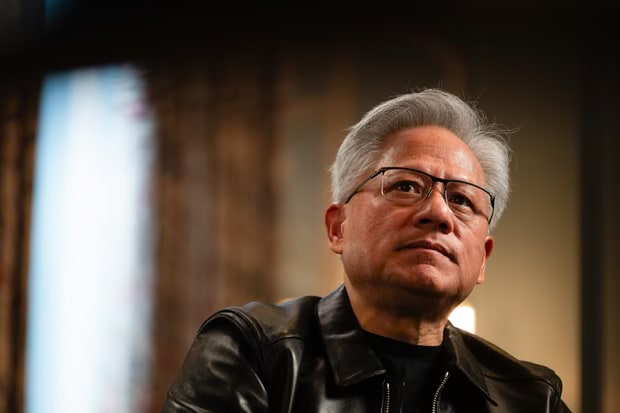
- Leadership change at Nvidia. Jensen Huang, who built Nvidia into the world's leading AI chipmaker, has stepped down as chief executive. Industry observers say it is too early to tell how that will affect Nvidia's partnership with Cassava.
- Electricity. GPUs use a lot of power. In parts of East and West Africa, an estimated 18% to 25% of electricity is lost in transmission and distribution, against a global average of roughly 7% to 8%.
Who else is chasing AI investment in Africa?
Governments are joining in. South African President Cyril Ramaphosa is in California this week leading a delegation of more than 300 people looking for investment and know-how in AI.
For ordinary Nigerians, the effect would be indirect but real: faster and cheaper AI services at banks and apps, and more local technology jobs, if the computing power arrives. For now, the $1B is a target, not money in the bank.
Sources & Verification
- Sources: Semafor Africa
- Editorial note: This explainer is an original RainingMoney adaptation of the report, RainingMoney has added explanatory context.

Founder and Editor-in-ChiefAbuja
Betini Udom
Founder and Editor-in-Chief of RainingMoney. Covers Nigerian, pan-African and global markets, finance and economic policy.
Author profile & archive →The Money Print
Market intelligence before the market opens.
Pan-African capital flows and the stories behind the numbers, on weekday mornings.