CompaniesMedium
Dangote Cement Drops 9.99% Again, Wiping ₦2.27tn Off NGX
Dangote Cement hit its daily limit down for the second time in two weeks, closing at ₦1,323. Why one stock moves the whole NGX and what the swings tell us.
By Chiamaka Prudence Published 5 min read Editorial Policy Report a correction
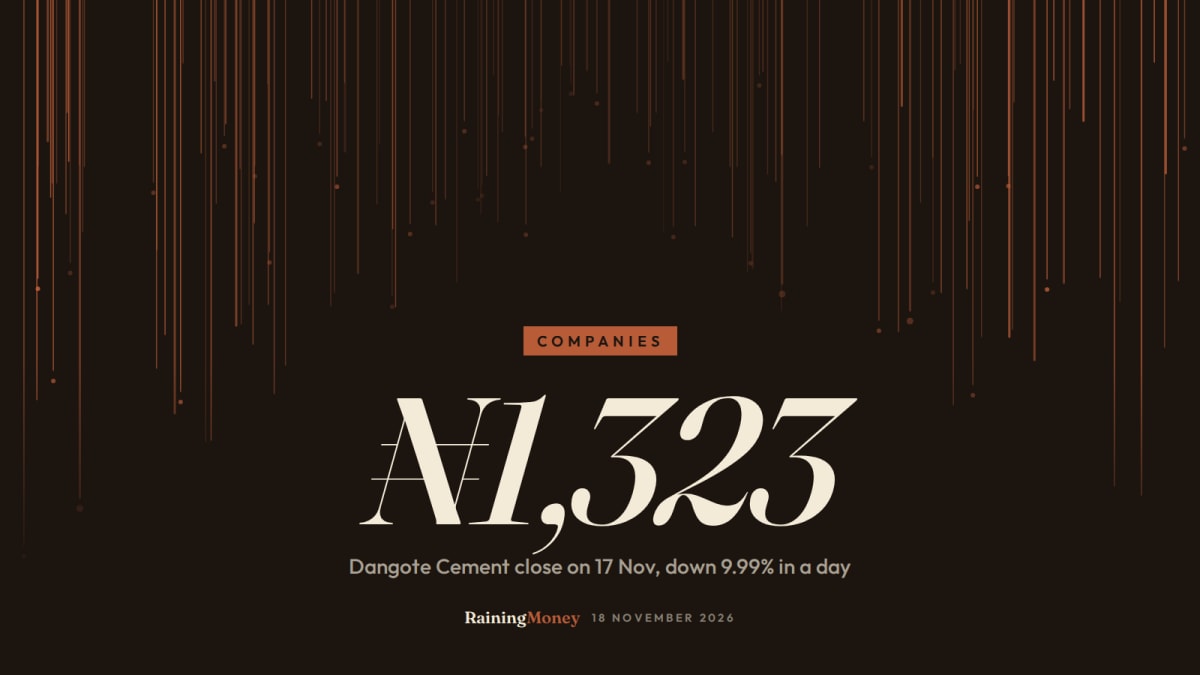
Shares in Dangote Cement Plc fell by the maximum amount allowed in a single day on Tuesday, 17 November 2026, for the second time in under two weeks. The stock closed at ₦1,323.00, down 9.99% from ₦1,469.90. Because Dangote Cement is one of the largest companies on the Nigerian Exchange (NGX), the fall dragged the whole market down: the NGX All-Share Index (ASI) lost 1.38% to 249,318.65 points, and the total value of listed shares fell by ₦2.27tn in one session.
The company gave no reason for Tuesday's drop, and no explanation had been published by the time of writing. It comes a week after Dangote Cement called off a planned share sale and listing in London, and after a month of unusually sharp swings in its price.
What happened on Tuesday?
Total market capitalisation, the combined value of every listed share, fell to ₦161.88tn from ₦164.15tn. Dangote Cement, valued at more than ₦22.32tn before the fall, was the biggest drag. The NGX Industrial Index, which tracks cement and building-materials companies, fell to 11,699.02 from 12,454.93, the sharpest move of any sector index. The NGX 30 and Premium indices, which hold the largest companies, also fell.
Elsewhere the picture was mixed. Big banks slipped slightly: Zenith Bank fell 0.86%, Guaranty Trust Holding Company 0.68% and Access Holdings 0.37%. Cadbury Nigeria rose 10.00% to ₦62.70, and Dangote Sugar Refinery gained 5.91% to ₦69.00. Trading volume fell 16.26% to 564.04 million shares across 30,992 deals.
Why can a share only fall 9.99% in a day?
The NGX limits how far a share can move in one session. For a stock like Dangote Cement, that cap is 10%, and a fall of 9.99% means the price hit the floor. Sellers who wanted out at lower prices simply could not trade below that level until the next day. RainingMoney's reading: hitting the limit tells you selling pressure was heavy, but it does not tell you how much further sellers would have pushed the price without the cap.
How wild has November been for the stock?
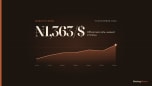
Very. Here are the closing prices on the key days, from the market reports.
| Date | Close | Move |
|---|---|---|
| Start of 2026 | ₦609 | |
| Wednesday, 4 November | ₦1,490 | |
| Thursday, 5 November | ₦1,341 | down 10% |
| Monday, 9 November | ₦1,469.90 | up 9.61% |
| Monday, 16 November | ₦1,469.90 | |
| Tuesday, 17 November | ₦1,323.00 | down 9.99% |
On 5 November the stock fell 10% to ₦1,341 from ₦1,490. That wiped an estimated ₦2.5tn off the company's value, roughly three-quarters of the ₦3.28tn the whole market lost that day. Two trading days later, on 9 November, it bounced 9.61% back to ₦1,469.90. Tuesday's fall took it back below the 5 November low.
Even after the drop, the shares are far above where they began the year. At ₦1,323 they are about 117% higher than the ₦609 they started 2026 at (derived: ₦1,323 divided by ₦609 is 2.17). In the four weeks before 10 November the stock had gained about 38%, and as of 9 November its gain for the year was about 141%.
What did the London decision change?
On 10 November, Dangote Cement told the NGX that it and its parent, Dangote Industries Limited (DIL), "will not proceed with the proposed secondary listing and offering on the London Stock Exchange at this time." The notice, signed by company secretary Edward Imoedemhe, cited "current market conditions and the Company's strategic priorities." It gave no new timetable.
The plan had been well advanced. Shareholders had approved it, the company hosted investors at a capital markets day in London on 21 September, and Goldman Sachs and UBS were expected to run the sale. About 10% of the shares were to be offered to outside investors, raising an estimated $1B. Importantly, this would have been a sale of existing shares by DIL, so the money would have gone to the parent, not into the cement company.
Press reports linked the decision to market turbulence after the United States midterm elections. The company has not said more. The shares remain listed on the NGX, and the company says its operations and business plans are unaffected.
Why does one company move the whole market?
The ASI is weighted by size. A company worth more than ₦22tn makes up a large share of the index, so when its price falls 10%, the index falls even if most other shares are flat. That is why Tuesday's loss of ₦2.27tn looks huge while bank shares barely moved. It also means the ASI can give a misleading picture of how the average listed company is doing. Market reports have noted that heavyweight stocks can set the market's direction in a year when the index has gained around 60%.
What does it mean for ordinary investors?
Many Nigerians hold Dangote Cement directly, and many more own it indirectly through pension funds and mutual funds, which hold large companies. A 10% daily fall reduces the value of those holdings on paper. It is a loss only for those who sell at the lower price.
The swings also show the risk of concentration. When one stock carries so much weight, its moves can drown out everything else in a portfolio or an index fund. This article does not tell you whether to buy, sell or hold the shares.
What isn't known yet?
- Who sold on Tuesday and why. No company statement or regulatory filing explained the fall.
- Whether the selling is profit-taking after this year's large gain or a reaction to the dropped London listing.
- When, or whether, Dangote Cement will revisit a London listing.
- How the stock will trade once the Dangote refinery's shares list on the NGX, which could draw money away from other large companies.
Sources & Verification
- Sources: Nairametrics
- Editorial note: This explainer is an original RainingMoney adaptation of the report, RainingMoney has added explanatory context.

Correspondent, OnitshaOnitsha
Chiamaka Prudence
I am a technology and finance enthusiast with a keen interest in digital innovation, emerging financial trends, and the evolving ways technology is shaping businesses and everyday life. I enjoy…
Author profile & archive →The Money Print
Market intelligence before the market opens.
Pan-African capital flows and the stories behind the numbers, on weekday mornings.