CompaniesMedium
First HoldCo Tops Nigeria's Bank Profit Table for 9M 2026
First HoldCo earned ₦744.61bn to lead Nigeria's most profitable banks in nine months, as the top ten made ₦4.52tn. Who gained, who slipped and what it means.
By Chiamaka Prudence Published 5 min read Editorial Policy Report a correction
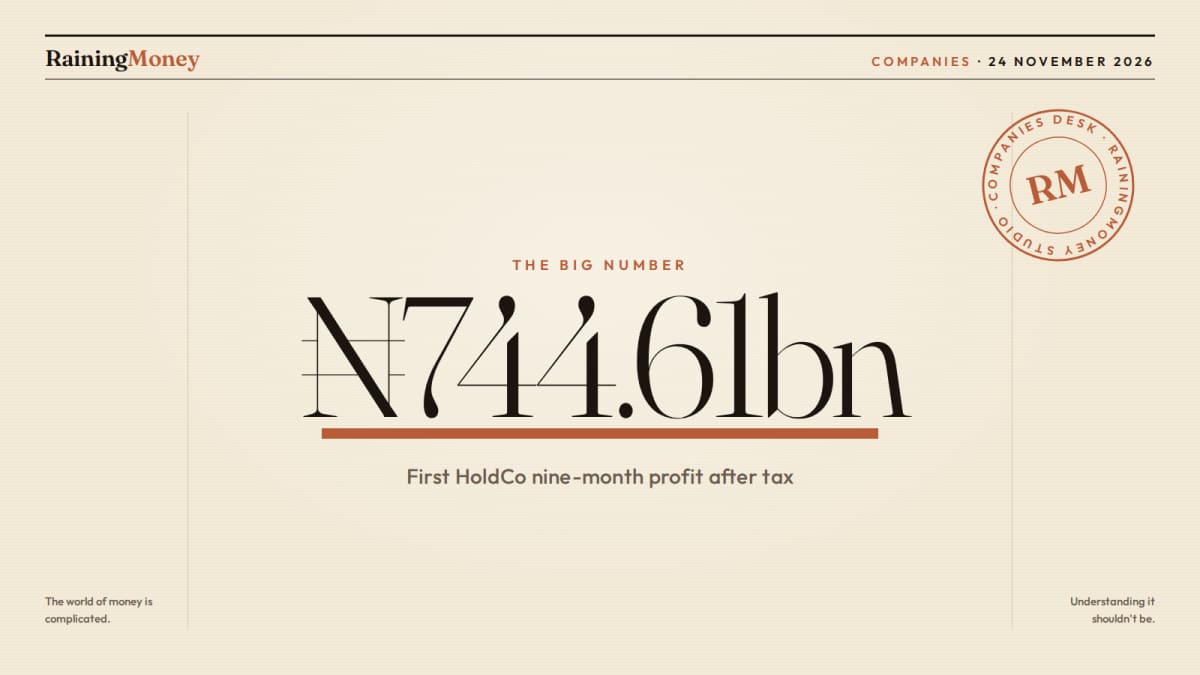
First HoldCo, the parent of First Bank of Nigeria, was the most profitable listed banking group in Nigeria in the first nine months of 2026, with profit after tax of ₦744.61bn. Ecobank Transnational came second with ₦707.41bn and Zenith Bank third with ₦675.48bn, according to a ranking built from the banks' results for the nine months to 30 September.
Together, the ten most profitable banks made about ₦4.52tn after tax, up 7.23% from ₦4.21tn a year earlier. Six of the ten grew their profit and four saw it fall, and the reasons behind those moves say a lot about how banks are making money now.
Who made the most money?
| Rank | Bank | 9M 2026 | 9M 2025 | Change |
|---|---|---|---|---|
| 1 | First HoldCo | ₦744.61bn | ₦458.08bn | +62.55% |
| 2 | Ecobank Transnational | ₦707.41bn | ₦711.92bn | -0.63% |
| 3 | Zenith Bank | ₦675.48bn | ₦764.20bn | -11.61% |
| 4 | GTCO | ₦614.57bn | ₦699.64bn | -12.16% |
| 5 | Access Holdings | ₦474.17bn | ₦447.55bn | +5.95% |
| 6 | UBA | ₦401.60bn | ₦537.53bn | -25.29% |
| 7 | Stanbic IBTC | ₦370.36bn | ₦277.71bn | +33.36% |
| 8 | FCMB Group | ₦232.91bn | ₦125.45bn | +85.66% |
| 9 | Wema Bank | ₦219.84bn | ₦127.41bn | +72.55% |
| 10 | Sterling Financial | ₦75.37bn | ₦62.30bn | +20.98% |
Profit after tax is what is left from a bank's income once it has paid its staff and running costs, set money aside for loans that may go bad, and paid tax. It is the pool from which dividends are paid.
The top three alone made about ₦2.13tn, or 47.1% of the ten banks' combined profit. Jaiz Bank, a non-interest bank, came eleventh with ₦23.28bn, roughly the same as a year earlier.
Why did First HoldCo jump to the top?
First HoldCo added about ₦286.53bn to its profit, the biggest rise of any bank in the list. Its income from interest on loans and securities actually fell, by 16% to ₦1.26tn. What made the difference was everything else.
- Its non-interest income, which covers fees, trading and gains on investments, rose 143.5% to ₦722.9bn.
- Net fees and commissions alone rose 48.1% to ₦316.43bn.
- The money it set aside for bad loans (impairment charges) fell 28.3% to ₦207.1bn.
- Its operating costs fell 8.1% to ₦866.6bn.
Its cost-to-income ratio, which shows how much of each naira of income goes on running the bank, improved to 43.7% from 52.4%.
Why did Zenith, GTCO and UBA earn less?
The three groups slipped for different reasons.
Zenith Bank set aside far less for bad loans: its impairment charges fell 70.5% to ₦230.77bn. But its trading income swung from a gain of ₦277.65bn a year earlier to a loss of ₦229.19bn, and its operating costs rose 18.4% to ₦1.02tn.
GTCO also had lower bad-loan charges, down 58.4% to ₦29.02bn. Its profit before tax fell only 2.3%, to ₦879.90bn, but its tax bill rose 31.9% to ₦265.32bn, and its interest costs rose 27.7%. That pulled profit after tax down 12.16%.
UBA went the other way on bad loans. Its total impairment charges jumped to ₦272.12bn from ₦56.89bn, with loan impairments alone rising to ₦255.09bn from ₦46.11bn. That outweighed a 48.8% rise in non-interest income to ₦477.25bn.
Which bank made the most of what it has?
The biggest profit is not the same as the best return. Two common measures adjust for size: return on average assets (profit compared with everything the bank owns, including its loans and securities) and return on average equity (profit compared with the shareholders' money in the business).
On both, Stanbic IBTC came first, with a return on average assets of 5.36% and a return on average equity of 38.56%, helped by a jump in trading revenue to ₦210.13bn from ₦23.86bn. Access Holdings had the lowest return on assets at 1.10%, and UBA the lowest return on equity at 12.03%.
RainingMoney's reading: the spread between the most and least efficient banks shows that size alone does not decide returns. Access Holdings, with total assets of ₦52.60tn, is one of the largest groups on the list, yet it earned the least per naira of assets.
How did the biggest five do together?
A separate tally of the five largest groups (First HoldCo, Zenith, GTCO, Access and UBA) puts their combined profit after tax at ₦2.91tn, up just 0.4% from ₦2.90tn a year earlier. In other words, almost all the growth among the big five came from First HoldCo and Access, while the other three gave ground.
Lower bad-loan charges were the common thread for four of the five; UBA was the exception.
What does this mean for customers and shareholders?
For customers, a bank's profit does not directly change its loan or deposit rates. RainingMoney's reading: strong earnings add to the capital banks hold to absorb shocks, which supports confidence in the system.
For shareholders, profit is the source of dividends, but share prices have already moved a lot. The banks' shares have generally fallen since the results came out, with First HoldCo down 27% over that time even though it topped the table. Over the year as a whole the picture is different: First HoldCo's share price has risen to ₦119.15 from ₦47.90, a gain of 148.75%. The NGX Banking Index, which tracks listed bank shares, fell 1.93% to 2,299.75 points on the last trading Friday, though it was still up 68.02% over the year.
What we don't know yet is how the full-year picture will look. These are nine-month figures, Fidelity Bank's numbers are missing from the ranking, and fourth-quarter results will show whether lower bad-loan charges and fee income can keep carrying profits.
Sources & Verification
- Sources: Nairametrics
- Editorial note: This explainer is an original RainingMoney adaptation of the report, RainingMoney has added explanatory context.

Correspondent, OnitshaOnitsha
Chiamaka Prudence
I am a technology and finance enthusiast with a keen interest in digital innovation, emerging financial trends, and the evolving ways technology is shaping businesses and everyday life. I enjoy…
Author profile & archive →The Money Print
Market intelligence before the market opens.
Pan-African capital flows and the stories behind the numbers, on weekday mornings.