MarketsMedium
NGX Group Buys 10% of Nairobi Exchange: What It Means
Nigeria's exchange operator has bought 10% of the Nairobi Securities Exchange, its second African bourse stake after Ethiopia. What it does and doesn't change.
By Chiamaka Prudence Published 4 min read Editorial Policy Report a correction
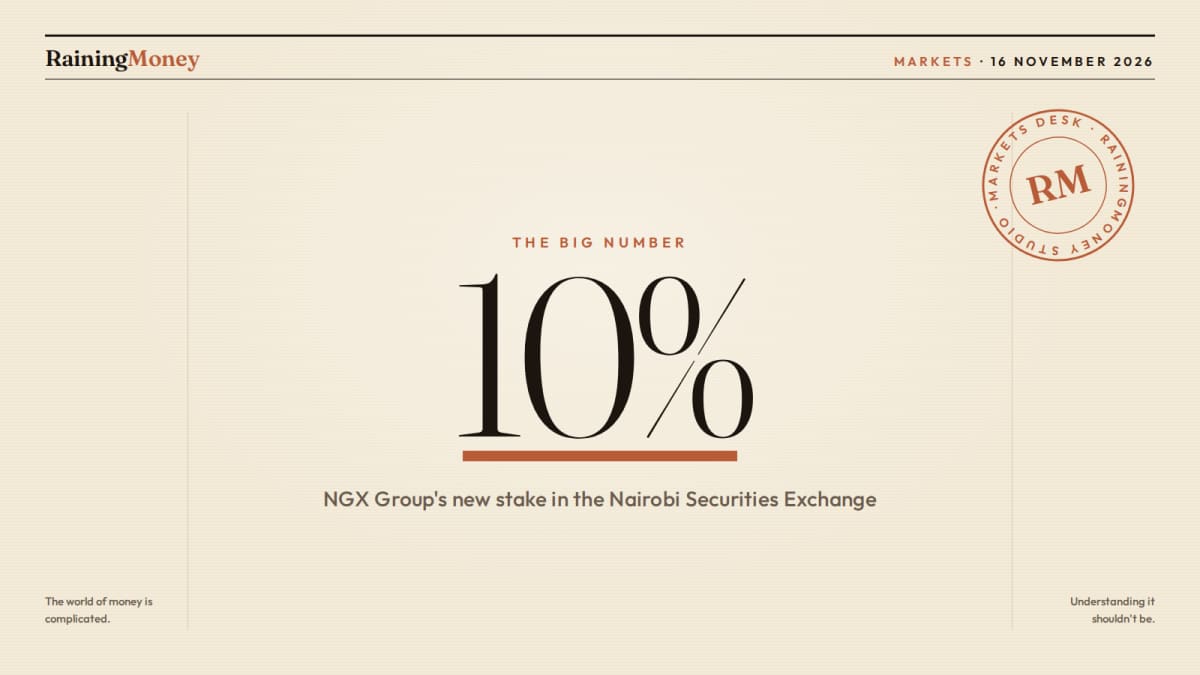
Nigerian Exchange Group Plc (NGX Group), the company that owns and runs Nigeria's stock exchange, has bought a 10% stake in the Nairobi Securities Exchange (NSE) in Kenya. The group announced the deal on Monday, 16 November 2026. It did not say how much it paid or who sold the shares.
The purchase is NGX Group's second investment in another African exchange, after the Ethiopian Securities Exchange (ESX) in 2024. It turns a West African market operator into a part-owner of one of East Africa's most established markets.
What exactly did NGX Group buy?
A stock exchange is a business in its own right. It earns fees when shares are listed and traded, and it can be owned by shareholders like any other company. NGX Group is itself a listed company, with its own shares traded on the Nigerian Exchange.
With this deal, NGX Group now owns one in every ten shares of the Nairobi exchange. That makes it a minority shareholder: it shares in the exchange's profits through dividends and in any rise in its value, but it does not control it. The group described the stake as a strategic equity investment.
Why is NGX Group doing this?
The group set out three aims: linking African markets more closely, earning money from outside Nigeria, and creating value for its own shareholders by investing carefully.
NGX Group chairman Umaru Kwairanga said African capital markets had reached a turning point, with plans to integrate them moving into concrete form. He described the Nairobi investment as a careful, long-term step to strengthen the financial links between West and East Africa.
Group managing director and chief executive Temi Popoola called Kenya a cornerstone of East Africa's financial system. Popoola said the stake gives the group exposure to Kenya's long-term growth, spreads its sources of income beyond Nigeria, and gives existing cooperation between the two markets a more lasting footing.
Has NGX Group done this before?
Yes. In April 2024 it bought a stake in the Ethiopian Securities Exchange when the new bourse raised its first capital. At the time the stake was reported at 5%, with the possibility of rising to 10% on board approval. NGX Group invested alongside FSD Africa and the Trade and Development Bank Group, and it did not disclose that price either. Temi Popoola joined the ESX board as NGX Group's nominee.
The Nairobi stake follows the same pattern: a minority holding, an undisclosed price, and a stated aim of tying African markets together.
Can NGX Group afford it?
The group is having a strong year. Its profit after tax for the nine months to September 2026 rose 86.44% to ₦14.69bn, from ₦7.88bn a year earlier, according to its unaudited results. Profit before tax rose 83.3% to ₦20.6bn. Nine months in, its profit after tax is already about 40% above its full-year 2025 figure of ₦10.5bn.
Most of that growth came from transaction fees, the money it earns when investors buy and sell shares. Those fees rose 112.39% to ₦20.68bn, from ₦9.74bn.
RainingMoney's reading: that dependence on Nigerian trading volumes is part of the reason for the deal. When the Nigerian market is busy, fees rise; when it is quiet, they fall. Owning part of exchanges in Kenya and Ethiopia gives the group income that does not move only with Lagos trading.
| Measure | 9M 2025 | 9M 2026 |
|---|---|---|
| Profit after tax | ₦7.88bn | ₦14.69bn |
| Profit before tax | ₦11.2bn | ₦20.6bn |
| Transaction fees | ₦9.74bn | ₦20.68bn |
What does it mean for ordinary investors?
For now, very little changes day to day. A Nigerian investor cannot suddenly buy Kenyan shares through a Lagos broker because of this deal, and a Kenyan investor cannot buy Nigerian shares through Nairobi. The stake is about ownership, and it does not merge the two markets or their trading systems.
Over time, closer ties between exchanges can make it easier for companies to list in more than one market, and for investors to reach shares across borders. NGX Group's leaders present the stake as a step in that direction. Whether it leads to shared listings or easier cross-border trading has not been announced.
For NGX Group's own shareholders, the effect depends on what the stake cost and what the Nairobi exchange earns. Neither the price nor the expected return has been made public, so it is not possible to judge yet whether the deal was good value.
What isn't known yet?
- The price. NGX Group did not disclose what it paid.
- The seller. The announcement did not say whose shares NGX Group bought.
- Board seats and approvals. It is not yet clear whether NGX Group will nominate a director in Nairobi, as it did in Ethiopia, or what regulatory approvals the deal needed.
Those details may come in the group's full-year accounts or in later filings. For now, the clearest signal is direction: Nigeria's exchange operator is using a year of strong profits to buy into other African markets, and it now has a foothold in both Ethiopia and Kenya.
Sources & Verification
- Source: BusinessDay
- Editorial note: This explainer is an original RainingMoney adaptation of the report, RainingMoney has added explanatory context.

Correspondent, OnitshaOnitsha
Chiamaka Prudence
I am a technology and finance enthusiast with a keen interest in digital innovation, emerging financial trends, and the evolving ways technology is shaping businesses and everyday life. I enjoy…
Author profile & archive →The Money Print
Market intelligence before the market opens.
Pan-African capital flows and the stories behind the numbers, on weekday mornings.