MarketsMedium
Naira Slides to ₦1,445/$ on Street as Festive Demand Builds
The naira fell to ₦1,445 per dollar in the parallel market, a 10-month low, while the official rate held near ₦1,358. Why the gap is widening, and what next.
By RainingMoney Desk Published 4 min read Editorial Policy Report a correction
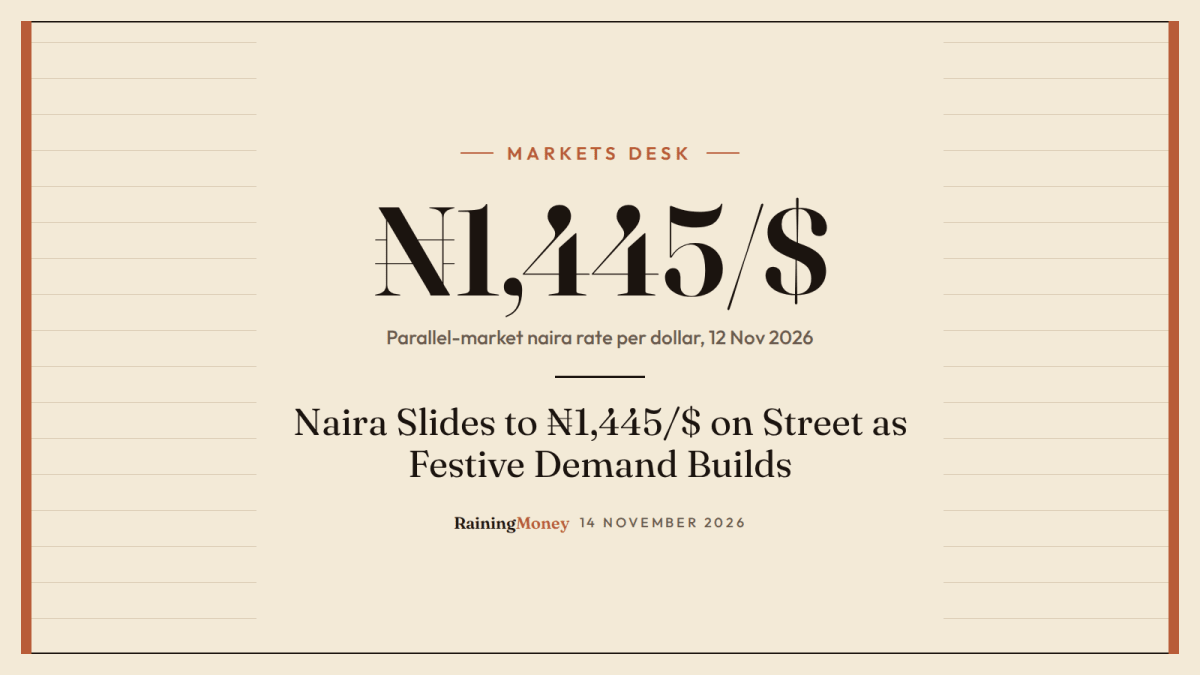
The naira weakened to ₦1,445 per dollar in Nigeria's parallel market on Thursday, 12 November 2026, down from ₦1,430 a day earlier, according to quotes from bureau de change (BDC) operators in Abuja. On the official market the naira moved the other way, closing at ₦1,358.50 per dollar, stronger than ₦1,364 the day before. The gap between the two rates widened to ₦86.50.
Traders blamed the street-market slide mainly on people buying dollars ahead of the festive season.
What are the two exchange rates?
Nigeria has two places where people swap naira for dollars. The official market, called the Nigerian Foreign Exchange Market (NFEM), is where banks and large companies trade. The Central Bank of Nigeria (CBN) publishes its rates daily. The parallel market, sometimes called the black market, is made up of BDC operators and street traders who sell cash dollars to individuals and small businesses.
When dollars are easy to get through banks, the two rates stay close. When people can't get what they need officially, or want cash quickly, they turn to the street, and the parallel rate rises.
How fast has the street rate moved?
The naira hit a 10-month low of ₦1,430 per dollar in the parallel market on Wednesday, 11 November, after ₦1,410 on Monday and ₦1,425 on Tuesday, according to dealer quotes. It then slipped to ₦1,445 on Thursday.
| Day | Parallel market | Official (NFEM) close |
|---|---|---|
| Monday, 9 Nov | ₦1,410 | ₦1,349.34 |
| Tuesday, 10 Nov | ₦1,425 | ₦1,350.86 |
| Wednesday, 11 Nov | ₦1,430 | ₦1,364 |
| Thursday, 12 Nov | ₦1,445 | ₦1,358.50 |
Over those four days the street rate weakened by ₦35 (derived: ₦1,445 − ₦1,410), about 2.5%. The official rate weakened by about ₦9 over the same period (derived: ₦1,358.50 − ₦1,349.34). On Monday the gap between the two was about ₦66 per dollar. By Thursday it was ₦86.50.
Parallel-market quotes vary by city and by hour, and different dealers gave slightly different numbers. The figures above are the ones dealers gave on each day.
What is driving the street-market demand?
BDC operators and currency traders pointed to seasonal demand. In the weeks before Christmas, families and businesses buy dollars for travel, school fees abroad and imported goods. One trader said spending linked to the 2027 elections could add further pressure.
Quest Merchant Bank said the naira lost about 1.2% against the dollar on the official market in October, ending the month around ₦1,346. It linked that to stronger seasonal demand and to foreign portfolio investors, overseas buyers of Nigerian bonds and shares, taking money out.
Earlier reporting has also tied swings in the parallel rate to leakages in public spending, speculation and arbitrage, which is buying dollars at one price and selling them at another for profit.
Why hasn't the official rate fallen as much?
The CBN has a large cushion. Gross external reserves, the country's stock of foreign currency, stood at $54.93bn on 9 November 2026, according to central bank data. That was down $330M from a record $55.26bn on 27 October, but still about 26.65% higher than a year earlier.
Gross reserves rose by about $295M in October, the slowest monthly increase this year. Quest Merchant Bank said reserves have grown by about $9.7bn since January, helped by higher crude prices, better oil output, steady remittances from Nigerians abroad and access to foreign borrowing. It said reserves can cover about 15.8 months of goods imports.
RainingMoney's reading: with reserves this large, the official market has enough dollars to meet big buyers. The street market serves people who can't easily use the official window, so it reacts faster to short bursts of cash demand, such as the end-of-year rush.
What does this tell us, and what doesn't it?
It tells us demand for cash dollars is rising faster than supply on the street. It does not, on its own, signal a crisis. The official rate has stayed within a narrow band, and reserves remain near record levels.
What would change the picture is if the pressure spread to the official market. Quest Merchant Bank has warned that seasonal demand could weigh on the naira in the near term, while expecting reserves to keep rising to year-end.
What does this mean for my money?
- If you buy dollars from BDCs: each dollar costs more this week than last. At ₦1,445, $1,000 costs ₦1.445M, about ₦35,000 more than at Monday's ₦1,410 (derived).
- Prices of imported goods: traders who price goods using the street rate may pass on higher costs, especially for items bought for the festive season.
- Dollar earnings: people paid in dollars, or receiving remittances, get more naira for each dollar they sell.
What to watch next
- Whether the gap between the two rates keeps widening through December.
- The CBN's weekly reserves data, for signs that pressure is reaching the official market.
- Foreign portfolio flows, which moved money out in October.
For now, the story is a split market: a steady official rate backed by strong reserves, and a street rate feeling the usual end-of-year squeeze.
Sources & Verification
- Source: BusinessDay
- Editorial note: This explainer is an original RainingMoney adaptation of the report, RainingMoney has added explanatory context.
The Money Print
Market intelligence before the market opens.
Pan-African capital flows and the stories behind the numbers, on weekday mornings.