MarketsHigh
How FirstHoldCo Met the Rigorous Liquidity and Capital Criteria for FTSE’s Elite Benchmark
FirstHoldCo and five other Nigerian firms enter the FTSE Frontier 50 on 21 September as Nigeria regains frontier status. Here is what an index inclusion is and what it changes.
By Betini Udom Published Last edited 6 min read Editorial Policy Report a correction
FirstHoldCo, the holding company that owns First Bank of Nigeria, is joining the FTSE Frontier 50 Index. The index is a list of 50 large companies from smaller, less developed stock markets, compiled by the London-based index provider FTSE Russell. The change takes effect on 21 September 2026.
FirstHoldCo is not alone. Five other Nigerian companies join the same index on the same day: GTCO, Zenith Bank, MTN Nigeria, Dangote Cement and Aradel Holdings. All six are getting in because Nigeria as a whole is being let back into FTSE Russell's family of frontier-market indices, three years after it was thrown out.
Index decisions steer global money and shape how foreign investors see Nigeria. This piece explains what an index inclusion is, why it happened now, what it might mean for FirstHoldCo, and how it connects to the bank recapitalisation that ran from 2024 to 2026.
What is a stock market index, and what does "inclusion" mean?
An index is a rule-based list of shares used to measure a market. FTSE Russell's frontier indices track markets that are investable but smaller and less liquid than "emerging" markets such as South Africa or India.
The FTSE Frontier 50 is built from a wider list, the FTSE Frontier Index. According to FTSE Russell's ground rules, the Frontier 50 holds the 50 largest companies by full market capitalisation (share price times all shares in issue) among that wider index's members. To be in the wider index at all, a share must pass screens such as free float (the portion of shares actually available to trade, not locked up by big owners), foreign ownership limits and liquidity (how easily shares can be bought and sold).
So "inclusion" is not an award. It is the outcome of a rule being applied. Once Nigeria became eligible again, its biggest, most tradeable companies went into the Frontier 50 more or less automatically.
Why was Nigeria out of the index in the first place?
The problem was foreign exchange. From late 2020, foreign investors who sold Nigerian shares often could not convert their naira back into dollars and take the money home. FTSE Russell put Nigeria on its watch list in September 2022. When there was still no material improvement in investors' ability to repatriate capital by August 2023, it moved Nigeria from "Frontier" to "Unclassified" in September 2023.
Since then, foreign-exchange reforms by the Central Bank of Nigeria (CBN) have made it easier for investors to get their money out. Nigeria went back on the watch list in late 2025. FTSE Russell's September 2026 review then confirmed Nigeria's reclassification from Unclassified to Frontier, effective 21 September. Alongside the Frontier 50 changes, 31 Nigerian companies were added to the broader FTSE Frontier index series, split into large, mid and small caps.
Why do passive funds matter here?
A passive fund (an index fund or exchange-traded fund) does not pick shares. It simply buys whatever is in the index it follows, in the same proportions. When a company enters an index, every fund tracking that index has to buy it. When it leaves, they have to sell.
The honest answer on size is that nobody knows yet. Cordros Securities projected $840 million to $1.04 billion of inflows into Nigeria from the return to frontier status. Businessfront, which reported that estimate, argued that local investors still dominate trading on the NGX and that even this figure may prove optimistic. Frontier-market index funds are much smaller than the giant funds tracking developed or emerging markets, so the buying is likely to be modest and gradual.
There was some early movement. BusinessDay reported that FirstHoldCo shares rose 8.1% to ₦160 in the last trading session before the index change, giving it a market value of about ₦7.28 trillion.
What was the CBN recapitalisation, and is it linked?
In March 2024, the CBN told banks to raise their minimum capital sharply: ₦500 billion for commercial banks with international licences, ₦200 billion for national and ₦50 billion for regional banks. Capital is the shareholders' own money in a bank, which absorbs losses before depositors are hurt.
Banks had until 31 March 2026. Only fresh money counted, such as paid-up capital and share premium (the amount investors paid above the shares' face value), and not retained earnings or other reserves. That forced banks to sell new shares, merge or step down to a smaller licence. Vanguard reported that 30 of 35 banks had met the requirement by mid-March 2026.
FirstBank, the group's main subsidiary, needed ₦500 billion. In a filing to the NGX dated 2 January 2026, FirstHoldCo said the bank had met it. It credited a rights issue (new shares offered first to existing shareholders), a private placement (new shares sold to selected investors) and money from selling its merchant bank. That bank, FBNQuest Merchant Bank, was sold to EverQuest Acquisition in late 2025.
RainingMoney's reading: the recapitalisation and the index inclusion are separate events with separate rules. The CBN test was about how much capital a bank holds. FTSE's test is about company size, free float and whether foreigners can trade and repatriate money. The link is indirect. Selling billions of naira of new shares enlarged FirstHoldCo's share base and its market value, and that helps it rank among the 50 largest frontier companies.
What does it mean for FirstHoldCo?
The group comes in with strong recent numbers. For the six months to June 2026, it reported profit before tax of ₦653.5 billion, up 83.5%, on gross earnings of ₦1.93 trillion. Its chairman, Femi Otedola, called the inclusion "a defining milestone in FirstHoldCo's evolution". Group Managing Director Wale Oyedeji credited the board, management and staff.
Being in the index puts the company in front of more foreign investors and analysts. Our earlier version said this "reduces FirstHoldCo's cost of capital" and opens doors to sovereign wealth funds. That is possible over time, but it has not been shown, and we should not have stated it as fact.
One thing to keep an eye on is free float. Otedola has been buying shares heavily this year, and Nairametrics reported in July that his stake had reached 25.87%. RainingMoney's reading: the more shares one holder locks up, the smaller the tradeable float that index weightings are based on.
What to watch
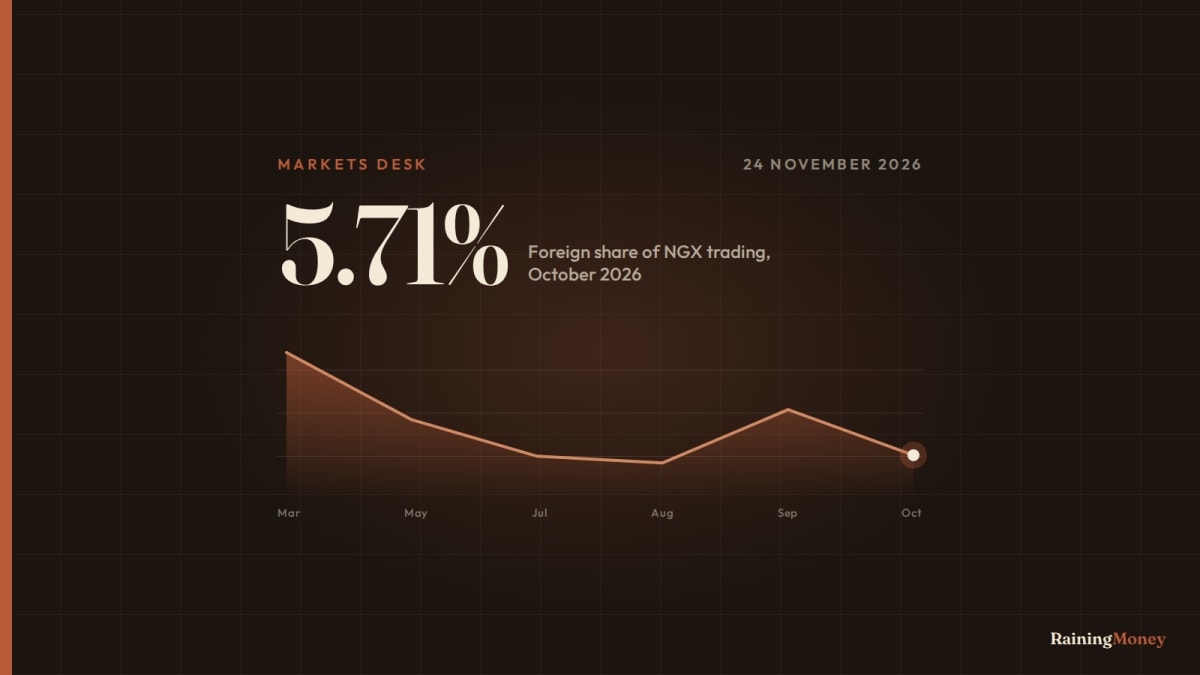
- Whether foreign trading in Nigerian shares rises after 21 September, in NGX monthly foreign-portfolio data.
- FirstHoldCo's weight in the Frontier 50, and whether it stays in at FTSE Russell's next reviews.
- Whether dollar repatriation stays smooth. A new backlog could put Nigeria back on the watch list.
- Changes in Otedola's stake and their effect on free float.
The bottom line
FirstHoldCo's entry into the FTSE Frontier 50 is real, but it is mostly a consequence of Nigeria fixing its foreign-exchange problems and being readmitted to FTSE Russell's frontier universe. The bank recapitalisation is a separate story, though it did help make FirstHoldCo bigger.
For ordinary investors, the inclusion is a sign that foreign money can come and go again, not a guarantee that it will flood in.
Sources & Verification
- (other sources) FirstHoldCo Plc Audited Financial Statements & CBN Capital Verification
- FTSE Russell Country Classification & Index Methodology Rules (Section 1.2.1)
- NGX Trading Statistics on Free-Float Velocity and Market Capitalization

Founder and Editor-in-ChiefAbuja
Betini Udom
Founder and Editor-in-Chief of RainingMoney. Covers Nigerian, pan-African and global markets, finance and economic policy.
Author profile & archive →The Money Print
Market intelligence before the market opens.
Pan-African capital flows and the stories behind the numbers, on weekday mornings.