CompaniesMedium
FCMB Doubles Nine-Month Profit to ₦272.8bn: What's Behind It
FCMB Group's nine-month profit before tax rose 103% to ₦272.8bn as cheaper deposits widened its interest margin, even though its loans to customers shrank 8.3%.
By Chiamaka Prudence Published 5 min read Editorial Policy Report a correction
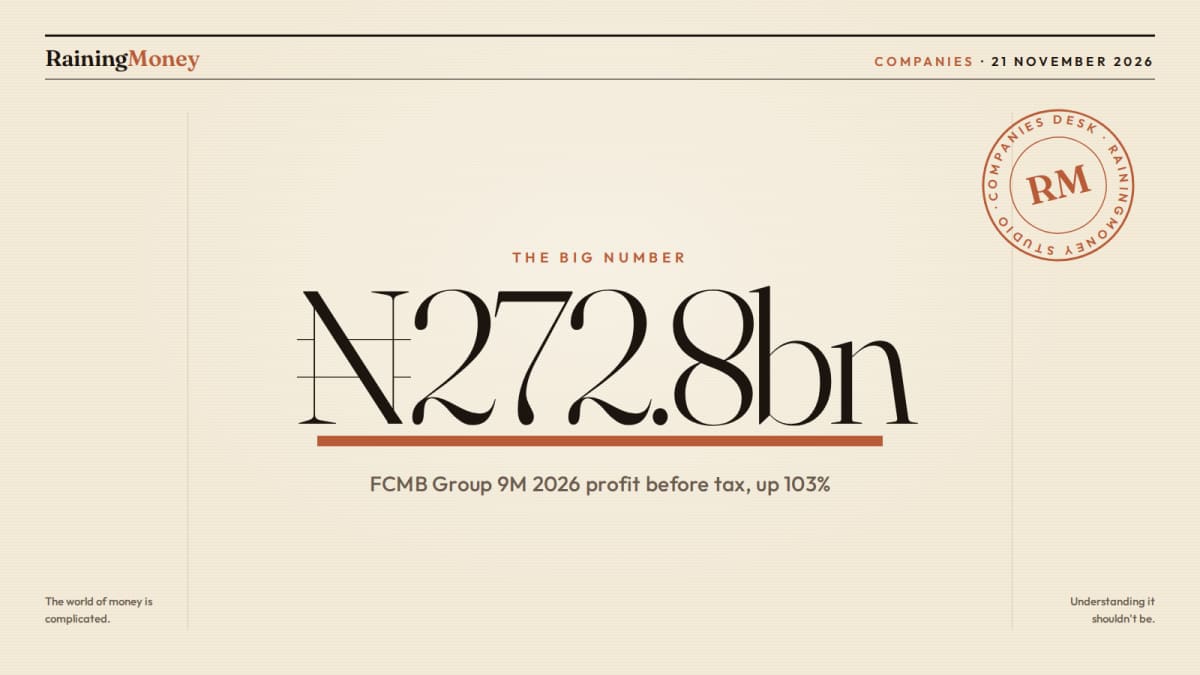
FCMB Group more than doubled its profit before tax to ₦272.8bn in the nine months to 30 September 2026, from ₦134.5bn a year earlier, its results released on Friday, 20 November, show. Profit after tax rose 85.7% to ₦232.9bn. The jump came mainly from earning more on its loans and investments while paying less for its deposits, even as the amount it lent to customers shrank.
What did FCMB report?
FCMB Group is the holding company for First City Monument Bank and a set of non-bank businesses in asset management, consumer finance and payments. Its gross earnings, everything it earned before costs, passed ₦1tn for the first nine months of a year, up 21% from ₦828.1bn.
| Item | 9M 2025 | 9M 2026 | Change |
|---|---|---|---|
| Gross earnings | ₦828.1bn | ₦1.0tn | +21.0% |
| Net interest income | ₦350.8bn | ₦534.2bn | +52.3% |
| Net fee and commission income | ₦56.2bn | ₦81.9bn | +45.8% |
| Operating expenses | ₦239.0bn | ₦268.9bn | +12.5% |
| Net impairment losses | ₦57.1bn | ₦76.8bn | +34.5% (derived) |
| Profit before tax | ₦134.5bn | ₦272.8bn | +102.8% |
| Profit after tax | ₦125.5bn | ₦232.9bn | +85.7% |
The impairment change is RainingMoney's own working from the reported figures (₦76.8bn ÷ ₦57.1bn).
Where did the extra profit come from?
The biggest driver was net interest income, the gap between what a bank earns on loans and investments and what it pays depositors and lenders. It rose 52.3% to ₦534.2bn and was the group's largest source of earnings.
Two things moved in FCMB's favour at once. Interest income rose 23.4% to ₦906.03bn as earning assets grew 10.7% to ₦5.43tn. At the same time, interest expense fell 3% to ₦371.85bn. The group says it shifted toward cheaper money: current and savings account deposits, which pay little or no interest, rose 24.4% to ₦3.60tn from December 2025, and now make up 76% of deposits, up from 65.4% at the end of last year.
The result is a wider net interest margin, the share of its earning assets that a bank keeps as profit from lending and investing. It rose to 12.3% from 10.1%.
Fees also helped. Net fee and commission income rose 45.8% to ₦81.9bn. The group's digital businesses, covering payments, digital loans and wealth management, brought in ₦142.5bn, up 25.4%, or 14.2% of gross earnings.
Did anything go the other way?
Yes, in three places.
- Lending shrank. Loans and advances to customers fell 8.3% to ₦2.17tn from ₦2.37tn in December 2025. FCMB said large corporate customers repaid loans, helped by stronger cash flows and cheaper funding from commercial paper and bond issues. Its digital loans to individuals and small businesses grew by more than 20% to ₦315bn, which was not enough to make up the difference.
- Bad-loan charges rose. Net impairment losses, the money set aside for loans that may not be repaid, rose to ₦76.8bn from ₦57.1bn. Management linked this to a clean-up of weaker loans in the second quarter. In the third quarter alone, the group recorded a net write-back of about ₦9bn, meaning some earlier provisions were released.
- Problem loans rose as a share of the book. The Nigerian bank's non-performing loan ratio, the share of loans in default, rose to 6.4% in September from 4.7% in June. The group said this followed new defaults being recognised and a smaller loan book, which makes the same bad loans a bigger share.
Trading income was also weaker. Net trading income fell 83.4% to ₦6.2bn after a loss on bond trading and lower income from Treasury bills and Eurobonds.
Did FCMB meet its own forecast?
It beat it. Profit before tax for the third quarter alone was ₦115.47bn, up 108.5% from ₦55.37bn a year earlier. The group had forecast ₦98.16bn for the quarter, so it came in ₦17.31bn, or 17.63%, ahead.
Costs grew more slowly than income. Operating expenses rose 12.5% to ₦268.9bn, and the cost-to-income ratio, the share of income eaten up by running costs, improved to 43.5% from 55.5% a year earlier.
How strong is the balance sheet?
Total assets rose 9.7% to ₦8.37tn. Customer deposits rose 7.1% to ₦4.73tn. Total equity, the shareholders' stake in the business, rose 47.8% to ₦1.24tn, helped by a capital injection of about ₦227bn in the first quarter. The capital adequacy ratio, a measure of how much loss a bank can absorb, was 24.6% at the end of September.
Return on equity, the profit the group makes for each naira shareholders have in the business, rose to an annualised 30.1% from 22.4%.
The banking arm produced ₦216.9bn of profit before tax, 80% of the total and up 94%. The non-bank businesses and the holding company produced ₦55.9bn, up 147%.
What does management expect?
Ladi Balogun, the group chief executive, credited the group's digital push, a rebalanced business and efficiency gains. He said he expects earnings momentum to continue in the fourth quarter, helped by lower operating costs now that the full 2026 levy owed to the Asset Management Corporation of Nigeria (AMCON) has been booked, and by seasonal growth in digital lending and payments. With nine-month return on equity at 30%, he expects the full-year figure to be well above the group's earlier guidance of 25%.
What does this tell us, and what doesn't it?
The results show a bank making more from a smaller loan book by funding itself more cheaply and earning higher yields on what it holds. That is a common pattern for Nigerian banks this year while interest rates remain high.
RainingMoney's reading: the profit rests heavily on the interest margin. If the central bank cuts rates, yields on government securities and loans would likely fall, and the margin could narrow. The rise in the problem-loan ratio to 6.4% is also worth watching, because it shows the clean-up of weaker loans is still under way.
The results do not say how fast lending will grow again, or how the bank will deploy the cash its corporate customers have repaid.
How did the shares react?
FCMB's shares closed at ₦10.95 on Friday, up 0.5% from ₦10.90, on a day when bank shares fell across the Nigerian Exchange. The stock is still down 9.13% this year from ₦12.05 at the start of January.
Why should I care?
For FCMB's shareholders, much higher profits raise the chance of a larger dividend, though the bank has not announced one for this period. For customers, the shift to cheaper deposits is a reminder that most bank savings accounts pay far less than the rates banks earn on government securities. For the wider economy, a bank lending less to companies while posting record profit shows where returns are being made: in high-yield securities rather than in new loans.
Sources & Verification
- Sources: Nairametrics
- Editorial note: This explainer is an original RainingMoney adaptation of the report, RainingMoney has added explanatory context.

Correspondent, OnitshaOnitsha
Chiamaka Prudence
I am a technology and finance enthusiast with a keen interest in digital innovation, emerging financial trends, and the evolving ways technology is shaping businesses and everyday life. I enjoy…
Author profile & archive →The Money Print
Market intelligence before the market opens.
Pan-African capital flows and the stories behind the numbers, on weekday mornings.