MarketsMedium
DMO Sells ₦1.42tn of Bonds as Borrowing Rates Edge Lower
The government sold ₦1.42tn of the ₦2tn bonds on offer at stop rates of 16.89% to 16.99%, below October's. What it means for borrowing costs and your savings.
By Betini Udom Published 7 min read Editorial Policy Report a correction
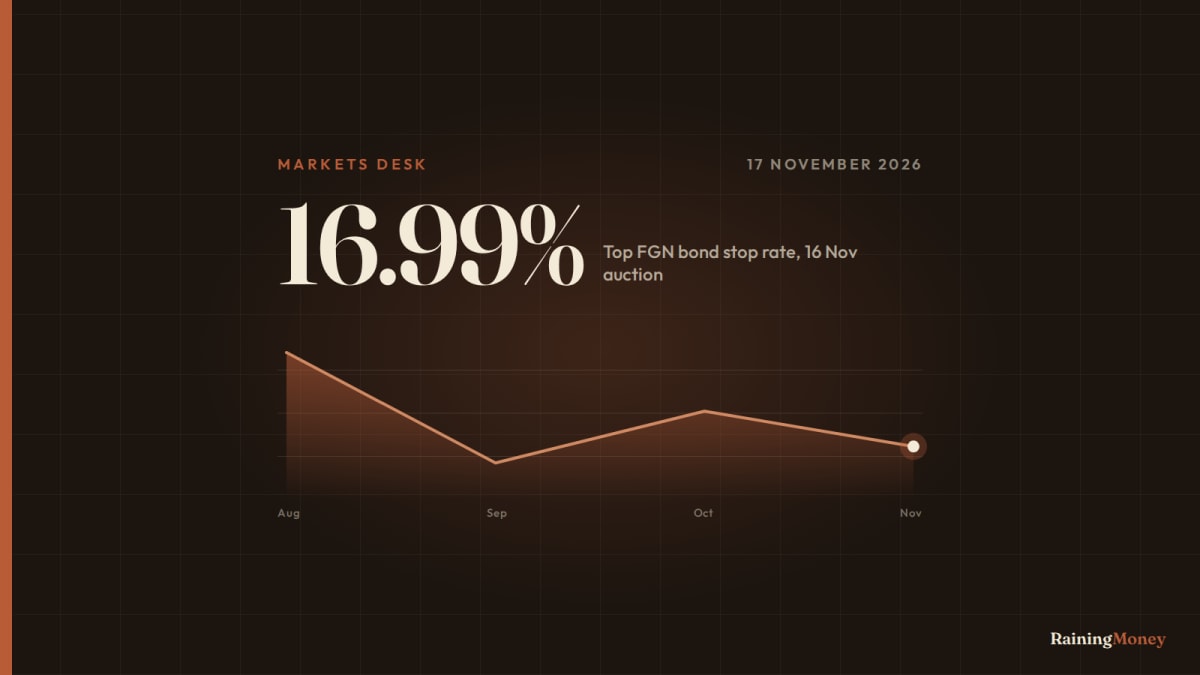
The federal government borrowed ₦1.42tn from investors at Monday's bond auction, and it paid a little less to do it. The Debt Management Office (DMO), the agency that handles the government's borrowing, sold ₦1.42tn of Federal Government of Nigeria (FGN) bonds on 16 November 2026 out of ₦2tn on offer. Investors bid ₦1.81tn in total. The highest rates the DMO accepted, called stop rates, ranged from 16.89% to 16.99%, below October's range of 16.99% to 17.29%.
Demand was lopsided. Investors piled into the longest bond on sale, which matures in May 2033, and largely ignored the shortest, which matures in March 2028. The result comes a week before the Central Bank of Nigeria (CBN) decides on interest rates on 23 and 24 November.
What happened at Monday's auction?
The DMO sold more of four bonds that already exist. These are called re-openings: each bond keeps its original yearly interest rate, the coupon, and its original maturity date, and the government simply issues more of it. Buyers pay on Wednesday, 18 November.
| Bond | Coupon | Offered | Bids | Sold | Stop rate |
|---|---|---|---|---|---|
| March 2028 | 21.00% | ₦700bn | ₦276.98bn | ₦162.99bn | 16.89% |
| April 2029 | 19.30% | ₦250bn | ₦350.77bn | ₦241.02bn | 16.99% |
| August 2030 | 17.945% | ₦750bn | ₦415.99bn | ₦336.12bn | 16.99% |
| May 2033 | 19.89% | ₦300bn | ₦766.40bn | ₦676.58bn | 16.99% |
| Total | ₦2tn | ₦1.81tn | ₦1.42tn | 16.89% to 16.99% |
Total bids covered 90.51% of the offer, so investors did not even bring enough money to buy everything on sale. The DMO then accepted about 78% of the bids it received and turned away about ₦390bn (derived: ₦1.81tn bid minus ₦1.42tn sold). In the end it sold 71% of what it advertised, leaving about ₦580bn unsold (derived: ₦1.42tn divided by ₦2tn, and ₦2tn minus ₦1.42tn).
Compared with October, the government sold more. The DMO allotted ₦1.21tn to competitive bidders at the 19 October auction, so November's figure is about 17% higher. Bids rose only about 3%, from ₦1.75tn, while the offer grew from ₦1.75tn to ₦2tn.
Why did everyone want the 2033 bond?
The May 2033 bond was the clear favourite. Investors bid ₦766.40bn for a ₦300bn offer, a subscription of 255.47%. The DMO sold ₦676.58bn of it, more than double the amount advertised, and that one bond made up about 48% of everything sold on Monday.
The March 2028 bond, the largest single offer at ₦700bn, drew bids of only ₦276.98bn, a subscription of 39.57%. The DMO sold ₦162.99bn, about 23% of the amount on offer (derived: ₦162.99bn divided by ₦700bn). The August 2030 bond, the other big line at ₦750bn, attracted ₦415.99bn of bids and sold ₦336.12bn.
RainingMoney's reading: when investors expect interest rates to fall, they prefer to lock in today's rate for as long as possible. A bond that pays until 2033 keeps paying close to 17% a year for nearly seven years, while one that ends in 2028 has to be replaced with whatever rates are on offer then. The auction results do not say why buyers chose as they did, but the pattern fits investors who think rates are heading lower.
What does a lower stop rate actually mean?
A bond is a loan. The buyer lends money to the government today; the government pays interest twice a year and returns the full amount on the maturity date. At an auction, investors bid the return, or yield, they want. The DMO lines up the bids from the lowest yield to the highest and decides where to stop. The stop rate is the highest yield it accepts, and it is the true cost of the new borrowing.
All four bonds cleared below their coupons. The March 2028 bond, for example, pays a coupon of 21% but sold at a yield of 16.89%. That means buyers paid more than the bond's face value. They still receive the full 21% coupon on the face value, but because they paid extra upfront, their overall return works out at about 16.89% a year if they hold to maturity.
A lower stop rate is cheaper for the government. As an illustration, every tenth of a percentage point on ₦1.42tn is worth about ₦1.42bn a year in interest (derived: 0.1% of ₦1.42tn). The bonds sold this month are different from October's, so the two months cannot be compared one for one. Only the March 2028 rate, at 16.89%, came in below the whole of October's range, and November's highest rate, 16.99%, matched October's lowest.
How have auction rates moved since the summer?
The direction of travel has been uneven. The DMO sells different bonds each month, so the clearest way to compare is the highest stop rate accepted at each sale.
| Auction | Stop-rate range | Highest |
|---|---|---|
| August | 17.15% to 17.79% | 17.79% |
| September | 16.79% to 16.85% | 16.85% |
| October | 16.99% to 17.29% | 17.29% |
| November | 16.89% to 16.99% | 16.99% |
Rates fell sharply in September, bounced in October as buyers pushed for more, and eased again this month. The top rate in November was 0.30 percentage points below October's (derived: 17.29 minus 16.99). The DMO has also been turning away expensive bids at its Treasury bill sales. On 28 October it rejected about ₦1.84tn of bids, roughly 96% of the money offered, and cut the one-year bill rate to 15.80%.
What does this mean for government borrowing?
The government is a heavy borrower at home, and the DMO plans to offer the same four bonds again for another ₦2tn on 14 December. It has said that calendar is provisional and could change at short notice. Together, the November and December sales add up to ₦4tn of planned bond offers in the last two months of 2026. The November line-up already departed from the DMO's earlier quarterly plan, which had listed bonds maturing in 2034, 2036 and 2038.
Cheaper borrowing matters because interest is paid from the same budget that pays for roads, salaries and services. Bonds lock in their cost for years, so each auction shapes the interest bill well beyond 2026.
RainingMoney's reading: the DMO is choosing to sell less rather than pay more. Selling 71% of the offer at lower rates suggests it is content to wait for cheaper money, especially with a possible rate cut ahead.
What does it mean for my savings?
Most people never bid at a bond auction. The buyers are mostly banks, pension funds, asset managers and other large investors. Ordinary savers feel the result through money market funds, pension savings and fixed deposits, whose returns tend to follow government rates.
When the government pays less to borrow, those products usually pay a little less over the following weeks and months. The one-year Treasury bill, a close benchmark for household savers, sold at 15.89% on 11 November, after 15.80% in late October. With headline inflation at 14.06% in October, a 16.99% bond yield is about 2.9 percentage points above inflation (derived: 16.99 minus 14.06), so savers in these products are still earning more than prices are rising.
This explains the market; it is not a recommendation to buy or sell any security.
Where does the CBN rate decision come in?
The CBN's Monetary Policy Committee (MPC), the group that sets the benchmark interest rate, meets on 23 and 24 November. In September it cut the Monetary Policy Rate (MPR) from 26.5% to 23%. The MPR is the anchor for what banks charge on loans and pay on deposits.
Bond rates of about 17% sit well below the 23% policy rate. RainingMoney's reading: that gap, and the rush into the 2033 bond, suggest investors expect the MPR to keep falling. If the committee cuts again, auction rates in December could ease further. If it holds, the DMO may find buyers asking for more.
What isn't known yet?
- Whether the DMO also sold bonds to non-competitive bidders, such as government agencies, on Monday. Those sales were added on top in October and September but have not been reported for this auction.
- What the MPC decides on 24 November, and how December's ₦2tn auction responds.
- Whether the weak demand for the March 2028 bond reflects a view on rates or simply where investors' cash was placed this month.
Sources & Verification
- Sources: BusinessDay
- Editorial note: This explainer is an original RainingMoney adaptation of the report, RainingMoney has added explanatory context.

Founder and Editor-in-ChiefAbuja
Betini Udom
Founder and Editor-in-Chief of RainingMoney. Covers Nigerian, pan-African and global markets, finance and economic policy.
Author profile & archive →The Money Print
Market intelligence before the market opens.
Pan-African capital flows and the stories behind the numbers, on weekday mornings.