MarketsMedium
DMO Offers ₦2tn of Bonds as ₦3.37tn Flows Back Into Banks
The DMO sells ₦2tn of FGN bonds on Monday as about ₦3.37tn of maturing bills and coupons return to banks. What it means for yields, savers and borrowing.
By Betini Udom Published 5 min read Editorial Policy Report a correction
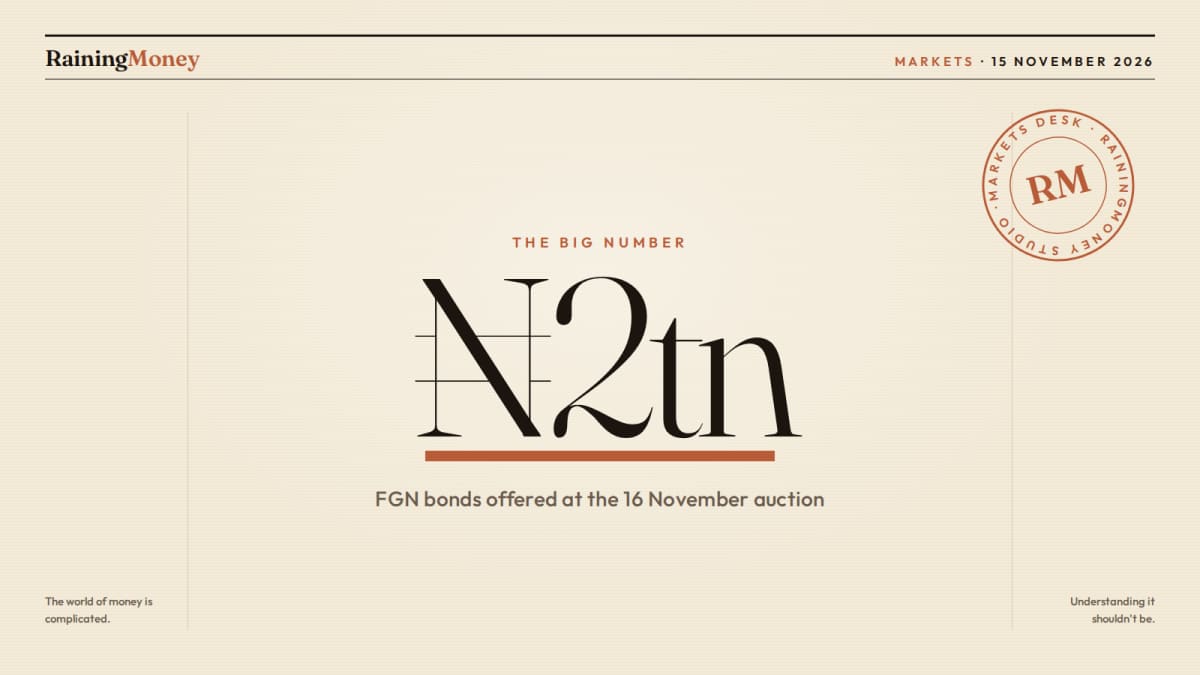
The Debt Management Office (DMO), the agency that handles the federal government's borrowing, will offer ₦2tn of Federal Government of Nigeria (FGN) bonds at an auction on Monday, 16 November 2026. The sale lands in a week when about ₦3.37tn is expected to flow back into the banking system from maturing central bank bills, maturing Treasury bills and interest payments on existing bonds.
Monday's result will show how much the government can borrow and at what price, and that price filters through to what savers earn.
What exactly is on offer on Monday?
The DMO is selling more of four bonds that already exist. In market language these are re-openings: the bonds keep their original interest rate and maturity date, and the government simply issues more of them.
| Bond | Coupon (yearly interest) | Amount offered |
|---|---|---|
| March 2028 | 21.00% | ₦700bn |
| April 2029 | 19.30% | ₦250bn |
| August 2030 | 17.945% | ₦750bn |
| May 2033 | 19.89% | ₦300bn |
| Total | ₦2tn |
The March 2028 and August 2030 bonds make up ₦1.45tn, or 72.5% of the offer. Settlement, the day buyers pay and receive their bonds, is Wednesday, 18 November. The minimum purchase is ₦50.001 million, with additional amounts in multiples of ₦1,000, so the auction is aimed at banks, pension funds and other large investors, who bid through appointed banks called primary dealers.
The offer is ₦250bn larger than the ₦1.75tn advertised in October, about 14% more (derived: ₦2tn minus ₦1.75tn, divided by ₦1.75tn). Under the DMO's revised calendar, which it says is provisional, the same four bonds will be offered again for another ₦2tn on 14 December, bringing planned sales for the last two months of 2026 to ₦4tn.
How does a bond auction work?
A bond is a loan. The buyer lends money to the government today; the government pays interest twice a year and returns the full amount, the principal, on the maturity date.
The coupon is the fixed yearly interest rate printed on the bond. A holder of ₦1m of the 21% March 2028 bond receives ₦210,000 a year, paid as two instalments of ₦105,000 (derived from the coupon, for illustration).
The yield is the return a buyer actually earns, given the price paid. At an auction, investors bid the yield they want. The DMO lines up the bids from lowest yield to highest and decides where to stop; the highest yield it accepts is the stop rate. If buyers demand a yield above the coupon, they pay less than the bond's face value. If they accept a yield below the coupon, they pay more.
Why do the ₦3.37tn of inflows matter?
Analysts at Cowry Asset Research put the week's expected inflows at about ₦3.37tn, made up of:
- ₦1.95tn of maturing open market operation (OMO) bills. These are short-term securities the Central Bank of Nigeria (CBN) sells to soak up spare cash in the banks.
- ₦1.11tn of maturing Treasury bills, the government's short-term IOUs of up to one year.
- About ₦312bn of coupon payments on existing FGN bonds.
The banking system was already flush before this money arrived. CBN data showed a surplus of about ₦3.97tn on Friday, 13 November, counting what banks held at the central bank's deposit window and their opening balances.
When a lot of cash is chasing a fixed amount of bonds, bidders compete harder and accept lower yields. If the DMO sells the full ₦2tn, it would absorb about 59.3% of the week's projected inflows, according to the analysts' estimate.
What happened at the last auctions?
October's bond sale showed that buyers have been pushing for higher returns and that the DMO has been willing to push back. At the 19 October auction, the stop rate on the September 2036 bond rose 50 basis points (half a percentage point) to 17.29%, and the June 2038 bond rose 34 basis points to 17.19%. The February 2034 bond cleared at 16.99%, even though some bidders asked for as much as 19.00%.
| Auction | Stop rate |
|---|---|
| July | 18.40% |
| August | 17.79% |
| September | 16.85% |
| October | 17.19% |
The DMO sold about ₦1.2tn to the market in October against bids of about ₦1.75tn, turning away roughly 30% of the money offered.
The same pattern appeared in Treasury bills. On 28 October the DMO rejected about ₦1.84tn of bids and pushed the one-year rate down to 15.80% from 15.90%. At the most recent sale, on 11 November, investors put about ₦1.08tn into the one-year bill against ₦600bn on offer; the DMO sold ₦672.91bn of it at 15.89%.
What does this mean for government borrowing?
The government is borrowing heavily at home. Bond sales from January to September 2026 came to ₦7.15tn, up 106% from ₦3.48tn in the same months of 2025.
Every percentage point on the stop rate adds to the interest bill for years. A higher rate on ₦1tn of borrowing costs ₦10bn more a year for each extra percentage point (derived: 1% of ₦1tn), money that comes out of the same budget that pays for roads, salaries and services.
RainingMoney's reading: with so much cash returning to the banks, the DMO has room to sell more of its offer without paying much more. Its recent habit of rejecting expensive bids suggests it will cap the amount sold before it accepts a sharp rise in rates.
What does it mean for savers and T-bill investors?
Most people feel the result indirectly, through money market funds, pension savings and fixed deposit rates, which all track government yields.
If plenty of cash pushes auction rates down, returns on these products tend to drift lower over the following weeks. If rates hold or rise, new savings and maturing Treasury bills can be reinvested at similar or better rates. One-year Treasury bills, around 15.8% to 15.9% in recent auctions, remain the closest benchmark for many household savers.
This explains the market; it is not a recommendation to buy or sell any security.
What should we watch next?
- Monday's stop rates on the four bonds, especially the August 2030 and March 2028 lines, which carry the largest offers.
- How much the DMO actually sells compared with the ₦2tn offered and the bids it receives.
- Whether the CBN steps in with fresh OMO sales to mop up the returning cash.
- The 14 December auction, when the same four bonds are due to be offered again.
Sources & Verification
- Source: BusinessDay
- Editorial note: This explainer is an original RainingMoney adaptation of the report, RainingMoney has added explanatory context.

Founder and Editor-in-ChiefAbuja
Betini Udom
Founder and Editor-in-Chief of RainingMoney. Covers Nigerian, pan-African and global markets, finance and economic policy.
Author profile & archive →The Money Print
Market intelligence before the market opens.
Pan-African capital flows and the stories behind the numbers, on weekday mornings.