EconomyHigh
CBN Holds Rate at 23% as Naira Pressure Rules Out a Cut
The central bank kept its main rate at 23% in its last meeting of 2026. Inflation is easing, but a weaker naira kept a cut off the table. What it means for you.
By Betini Udom Published 6 min read Editorial Policy Report a correction
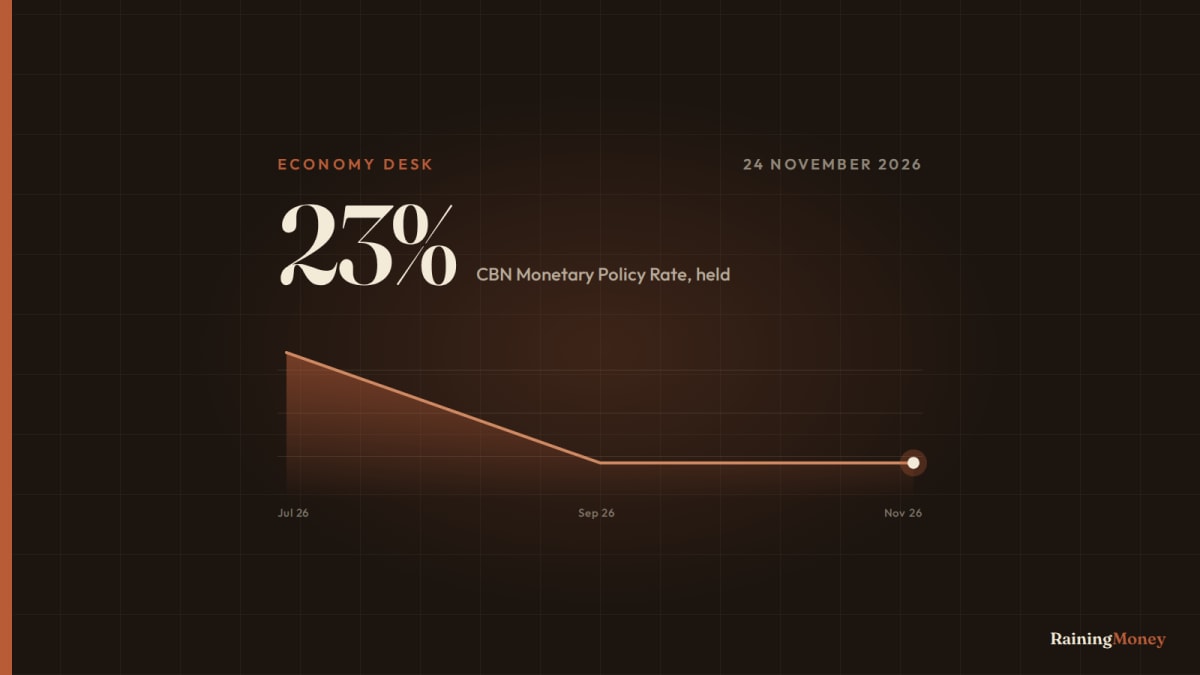
The Central Bank of Nigeria (CBN) has kept its main interest rate at 23%. Governor Olayemi Cardoso announced the decision in Abuja on Tuesday, 24 November 2026, at the end of the 308th meeting of the bank's Monetary Policy Committee (MPC), the group that sets the rate. He said all members voted to hold. It was the committee's last meeting of the year.
The bank also left its other main settings unchanged. The hold comes two months after a large cut in September, and at a time when inflation is still easing but the naira has come under fresh pressure.
What exactly did the central bank decide?
The committee held the Monetary Policy Rate (MPR) at 23%. The MPR is the bank's benchmark rate. It is the anchor for what banks pay to borrow from the CBN and from each other, and it shapes what they charge customers and pay savers.
Three other settings stayed where they were:
- The corridor around the rate stays at +50 and -300 basis points. A basis point is one hundredth of a percentage point. In practice, banks that borrow overnight from the CBN pay 23.5%, and banks that park spare cash with it earn 20%.
- The cash reserve requirement for commercial banks stays at 45%. That is the share of customer deposits a bank must keep locked at the CBN instead of lending out.
- The same requirement for merchant banks stays at 16%, and for public sector deposits held outside the government's Treasury Single Account it stays at 75%.
| Setting | Level | Change |
|---|---|---|
| Monetary Policy Rate | 23% | Unchanged |
| Corridor around the rate | +50 / -300 basis points | Unchanged |
| Cash reserve requirement, commercial banks | 45% | Unchanged |
| Cash reserve requirement, merchant banks | 16% | Unchanged |
| Cash reserve requirement, non-TSA public deposits | 75% | Unchanged |
How did the rate get to 23%?
At its previous meeting in September, the committee cut the rate by 350 basis points, from 26.5% to 23%. That was its second cut of 2026, and it took the rate to its lowest level since February 2024, when it stood at 22.75%.
Before that, the rate had sat at 26.5% for most of the year, including at the July meeting. When it made the September cut, the committee described it as an operational reset meant to make monetary policy work better, and said it did not change the bank's overall stance. At the time, the rates banks were actually charging each other overnight were around 22%, well below the 26.5% benchmark, so the cut brought the official rate closer to the market.
Tuesday's decision tells borrowers that the bank wants to see more evidence before it moves again.
Why didn't the bank cut again?
The committee said it was taking a cautious stance. It pointed to three things: inflation that is easing, renewed pressure on the naira, and risks at home and abroad. Cardoso said the committee reviewed recent developments in the world economy and in Nigeria, and the risks building in both.
Inflation is moving in the right direction. Figures from the National Bureau of Statistics show headline inflation fell to 14.06% in October 2026 from 14.63% in September. Headline inflation measures how fast the prices of a typical basket of goods and services are rising compared with a year earlier.
The naira is the harder part. In the official market, the dollar cost ₦1,394.01 on Monday, 23 November, up from ₦1,389.73 on the previous Friday. On the street (the parallel market) it cost about ₦1,445. External reserves, the dollars the CBN holds to support the currency and pay for imports, stood at $54.58bn on 20 November. That is lower than earlier in the month, though still about 23.5% higher than a year before, when they were $44.19bn.
Analysts at Cordros Securities said before the meeting that the naira had become the main constraint on the committee's choice. Their reasoning: a further cut would make naira savings and bonds less attractive to foreign investors, who could then sell and take their dollars out, adding to the pressure on the currency.
Analysts polled before the meeting also pointed to higher global oil prices, energy and transport costs, and the risk that spending ahead of the 2027 elections could push prices up again.
What does 23% mean next to 14.06% inflation?
One simple way to read the two numbers together is to subtract inflation from the policy rate. Derived: 23% minus 14.06% gives a gap of about 8.9 percentage points. Economists call this the "real" interest rate. When it is positive and wide, as here, money held in naira earns well above the pace at which prices are rising, at least at the level of the benchmark rate.
RainingMoney's reading: that wide gap is part of what the bank is protecting. A high real rate is one of the reasons foreign investors hold naira assets, and their dollars help steady the currency. Cutting again while the naira is weakening would narrow that cushion.
What does this mean for my loan, savings and prices?
For most households and small businesses, a hold means little changes in the short term.
- Borrowers should not expect loan rates to fall quickly. Banks price loans well above the policy rate, and the September cut is still working its way through. Tuesday's hold removes the prospect of a further push down this year.
- Savers may find that rates on deposits and Treasury bills stay closer to where they are, since the anchor has not moved.
- Prices depend more on food, fuel and the naira than on this single decision. If holding the rate helps keep the naira steady, that can help slow the rise in the cost of imported goods.
Banks also still have to keep 45% of customer deposits at the CBN. That rule limits how much they can lend, which is one reason credit remains expensive and hard to get for many small firms.
What happens next?
This was the committee's final meeting of 2026, so the 23% rate will stand into the new year. The bank has not published the date of its first meeting of 2027 in the material we reviewed.
Three things will shape that next decision: whether inflation keeps falling in the November and December figures, whether the naira steadies as dollar demand rises in the festive season, and how much the government spends in the run-up to the 2027 elections.
What we don't know yet is how each member voted on the other options in front of them, or how far the bank expects inflation to fall in 2027. The CBN usually publishes a fuller communiqué and, later, members' personal statements, which should answer both.
Sources & Verification
- Sources: Nairametrics
- Editorial note: This explainer is an original RainingMoney adaptation of the report, RainingMoney has added explanatory context.

Founder and Editor-in-ChiefAbuja
Betini Udom
Founder and Editor-in-Chief of RainingMoney. Covers Nigerian, pan-African and global markets, finance and economic policy.
Author profile & archive →The Money Print
Market intelligence before the market opens.
Pan-African capital flows and the stories behind the numbers, on weekday mornings.