EconomyLow
Nigeria Starts Building a $70M Passport Factory in Abuja
Work has begun on a privately funded $70M plant in Abuja to make 6 million passport booklets a year from May 2027. What it means for costs, fees and FX.
By Betini Udom Published 6 min read Editorial Policy Report a correction
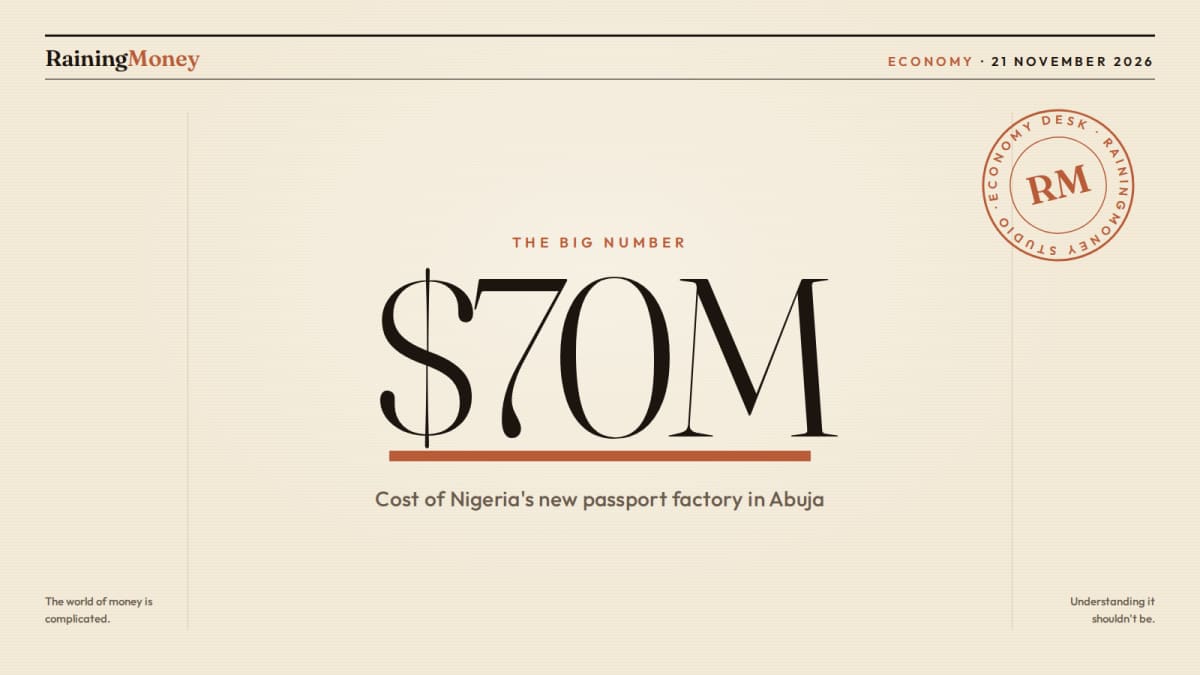
Nigeria has started building a factory in Abuja to make its own passport booklets, ending its reliance on imported ones. The Minister of Interior, Olubunmi Tunji-Ojo, broke ground on the National Passport Manufacturing Centre at the headquarters of the Nigeria Immigration Service (NIS) on Friday, 20 November 2026. The NIS put the cost at about $70M and said the project is privately funded, with no financial commitment from the Federal Government. The plant is due to start work in May 2027 and to make 6 million booklets a year at first, rising to 10 million.
What exactly is being built?
The centre will make the passport booklet itself: the bound document with its security pages and the electronic chip that makes it an e-passport. Today Nigeria buys these blank booklets from abroad, then prints each holder's details into them at home.
The site covers 1.1 hectares at the NIS headquarters in Abuja. Officials described it as AI-driven and off-grid, meaning it will produce its own electricity rather than depend on the national grid. Commissioning and the start of operations are targeted for May 2027.
The minister said the facility "will complete the full localisation of the Nigerian passport value chain". A value chain is every step that goes into a product, from raw materials to the finished item in a customer's hand. Nigeria already handles the later steps at home. This plant brings the first step, making the booklet, into the country as well.
How much will it cost, and who is paying?
The NIS statement on the groundbreaking put the price at about $70M and said the money is coming entirely from private investors. Neither the statement nor the reports of the event named those investors or the company building the plant, and they did not explain how the investors will earn their money back. That is the biggest question the announcement leaves open.
To put the figure in naira: at Friday's official closing rate of ₦1,394 to the dollar, $70M is about ₦97.6bn (derived: 70,000,000 × 1,394). That rate moves every day, so the naira figure is a guide only.
When a private investor builds public infrastructure, the usual arrangement is that the investor recovers the cost over time through fees, a share of revenue or payments from the government. RainingMoney's reading is that passport holders could end up paying for the plant indirectly through what they pay for a passport. Nothing published so far confirms or rules this out.
How many passports does Nigeria need?
The minister put Nigeria's need at about 2 million passports a year (one account of his remarks gives 1.8 million to 2 million). The plant's first-stage capacity of 6 million a year is about three times that, and the planned 10 million is about five times it (derived: 6 ÷ 2 and 10 ÷ 2).
| Item | Figure |
|---|---|
| Cost (NIS statement) | About $70M, privately funded |
| Site | 1.1 hectares, NIS headquarters, Abuja |
| Starting capacity | 6 million booklets a year |
| Planned capacity | 10 million booklets a year |
| Nigeria's yearly need (minister) | About 2 million |
| Target start | May 2027 |
The spare capacity is deliberate. Officials said the plant could supply other members of the Economic Community of West African States (ECOWAS) and the wider African market. Neighbouring countries currently buy their passports from Europe and the Americas, according to the reports of the minister's remarks.
The minister said Nigeria would be the first country in West Africa with an e-passport manufacturing plant and the second in Africa with full e-passport production capacity. He did not name the first, and that claim comes from the minister alone.
Why does making passports at home matter for money?
Every imported booklet is paid for in foreign currency. When the naira weakens, the cost of each booklet in naira rises even if the supplier's price stays the same. The naira fell 2.50% on Friday and briefly touched ₦1,400 to the dollar, so this is a live concern.
The minister said local production would soften the effect of exchange-rate swings on the cost of making passports. That makes sense: some costs, such as wages, power from an on-site plant and local services, would be paid in naira. Some inputs, such as the chips and special papers and inks, may still need to be imported. The reports do not say what share of the booklet's cost will stay in dollars.
There is also a possible gain for Nigeria's earnings. If the plant does sell booklets to other countries, those sales would bring foreign currency in rather than send it out. No buyer has been announced, so this is a hope for now.
Will passports get cheaper?
Nobody has said so. The minister gave no details on how passport fees would be affected. Adams Oshiomhole, chairman of the Senate Committee on Interior, said the plant would make passport production more affordable, but he gave no figures.
For context, fees have risen sharply in recent years. From 1 September 2025, a 32-page passport valid for five years cost ₦100,000 and a 64-page passport valid for ten years cost ₦200,000. In 2023 the same booklets cost ₦35,000 and ₦70,000. A cheaper booklet to make does not automatically mean a cheaper passport to buy, because the fee is set by the government and also covers processing.
What has already changed in passport processing?
The factory is the latest in a series of changes to how Nigerians get passports. Officials listed:
- 2023: automated applications.
- 2024: contactless biometric applications, which let some applicants abroad renew without visiting an office. Contactless renewal went live in Canada on 1 November 2024.
- 2025: the Centralised Passport Personalisation Centre, opened in September 2025. Personalisation is printing each holder's photo and details into the booklet. The centre can handle up to 5,000 passports a day, against 250 to 300 before, and aims to deliver passports within a week.
- A backlog of 204,332 passports was cleared, a data centre was built and e-gates were installed at airports.
Mr Oshiomhole said applicants used to face delays, shortages of booklets and demands for unofficial payments, and that these problems were dealt with soon after the minister took office. Those are his claims and have not been independently measured.
Who else spoke at the groundbreaking?
The Comptroller-General of Immigration, KN Nandap, spoke about stronger document security and a more reliable supply chain. A supply chain is the route by which materials reach the factory and finished products reach users. Abdullahi Aliyu Ahmed, chairman of the House Committee on Interior, called the project a "strategic intervention". Mr Oshiomhole said it would create jobs for artisans and professionals; the number of jobs was not given.
What is still unknown?
- Who the private investors are, and how they will be repaid.
- Who is building the plant.
- How much of the cost of each booklet will still be paid in dollars.
- Whether passport fees will change once the plant is running.
- Whether any other country has agreed to buy booklets from Nigeria.
May 2027 is the date to watch. If the plant starts on time and the investors' terms are made public, readers will be able to judge whether the project saves money for the country and for passport applicants, or mainly moves the spending from foreign suppliers to local ones.
Sources & Verification
- Sources: Nairametrics
- Editorial note: This explainer is an original RainingMoney adaptation of the report, RainingMoney has added explanatory context.

Founder and Editor-in-ChiefAbuja
Betini Udom
Founder and Editor-in-Chief of RainingMoney. Covers Nigerian, pan-African and global markets, finance and economic policy.
Author profile & archive →The Money Print
Market intelligence before the market opens.
Pan-African capital flows and the stories behind the numbers, on weekday mornings.