EconomyHigh
Food Inflation Tops 20% in 19 States as National Rate Eases
Food prices rose over 20% a year in 19 of Nigeria's 36 states in October, led by Ondo and Lagos, even as national food inflation eased to 19.13% from 19.59%.
By Betini Udom Published 5 min read Editorial Policy Report a correction
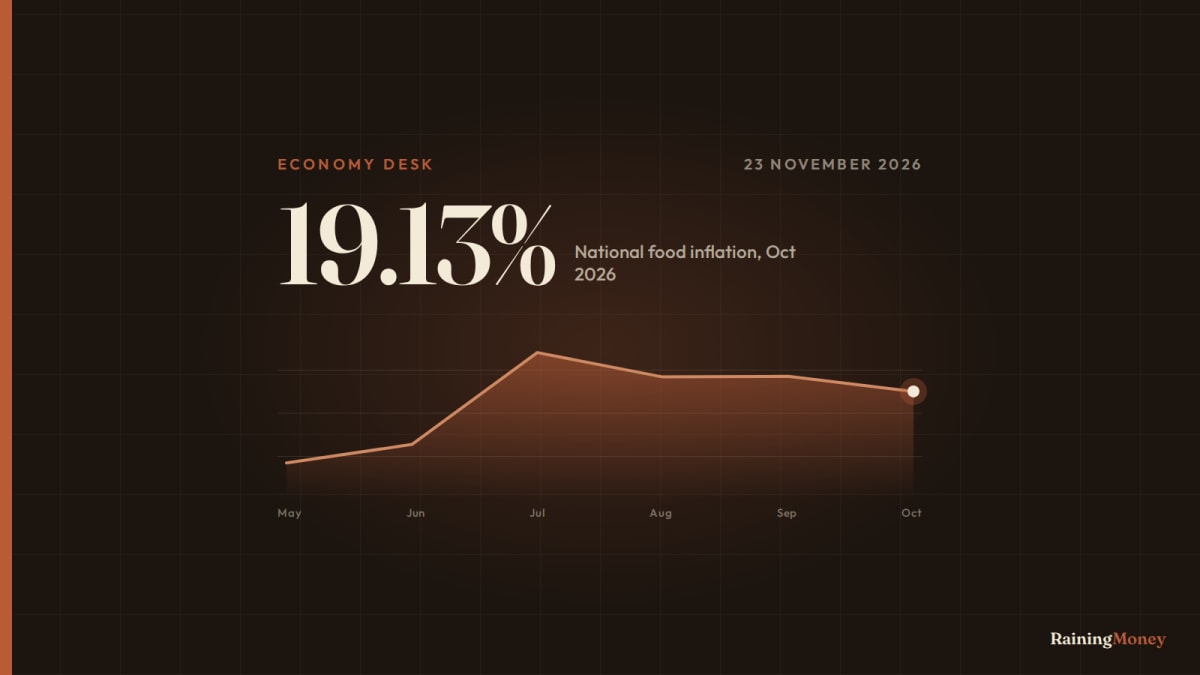
Food prices were still rising more than 20% a year in 19 of Nigeria's 36 states in October 2026, even though the national food inflation rate eased. State figures from the National Bureau of Statistics (NBS) show Ondo at 31.74%, Lagos at 31.43% and Imo at 29.75%, while national food inflation slowed to 19.13% from 19.59% in September.
The gap matters because the national figure is an average. A family in Akure or Ikeja is living with food prices rising far faster than the headline suggests, while families in some northern states are seeing much slower increases. The figures land as the Central Bank of Nigeria's (CBN) Monetary Policy Committee meets on 23 and 24 November to decide interest rates.
What does "food inflation above 20%" mean?
Food inflation measures how much more a typical basket of food costs than it did a year earlier. If a state's food inflation is 31.74%, a basket of food that cost ₦10,000 in October 2025 cost about ₦13,174 in October 2026 (derived: ₦10,000 × 1.3174). In a state at 20%, the same basket would cost about ₦12,000.
It does not mean prices rose that much last month. It compares this October with last October.
Which states were hit hardest?
Two states, Ondo and Lagos, were above 30%. Six were above 25%. All 19 states above 20% are listed below.
| State | Food inflation, year on year |
|---|---|
| Ondo | 31.74% |
| Lagos | 31.43% |
| Imo | 29.75% |
| Oyo | 28.81% |
| Ebonyi | 27.96% |
| Rivers | 25.33% |
| Abia | 24.22% |
| Delta | 23.91% |
| Enugu | 23.48% |
| Zamfara | 22.88% |
| Ogun | 22.47% |
| Yobe | 22.26% |
| Anambra | 22.23% |
| Kebbi | 22.21% |
| Akwa Ibom | 21.56% |
| Edo | 21.52% |
| Sokoto | 21.40% |
| Ekiti | 20.61% |
| Kaduna | 20.32% |
The list leans heavily to the South-West and South-East. Five of the six South-West states are on it, along with all five South-East states. Four North-West states, Zamfara, Kebbi, Sokoto and Kaduna, also crossed 20%.
At the other end, Nasarawa recorded the lowest food inflation at 3.70%, followed by Bayelsa at 7.11% and Kano at 7.13%. Taraba, where food prices were lower than a year earlier in September (its rate was -7.5%), was back to rising prices in October, at 8.9%.
Which states got worse, and which got better?
Some states moved sharply in one month. Sokoto's food inflation jumped to 21.4% in October from 6.1% in September. Ekiti's rose to 20.6% from 15.3%, and Oyo's to 28.8% from 24.5%. Ondo was almost flat at the top of the table.
Others improved. Ogun eased to 22.5% from 24.2%, and Rivers fell to about 25% from about 28%. Osun dropped out of the group altogether, falling to 18.0% from 25.2%.
Why is the national rate falling if so many states are above 20%?
The national rate is a weighted average of all states. Very low readings in states such as Nasarawa, Bayelsa and Kano pull the average down, while very high readings in Lagos and Ondo pull it up. The result is a national figure of 19.13%, which describes almost no single state well.
The NBS itself warns against comparing states directly. Families in different states buy different things, so each state's food basket is weighted differently. A rise in the price of yam counts for more where people eat a lot of yam.
What drove food prices in October?
Nationally, the NBS linked the month's price changes to vegetable oil, sardines, green peas, frozen fish, local rice, fresh catfish, beef tripe, palm oil and millet flour. Overall food prices fell 0.75% between September and October, a smaller fall than September's 1.55% drop. So prices were still falling month to month, but more slowly.
Analysts had expected this. Nabila Mohammed, a research analyst at Chapel Hill Denham, said food inflation fell in August and September because of the harvest, which brings more food to market. She expected prices to edge higher in October as the harvest ended, especially with transport costs rising.
RainingMoney's reading: Lagos and Ondo sit at the end of long supply chains. Much of the food sold in Lagos is trucked in from other states, so higher transport costs add more to prices there than in farming states where the food is grown. The NBS does not say this; it is our interpretation of why consuming states top the list while some producing states sit near the bottom.
How does this fit the bigger picture?
Headline inflation, which covers everything people buy, fell to 14.06% in October from 14.63% in September. Core inflation, which leaves out farm produce and energy, was 10.78%. Food is the stubborn part. National food inflation rose from 16.96% in May to 20.31% in July, then eased to 19.57% in August, 19.59% in September and 19.13% in October.
Food also matters more than anything else to the headline number. Food and non-alcoholic drinks contributed 5.63 percentage points of October's 14.06% headline rate, more than any other category.
What does this mean for my money?
- Your local rate may be very different from the news. If you live in Lagos, Ondo or Imo, the national 19.13% understates how much faster your food bill is rising.
- Your income needs to keep up. A salary that rose 15% in a year buys less food in a state with 30% food inflation than it did a year ago.
- Interest rates are part of the story. The CBN watches inflation when it sets its benchmark rate, now 23%. Analysts expect it to hold the rate at this week's meeting, partly because of pressure on the naira and the risk of higher spending before elections. Stubborn food inflation is one more reason it may be cautious about cutting.
What is still unknown?
November's figures are due in mid-December. Festive season demand usually pushes food prices up in November and December, and the naira has been weakening against the dollar, which makes imported food such as vegetable oil and sardines dearer. Whether the national slowdown holds through the end of the year is not yet clear.
The bottom line
Nigeria's food inflation is easing on average, but in more than half the states food still costs over 20% more than a year ago. For households in Ondo, Lagos and much of the South, the cost of feeding a family is rising far faster than the national figure shows.
Sources & Verification
- Sources: Nairametrics
- Editorial note: This explainer is an original RainingMoney adaptation of the report, RainingMoney has added explanatory context.

Founder and Editor-in-ChiefAbuja
Betini Udom
Founder and Editor-in-Chief of RainingMoney. Covers Nigerian, pan-African and global markets, finance and economic policy.
Author profile & archive →The Money Print
Market intelligence before the market opens.
Pan-African capital flows and the stories behind the numbers, on weekday mornings.