
EconomyHigh
FG Passes Its 2026 Domestic Borrowing Target by September
The federal government's net domestic borrowing hit ₦20.32tn by 30 September, above its ₦18.4tn target for 2026, as it leaned on Treasury bills and FGN bonds.
By Chiamaka Prudence Published 5 min read Editorial Policy Report a correction
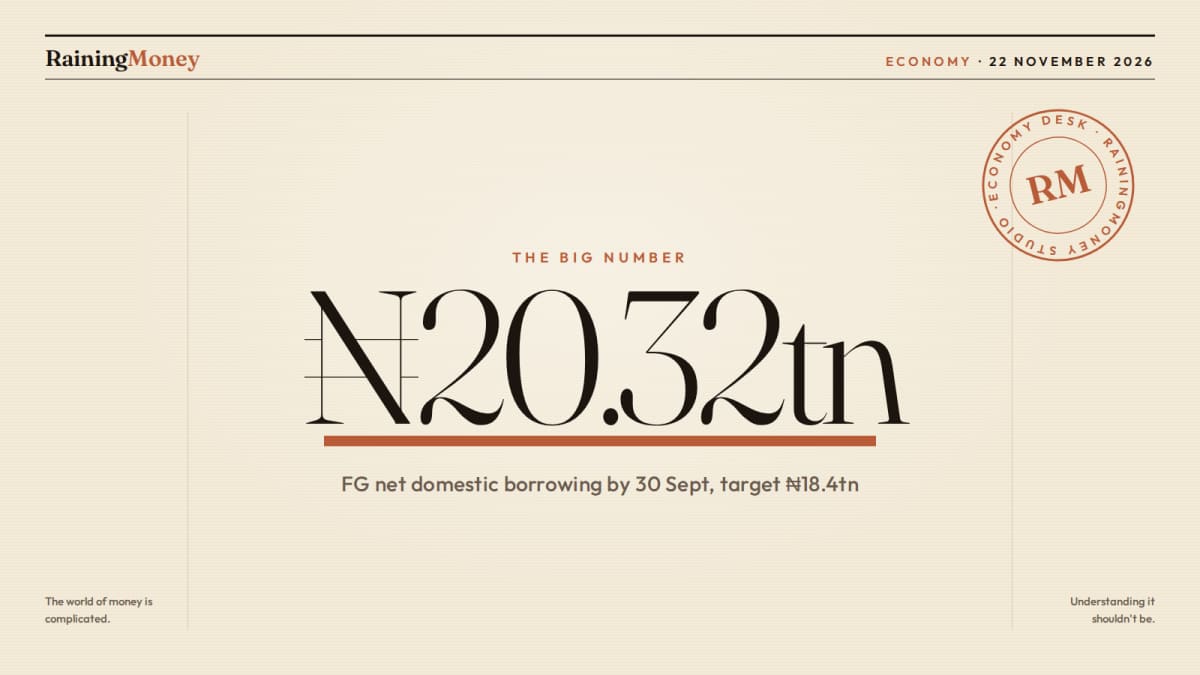
Nigeria's federal government had already borrowed more at home by the end of September than it planned to borrow in all of 2026. Net domestic borrowing reached ₦20.32tn by 30 September 2026, about 110% of the full-year target of ₦18.4tn, according to the Financial Markets Dealers Association's (FMDA) report on the third quarter. That leaves the government above its own plan with three months of the year still to go.
What does "net domestic borrowing" mean?
When the government spends more than it collects in taxes and other income, it fills the gap by borrowing. Domestic borrowing is money raised inside Nigeria, in naira, mostly by selling Treasury bills (short loans of up to a year) and FGN bonds (longer loans, some running past 2035). The Debt Management Office (DMO) sells bonds on the government's behalf, and the Central Bank of Nigeria (CBN) runs the Treasury bill auctions.
"Net" means new borrowing minus old loans that were paid back. If the government sells ₦100 of bills but repays ₦40 of bills that fall due, its net borrowing is ₦60.
How fast did the borrowing grow?
The third quarter did most of the damage. Net domestic borrowing stood at ₦10.74tn at the end of June, the report shows, so the government added roughly ₦9.65tn between July and September alone. That is almost as much as it borrowed in the whole first half of the year.
| Measure | Figure |
|---|---|
| Full-year domestic borrowing target | ₦18.4tn |
| Net domestic borrowing, end-June | ₦10.74tn |
| Net domestic borrowing, 30 September | ₦20.32tn |
| Amount above target (derived: ₦20.32tn minus ₦18.4tn) | ₦1.92tn |
| Treasury bills allotted in Q3 | ₦8.14tn |
| FGN bonds sold in Q3 | ₦4.14tn |
Treasury bill sales in the quarter rose 33% to ₦8.14tn, and most of that, ₦7.08tn, was in the 364-day bill. After ₦2.64tn of maturing bills were repaid, net new bill borrowing came to ₦5.49tn. Bond sales rose 44% from the previous quarter to ₦4.14tn, with a bond maturing in June 2038 taking about ₦2.44tn of that. Treasury bills made up about 57% of the quarter's net new domestic debt.
Why is the government borrowing so much?
The 2026 budget, as passed, allows ₦29.2tn of new borrowing in total, of which ₦18.4tn was meant to come from the domestic market and the rest from abroad. Spending has run ahead of revenue, and the domestic market has been the quickest place to raise cash.
RainingMoney's reading: borrowing heavily in short-term bills is fast but expensive to keep up. Each bill has to be repaid or rolled over within a year, so a large stock of bills means a large refinancing bill next year. The report's own figures point the same way: ₦5.43tn of Treasury bills fall due in the fourth quarter, and the DMO has scheduled ₦5.75tn of bond offers for the same period.
Who is the government borrowing from, and does it crowd out businesses?
Banks, pension funds and other investors buy most of the government's paper. The FMDA's figures show credit to the federal government rose 63.1% in a year to ₦39.40tn in September, while credit to the private sector rose 15.7% to ₦83.93tn and actually fell by about ₦537.6bn from August to September.
In everyday terms, when a bank can lend safely to the government at high rates, it has less reason to lend to a shop owner or a factory. Over the past year, the government took about 57% of the new credit created in the economy, even though it holds only about 32% of all the credit outstanding, the report shows.
What does this mean for interest rates?
Heavy government borrowing tends to keep interest rates high, because the government must offer attractive returns to raise so much money. The stop rate on the 364-day bill, the rate at which the auction clears, fell from 17.70% in July to 15.89% at the 23 September auction and was 15.89% again on 11 November. Its true yield, which accounts for the bill being sold at a discount, is about 18.9%.
For borrowers, rates are much higher. Average maximum lending rates across sectors ranged from 29% to 35% in October, the report shows. The CBN cut its benchmark Monetary Policy Rate (MPR) by 350 basis points to 23% in September (a basis point is one hundredth of a percentage point), but the Manufacturers Association of Nigeria has said prime lending rates would remain around 27% to 30% even at that level.
Why does this matter this week?
The CBN's Monetary Policy Committee (MPC) meets on 23 and 24 November 2026, its last scheduled meeting of the year. The committee decides whether to hold, raise or cut the MPR. The FMDA report adds another pressure point: ₦31.55tn of the CBN's own short-term bills, known as OMO bills, fall due in the fourth quarter, and how the CBN handles those repayments will affect interest rates and the naira.
The government has kept borrowing since September. It sold another ₦3.52tn of bonds in October and November, the report shows.
What does this mean for my money?
- Savers and investors: high government borrowing has kept returns on Treasury bills and bonds high. That is good for people who hold them, but those returns are paid from public money.
- Borrowers: as long as the government keeps raising large sums at home, loans for businesses and households are likely to stay expensive.
- Taxpayers: each naira borrowed must be repaid with interest, and at Treasury bill yields near 18.9% that interest is costly. Money spent on interest is money not spent on roads, schools or hospitals.
What we don't know yet
The government has not said whether it will revise the borrowing target, or how much more it plans to raise before December. Fourth-quarter figures will show whether bond and bill sales slow down. Nor is it clear how much of the overshoot reflects lower revenue rather than higher spending; the report does not break that down.
Sources & Verification
- Sources: Nairametrics
- Editorial note: This explainer is an original RainingMoney adaptation of the report, RainingMoney has added explanatory context.

Correspondent, OnitshaOnitsha
Chiamaka Prudence
I am a technology and finance enthusiast with a keen interest in digital innovation, emerging financial trends, and the evolving ways technology is shaping businesses and everyday life. I enjoy…
Author profile & archive →The Money Print
Market intelligence before the market opens.
Pan-African capital flows and the stories behind the numbers, on weekday mornings.