EconomyMedium
Ghana Cuts Its Policy Rate to 11% Days Before CBN Decision
The Bank of Ghana lowered its policy rate from 14% to 11% on 18 November, calling it a realignment with market rates, days before Nigeria's MPC meets.
By Betini Udom Published 4 min read Editorial Policy Report a correction
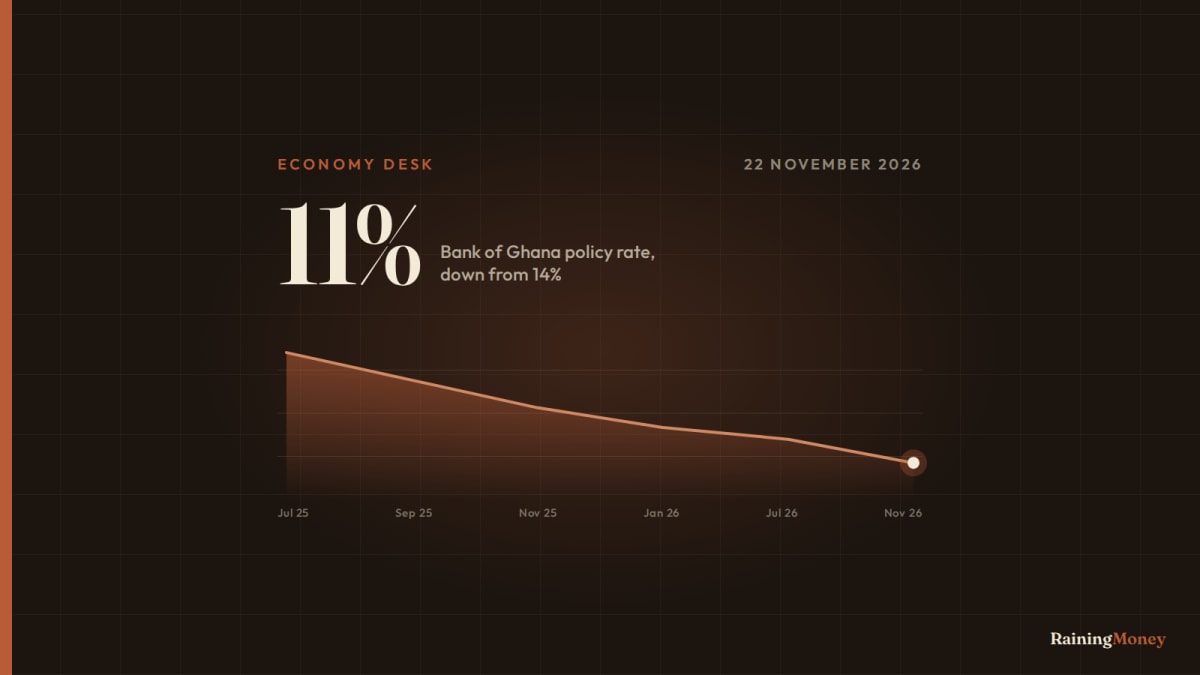
The Bank of Ghana has cut its benchmark interest rate from 14% to 11%, a drop of 300 basis points, in a decision announced on 18 November 2026. Governor Johnson Asiama said the move was a "realignment" with market rates, not an ordinary cut. It comes days before Nigeria's own rate-setters meet on 23 and 24 November.
What exactly did Ghana's central bank do?
The policy rate, called the Monetary Policy Rate, is the benchmark a central bank uses to steer what banks charge each other and their customers. Ghana's Monetary Policy Committee met from 16 to 18 November, its 133rd meeting, and lowered that rate to 11%. A basis point is one hundredth of a percentage point, so 300 basis points is three percentage points.
It was the first cut since March, and it came as a surprise: the rate had been held at 14% at the bank's recent meetings, including in July. Alongside the cut, the central bank changed how it runs its money-market operations, so that its decisions pass through more directly to the rates people actually pay.
Why does the governor call it a "realignment"?
Because market rates had already fallen below 14%. The central bank said interest rates in the market had settled under its official benchmark, so its real stance was already looser than the 14% figure suggested. Moving to 11% brings the official number closer to where borrowing costs already were.
In everyday terms, the price tag on the shelf said 14%, but people were already paying less at the till. The central bank has now changed the price tag.
Mr Asiama also pointed to what the committee called significant improvements in the economy: stronger activity, more lending to businesses and better government finances.
How has Ghana's rate fallen over time?
Ghana has been cutting steadily since mid-2025, after a period of very high inflation and a debt crisis.
| Date | Policy rate | Move |
|---|---|---|
| July 2025 | 25% | Cut from 28% |
| September 2025 | 21.5% | Cut |
| November 2025 | 18% | Cut |
| January 2026 | 15.5% | Cut |
| July 2026 | 14% | Held |
| 18 November 2026 | 11% | Cut ("realignment") |
What do the numbers say about Ghana's economy?
- Inflation: prices rose 5.5% in the year to October 2026, up from 5.2% in September. That is the third monthly rise in a row and the highest reading since November 2025.
- Bank lending rates: the average rate charged by commercial banks fell to 15.8% in October 2026, from 22.2% a year earlier.
- Credit: lending to the private sector grew 37.2% in October, against 13.9% a year earlier.
- Activity: the central bank's composite index of economic activity grew 17.7% in September from a year earlier, up from 9.6% growth in September 2025.
So the central bank cut even though inflation has been creeping up. It judged that the gap between its official rate and market rates, plus a stronger economy, mattered more.
How does Ghana compare with Nigeria?
Nigeria's rates are far higher. The Central Bank of Nigeria (CBN) cut its Monetary Policy Rate by 350 basis points to 23% in September. Nigeria's headline inflation was 14.06% in October 2026, its lowest in more than six years.
A simple way to compare is the "real" rate: the policy rate minus inflation. It shows how much a saver earns, or a borrower pays, after rising prices are taken into account.
- Ghana (derived): 11% minus 5.5% inflation = a real rate of about 5.5 percentage points.
- Nigeria (derived): 23% minus 14.06% inflation = a real rate of about 8.9 percentage points.
On this measure Nigeria's policy is tighter than Ghana's, which is one reason some analysts see room for another Nigerian cut. Most analysts who spoke ahead of the CBN meeting still expect a hold at 23%.
What does this mean for Nigerian readers?
RainingMoney's reading: Ghana's move adds to the case being made for lower rates in Nigeria, because it shows a neighbour cutting while its inflation is low and its lending rates are already falling. But Nigeria's situation differs in one important way. The naira has been under pressure in November, touching ₦1,400 to the dollar, and a rate cut can make naira assets less attractive to foreign investors at a time when the CBN wants dollars to flow in. That is the balance the MPC will weigh this week.
Why does a central bank's rate matter to an ordinary person at all? Banks borrow from each other and from the central bank, and they pass those costs on. When the benchmark falls, banks can, over time, charge less for loans and also pay less on deposits. The effect is slow and uneven, which is why Ghana's bank lending rates fell well before this week's cut.
For a Nigerian household, the CBN's decision matters more than Ghana's. A cut could slowly ease loan costs, though lending rates in Nigeria remain far above the policy rate. A hold would keep returns on savings and Treasury bills high.
What we don't know yet
The Bank of Ghana has not said whether more cuts will follow, and inflation is moving up, which could limit them. In Nigeria, the MPC announces its decision on 24 November.
Sources & Verification
- Sources: BusinessDay
- Editorial note: This explainer is an original RainingMoney adaptation of the report, RainingMoney has added explanatory context.

Founder and Editor-in-ChiefAbuja
Betini Udom
Founder and Editor-in-Chief of RainingMoney. Covers Nigerian, pan-African and global markets, finance and economic policy.
Author profile & archive →The Money Print
Market intelligence before the market opens.
Pan-African capital flows and the stories behind the numbers, on weekday mornings.