PoliticsHigh
Inside the Executive Purge: How Pete Hegseth Is Reshaping the Pentagon's Power Structure
Over 20 military and civilian defense leaders have been ousted under Defense Secretary Pete Hegseth, marking the largest Pentagon governance shift in modern history.
By Betini Udom Published 1 min read Editorial Policy Report a correction

The Department of Defense is undergoing its most radical executive restructuring in modern American history. Since Pete Hegseth assumed office as Secretary of Defense, at least 20 four-star generals, admirals, and senior civilian leaders have been fired, forced into early retirement, or driven to resign.
The sweep has reached the absolute peak of the U.S. national security hierarchy. From Air Force General Charles Q. Brown—the second Black officer to serve as Chairman of the Joint Chiefs of Staff—to Navy Admiral Lisa Franchetti, the first woman on the Joint Chiefs, decorated leaders are being systematically removed. The dismissals extend to civilian leadership, highlighted by the recent resignation of Army Secretary Dan Driscoll following escalating clashes over military transformation strategies.
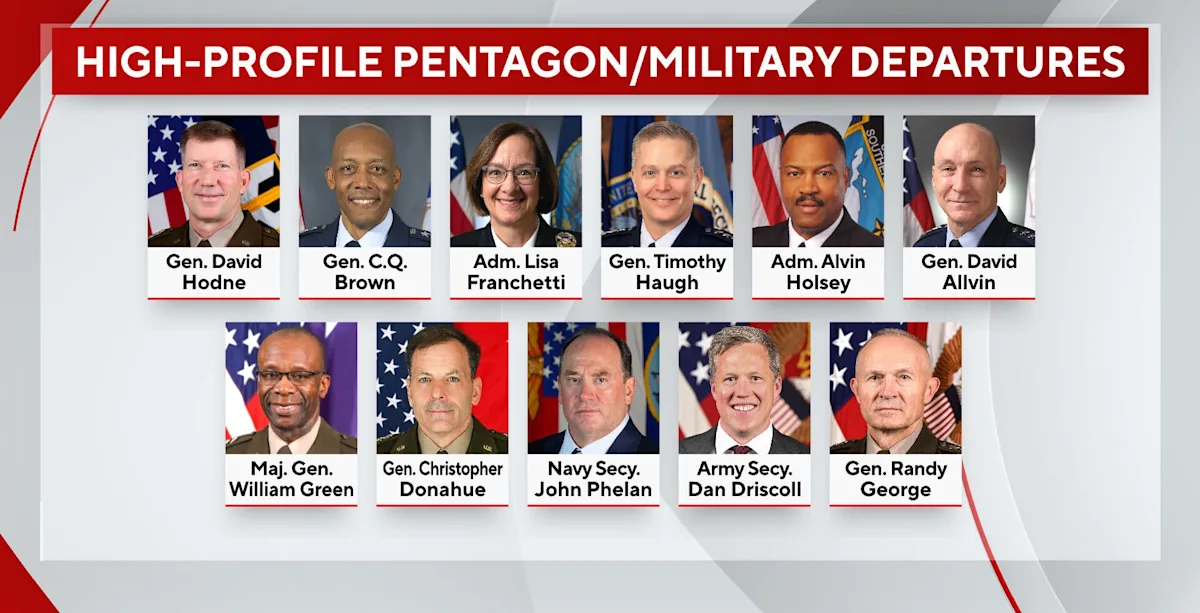
At the heart of this campaign is an explicit effort to dismantle diversity, equity, and inclusion (DEI) initiatives, strip away legal's roadblocks; within the Judge Advocate General (JAG) corps, and enforce absolute alignment with executive policy. Hegseth has openly criticized the military's senior officer corps as an insulated status quo; that has compromised warfighting focus. However, critics and departing officials warn that removing experienced military commanders creates a unprecedented governance vacuum within the world's largest defense apparatus during heightened geopolitical volatility.
RAININGMONEY EDITORIAL VIEW - WHY IT MATTERS:
MACRO: Re-establishes direct executive authority over military leadership, breaking decades of non-partisan institutional continuity in national defense management.
MARKETS: Introduces policy volatility for long-term defense programs as incoming leadership resets procurement priorities.
CORPORATE: Leaves major military branches without Senate-confirmed civilian leadership, stalling multi-billion-dollar acquisition approvals.
CONSUMER: Shifts public tax dollars away from broad institutional programs toward specific administration readiness mandates.
FUTURE RISK: Heightens institutional instability and risks brain drain across top-tier military operational and technical commands.
Sources & Verification
The Money Print
Market intelligence before the market opens.
Pan-African capital flows and the stories behind the numbers, on weekday mornings.