EconomyHigh
Zimbabwe hands its investment portfolio to a sanctioned tycoon. Here's the problem
Zimbabwe appointed US- and UK-sanctioned tycoon Kudakwashe Tagwirei as investment minister. What sanctions mean in practice and who is affected.
By Betini Udom Published 6 min read Editorial Policy Report a correction
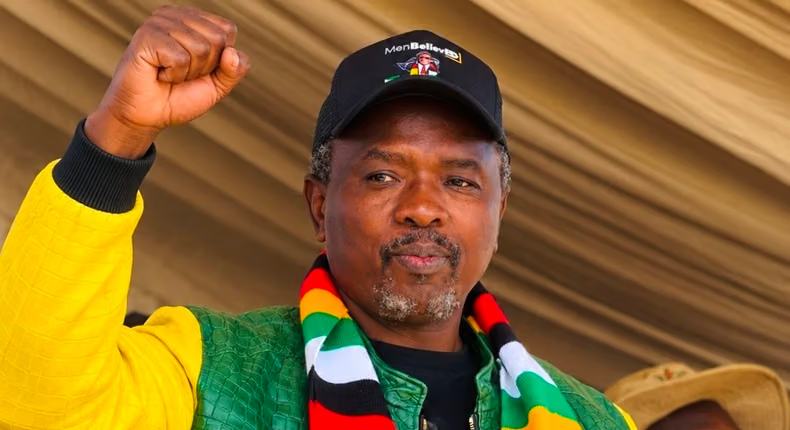
On Thursday 8 October, Zimbabwe's President Emmerson Mnangagwa broke his finance ministry into two. Mthuli Ncube, who had run the whole thing, keeps the narrower job of finance minister. The economic development and investment promotion half goes to Kudakwashe Tagwirei, the businessman behind Sakunda Holdings.
Tagwirei's new job is, in plain terms, to bring foreign money into Zimbabwe. The complication is that the United States has had him on its sanctions list since August 2020, and the United Kingdom since July 2021.
What does "sanctioned" actually mean here?
The word gets used loosely, so it is worth being precise about what each measure does.
The US measure. Tagwirei is on a US Treasury list of designated individuals. In practice that freezes any assets of his that sit within reach of the American financial system, and it generally bars US citizens, US companies and anyone operating from the US from doing business with him. He was first listed in August 2020 alongside Sakunda Holdings — roughly six years ago. (Derived from the August 2020 date.)
The UK measure. Britain imposed an asset freeze and a travel ban in July 2021. The asset freeze stops people and companies in the UK from making money or economic benefit available to him; the travel ban keeps him out of the country. In April 2025 the UK added a disqualification stopping him from acting as a company director.
What it does not mean. Sanctions of this kind attach to a person, not to a country or a ministry. Zimbabwe as a state is not sanctioned by the US — Washington actually closed its Zimbabwe-specific sanctions programme in March 2024. What it did at the same time was move certain individuals, Tagwirei and President Mnangagwa among them, onto a separate list used for corruption and human rights cases.
So the obstacle is not that Zimbabwe cannot receive Western investment. It is that the official now responsible for soliciting it is someone Western institutions must handle carefully. (This distinction is Rainingmoney's reading of how the measures work, not a legal opinion.)
Why would that stop a deal?
Think about what an investment minister's day looks like: meeting investors, signing memoranda, negotiating terms, approving incentives, fronting roadshows.
Now put a large international bank or pension fund on the other side of that table. Before committing capital, its compliance department checks every significant counterparty and official against sanctions lists. A hit on a list does not automatically kill a deal, but it triggers legal review, slows everything down and sometimes ends it — not because the investment is illegal, but because the institution decides the risk and paperwork are not worth it.
That caution has a name in banking: de-risking. It is why many African businesses already find correspondent banking harder than their numbers justify. (Rainingmoney's reading.)
What is he actually in charge of?
This is the part nobody has confirmed, and it is the single most important unanswered question in the story.
The announcement, made by Chief Secretary Martin Rushwaya under section 104(1) of the constitution, transferred the economic development and investment promotion functions to Tagwirei and said the appointment took effect immediately. It did not publish a list of the agencies that move with those functions.
Zimbabwean outlets have reported it is expected that two things come with the portfolio:
- ZIDA, the Zimbabwe Investment and Development Agency, the one-stop shop that licenses and processes inbound investment.
- The state companies held inside the Mutapa Investment Fund, Zimbabwe's sovereign wealth fund.
Treat that as expectation rather than fact until the government confirms it. If both do sit under the new ministry, this is a far larger story than a cabinet reshuffle.
How big is the Mutapa fund?
Big enough that the answer matters. The fund was created in 2014 and renamed Mutapa in September 2023, when a batch of state-owned companies was moved into it. By its own account it held gross assets of about US$16bn at the end of 2024, spread across 30-odd state companies, and says its portfolio supports more than 24,000 jobs.
It also says it needs more than US$10bn of fresh capital to recapitalise those companies and modernise their infrastructure.
Shrink that to US$100 to see the shape of it: for every US$100 of assets the fund says it holds, it says it needs roughly US$63 of new money to fix the businesses behind them. (Derived from the fund's own US$16bn and US$10bn figures.)
Where does US$10bn of new money come from? Largely from exactly the international banks, development lenders and private investors whose compliance rules are now in question.
What do the two sides say?
The government is unmoved. Presidential spokesperson George Charamba argued the appointment is Zimbabwe's business alone, writing that "America has no jurisdiction in Zimbabwe" and pointing out that Mnangagwa is himself designated. Zimbabwe's government has consistently rejected Western sanctions as politically motivated, and Tagwirei has denied the corruption allegations behind them.
Critics have raised two separate objections. Opposition leader Jameson Timba questioned the conflict of interest, noting that Tagwirei holds commercial interests in sectors his ministry will now make decisions about. Others questioned the diplomatic cost. The government's announcement did not address conflict of interest, and it is not known whether Tagwirei will give up any private holdings.
The allegations behind the listings
Both governments set out reasons when they designated him, and both are allegations rather than findings of a court.
The US Treasury said he used relationships with officials to win state contracts and get preferential access to foreign currency. The UK said Sakunda redeemed government Treasury Bills at up to ten times their official value, which it argued accelerated the collapse of the currency and pushed up food prices. Separately, a 2019 report commissioned by Zimbabwe's own government found that Tagwirei and associates could not account for at least US$3bn under the Command Agriculture farm support scheme, which Sakunda administered.
What to watch
This section is Rainingmoney's reading.
The agency list. Whether ZIDA and the Mutapa portfolio formally sit under the new ministry. This determines whether the appointment is symbolic or structural.
Conflict-of-interest arrangements. Whether Tagwirei divests, places holdings in a blind trust, or recuses himself from decisions touching Sakunda's sectors — and whether any of that is made public.
The first big deal. Watch who signs. A major Western institutional investor closing a Zimbabwean deal through this ministry would tell you compliance teams found a workable path. Silence would tell you the opposite.
Where the money comes from instead. If Western capital stays away, the gap is most likely filled by investors from countries that do not apply these sanctions. That changes who owns Zimbabwe's strategic assets, and on what terms.
The bottom line: Zimbabwe did not just reshuffle a cabinet. It made a bet that it can raise foreign capital without the help of the two financial systems that impose the restrictions.
Sources & Verification
- Based on reporting by Nehanda Radio, NewZimbabwe and News24, with sanctions details as attributed to the US Treasury and UK government in that reporting, and fund figures from the Mutapa Investment Fund's own disclosures.
The Money Print
Market intelligence before the market opens.
Pan-African capital flows and the stories behind the numbers, on weekday mornings.