PoliticsHigh
Inside the Ban Keun airfield and the debt that surrounds it,What satellite images of a Chinese facility in Laos do and do not prove
Eight attack jets at a new Chinese facility in Laos, a country owing China 52% of GDP. What is verified, what is not, and what the lending built.
By Betini Udom Published 7 min read Editorial Policy Report a correction
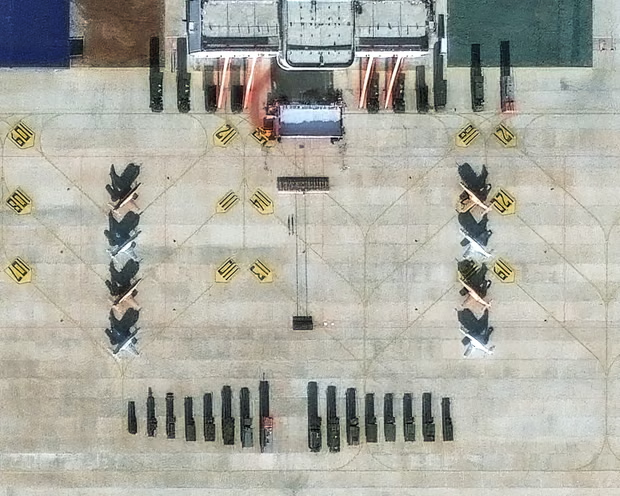
On 30 September, the commercial satellite firm Vantor photographed an airfield at Ban Keun, in Vientiane Province, Laos, about an hour's drive from the capital. Reuters obtained and reviewed the images and reported the findings on 6 October.
Security analysts who examined the pictures believe they show eight light attack jets and more than two dozen support vehicles positioned beside a runway that is still under construction. Earthworks around the runway were extensive.
China's Ministry of National Defense has publicly confirmed the facility, describing it as a joint training site. Asked about what the images show, the Chinese defence ministry did not immediately respond. Nor did Laos's Ministry of Foreign Affairs or its embassy in Bangkok.
No agreement has been published. No cost, lease term, duration or division of responsibilities is in the public record.
In Simple Terms
A satellite company took a picture of an airfield in Laos that China helped build. Military aircraft were parked on it before the runway was finished.
China says the site is for joint training. Some analysts and unnamed regional military attachés think it could become something more permanent — potentially China's first proper military base in Southeast Asia.
Both governments have declined to elaborate. Everything beyond "the facility exists and China built it" is currently other people's reading of photographs.
The Money
The reporting on the airfield carries no financial figures, because none have been released. But the financial relationship between these two countries is extensively documented, and it is unusual.
Between 2000 and 2023, China committed about $22.5bn of development finance to Laos across 367 projects, according to AidData, a research lab at William & Mary that tracks Chinese overseas lending.
The split matters more than the total:
- Loans: about 96%, roughly $21.6bn. Money that must be repaid with interest.
- Grants and in-kind donations: about 4%, $761m across 236 separate grants.
Shrink the relationship to $100: about $96 of every $100 China committed to Laos is a debt, and about $4 is a gift. (Derived.)
Where it went:
- Energy: $11.2bn, half of everything — hydropower dams and the national grid.
- Transport and storage: $5.9bn, about a quarter — principally the Laos-China Railway.
Individual projects give the texture. The Nam Ou hydropower scheme drew $1.5bn from China Development Bank, more than half its $2.6bn cost. Nam Ngum 3 took a $1.2bn export credit from China Eximbank. A national grid expansion took $519m from ICBC. The Laos-China Railway was financed by China Eximbank loans; AidData's own profile reports these inconsistently, giving about $3.6bn in one place and a $523m equity loan plus $3.6bn to the railway company in another, so treat the precise figure with caution.
Follow the Money
Beyond the published figures, the attribution of consequences below is Rainingmoney's reading.
China holds about $8.6bn of claims on a country whose grid and railway it financed, and has now built a facility there. It also carries the risk: 45% of its commitments to Laos are classed as distressed, which is a loss exposure as well as a lever.
Laos got infrastructure it could not otherwise have afforded — dams, a grid, a railway — and a repayment schedule it has already failed once. It kept the assets and the obligations.
Laotian taxpayers are servicing roughly 52% of annual national output in debt to a single foreign lender, until a projected 2041.
Regional governments — Thailand, Vietnam, Cambodia — gain a Chinese military presence on mainland Southeast Asia they did not ask about.
Other borrowers get a reference case. What happens in Laos between 2027 and 2040, as deferred principal comes due, will be studied by every finance ministry with concentrated Chinese exposure.
The Bigger Picture
China is generally understood to operate one overseas military base, a logistics facility in Djibouti, and to have secured naval access at Ream in Cambodia. A full base in Laos would be a third point on that line and the first of its kind in Southeast Asia.
Rachel Vandenbrink, a senior analyst at the Australian Strategic Policy Institute, offered a deflating read on the location: the choice of site is, she said, "likely more about a target of opportunity" than an obvious operational requirement. Laos is landlocked, militarily negligible, and offers a foothold on mainland Southeast Asia rather than a strategic prize.
Alexander Neill of the Pacific Forum noted the airfield appears engineered to allow a runway extension, which would admit larger aircraft including signals-intelligence and electronic-surveillance platforms. That is an inference from construction, not a disclosed plan.
There is also history. Records surfaced by Ryan Wolfson-Ford, a Southeast Asia specialist at the Library of Congress, identify Ban Keun as "Lima Site 44," an airfield used by Air America — the airline owned by the CIA — during the war in Laos. Joachim Leeker, an academic who has written on Air America, said it served from 1968 as a staging point for helicopters carrying Hmong troops. The same strip has now been built on by a different great power, roughly sixty years apart.
The Jargon
Public and publicly guaranteed (PPG) debt — what a government owes directly, plus debt owed by others that the government has promised to cover if they default. It is the honest measure of a state's obligations.
Deferral — pushing a payment to a later date. The debt still exists. This is not forgiveness, and conflating the two is the commonest error in debt coverage.
Restructuring — rewriting a loan's terms: longer to repay, different interest, sometimes a reduced principal.
Debt distress — when a borrower cannot meet obligations on the agreed schedule, or plainly will not be able to.
Export credit / buyer's credit — a loan from the exporter's country that pays its own companies to build something abroad. The money often never leaves the lending country; the borrower gets the asset and the debt.
Signals intelligence — intercepting communications and electronic transmissions.
What Happens Next
Known. The facility exists; China has confirmed it. The runway was unfinished on 30 September. Laos's deferred principal starts falling due from 2027, with repayment projected to 2041.
Possible. The runway could be extended, which would make larger aircraft feasible. The site could develop into a permanent base. Neither is confirmed, and both are inferences from groundworks.
Unknown. Whose aircraft those are. The terms of whatever agreement permits the facility. Its cost and who bore it. Whether Laos can meet the 2027 schedule. And whether any connection exists between the lending and the facility — on which there is currently no evidence in either direction.
Rainingmoney's Take
Analysis, not reporting.
The temptation in this story is a straight line: Laos could not pay, so China took a base. Resist it. No document supports it, neither government has said it, and no analyst in the reporting claimed it. Two facts sharing a map are not a transaction.
What the story does show, without needing any such claim, is a structure worth understanding. Over two decades, China lent Laos roughly $21.6bn and granted it $761m. That money built the things a state cannot relocate or relinquish — the grid, the dams, the railway. When repayment failed, there was no creditor committee to convene, because one lender held 85% of the external debt. There was a conversation, and its terms were not published.
That is the mechanism, and it needs no bad faith from anyone to work. A government owing one creditor almost everything has fewer things it can comfortably decline, on every subject. Any creditor in any century would find that true.
For African readers the relevant number is not China's. African countries owed about $61.2bn in Chinese PPG loans as of 2023 on World Bank figures — Kenya $6bn, Ethiopia $5.4bn, Nigeria $5.2bn. Nigeria's exposure sits inside a roughly $490bn economy and a creditor base spread across multilaterals, eurobond holders and several bilaterals. That dilution is the protection, and it is worth recognising as protection rather than taking for granted.
The question to carry away is not whether to borrow from China. It is how much of your external debt any single creditor should ever hold, and which of your assets you let that creditor finance. Laos answered both questions one project at a time, over twenty years, and arrived at 85%.
Sources & Verification
- Satellite imagery findings reported by Reuters from images supplied by Vanto.
- Laos debt and lending figures from AidData's May 2026 country profile, drawing on IMF analysis; African loan figures from World Bank data.
The Money Print
Market intelligence before the market opens.
Pan-African capital flows and the stories behind the numbers, on weekday mornings.