EconomyHigh
Ethiopia struck Eritrean troops in Tigray. What it means for its economy.
Drones hit Eritrean troops near Adigrat in Tigray. What the Ethiopia-Eritrea escalation means for its IMF programme, its debt deal and African trade.
By Betini Udom Published 5 min read Editorial Policy Report a correction
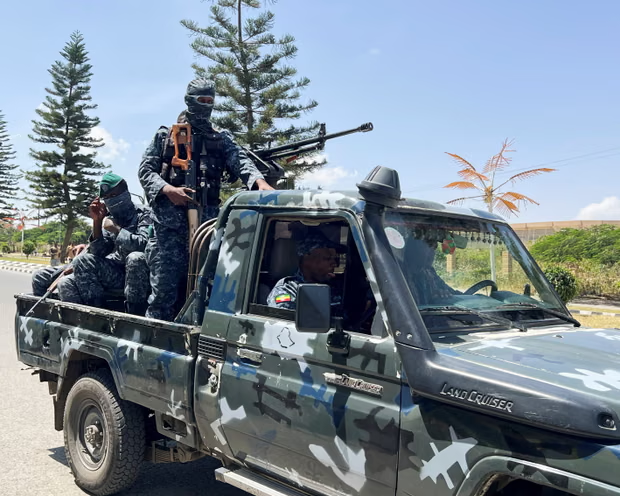
Overnight on Wednesday into Thursday this week, drones hit Eritrean troops and ammunition near Adigrat, a city in northern Tigray. The conflict monitoring group ACLED recorded multiple strikes in the area. Witnesses who spoke to the AFP news agency described destroyed lorries, a large explosion during the night, and Eritrean soldiers who appeared to be withdrawing northwards.
Reports attribute the strikes to Ethiopian forces. Ethiopia has not claimed them, Eritrea has not confirmed its losses, and neither government answered questions from reporters. No casualty figures have been published by anyone.
Why are these two countries fighting again?
They have done this before. Ethiopia and Eritrea fought a border war from 1998 to 2000. When Eritrea became independent in 1993, Ethiopia lost its coastline and became landlocked — a fact that sits underneath everything that follows.
Relations warmed after Abiy Ahmed became Ethiopia's prime minister in 2018, and that thaw won him a Nobel Peace Prize. Eritrea then fought alongside Ethiopia's federal government in the civil war against Tigrayan forces between 2020 and 2022. The two fell out afterwards, partly over the terms of the peace deal that ended that war and partly over Ethiopia's renewed argument that it should have access to the sea.
Now they are on opposite sides. Ethiopia says Eritrea is backing a rebel coalition led by the Tigray People's Liberation Front, which launched an offensive last week. Eritrea says Ethiopia is arming its own opponents and looking for an excuse to invade and seize a port. Eritrea's information minister, Yemane Meskel, posted that Ethiopia was "openly working to bring about regime change in Eritrea."
Last week Ethiopia expelled ten Eritrean diplomats and closed its embassy in Asmara. Eritrea said it would cut diplomatic ties completely.
Where does the money come into it?
Here is the figure that explains why a landlocked country keeps raising the subject of ports.
Shrink Ethiopia's import bill to $100. About $90 of it arrives through the corridor to the Port of Djibouti. At least 90% of Ethiopia's international trade moves that way, and on 2024 figures the country imported roughly $25.9bn of goods — so somewhere near $23bn of imports depend on one route. (Derived from the 90% share and the 2024 import total.)
That dependence is expensive even in peacetime. TradeMark Africa estimates logistics eat 27% of the final cost of an Ethiopian product, and that freight runs about 60% dearer than for coastal neighbours. It also runs the other way: the IMF reckons about 95% of Djibouti's port activity is Ethiopian cargo, worth an estimated $1.5bn to $2bn a year to Djibouti — roughly a quarter of that country's income.
So when Ethiopian officials talk about sea access, they are talking about a bill, not just a flag. And when Eritrea says Ethiopia wants a pretext to take a port, that is the claim it is making.
What has Ethiopia actually got to lose?
A recovery that is real and recent.
- Inflation. Average inflation ran at 26.6% in 2023/24. It fell to 16.0%, then to 11.7% in 2025/26 — less than half the rate of two years earlier.
- Growth. The economy grew 9.2% in 2024/25 and 7.8% in 2025/26. The IMF projects 8.2% for 2026/27, a forecast made before this week.
- An IMF programme. Ethiopia is drawing on a facility worth about $3.4bn, approved in July 2024. About $2.647bn had been paid out by July this year — a little over three-quarters of the total, leaving roughly $750m still to come. (Derived.)
- A debt deal. Ethiopia defaulted in 2023. In June this year it reached an agreement in principle with holders of a $1bn bond, swapping it for a new $880m bond maturing in 2029 — a 12% cut to the principal.
Those last two are the fragile ones. Money from an IMF programme arrives in instalments, each released after a review. Reviews assess whether the government is still hitting its targets. A war is not a target-friendly environment. (This is Rainingmoney's reading; the IMF has not commented on this week's events.)
One more number worth holding on to: Ethiopia's foreign reserves cover about 2.1 months of imports. That is up from 0.7 months two years ago, but it is still a thin cushion for a country importing most of what it uses.
What don't we know?
Quite a lot, and the gaps are the honest part of this story.
Who fired. Reports point to Ethiopia. Ethiopia has not said so.
How bad it was. No casualty figures. Witness accounts are anonymous and describe what three people saw in one town.
Whether this escalates. An unnamed Ethiopian commander referred to remaining pockets of resistance. That is one side's framing of its own operation, not an independent assessment.
The economic damage. Nobody has measured it, because it has not happened yet. Everything above is about exposure, not loss.
What to watch
This section is Rainingmoney's reading.
The next IMF review. It is the clearest early signal. If the programme stays on track, the government has contained the economic fallout. If a review slips, the cost is showing up.
The Djibouti corridor. Fighting in Tigray and Afar sits near routes that matter. Watch shipping and freight rates, not statements.
Ethiopian Airlines. The continent's largest carrier earned a record $9.1bn in the year to mid-2026, up 20%, and carried 20.7 million passengers through Addis Ababa. Its costs rose faster than its revenue, by 25%. Airspace restrictions or higher insurance would land directly on that gap.
Eritrea's response. It has cut diplomatic ties and lost equipment. What it does next decides whether this is a border incident or a war.
The bottom line: nothing measurable has been lost yet. What is at stake is the most convincing economic turnaround in the Horn of Africa, and the single trade route that nearly all of it runs through.
This article is for information only and is not investment advice.
Sources & Verification
- Strike details from ACLED and witness accounts reported by AFP.
- Macroeconomic and programme figures from the IMF's fifth ECF review.
- Bond terms from Ethiopia's Ministry of Finance bondholder talks.
- Corridor figures from TradeMark Africa.
The Money Print
Market intelligence before the market opens.
Pan-African capital flows and the stories behind the numbers, on weekday mornings.