EnergyHigh
Why oil companies are pumping more and finding less
EY's benchmarking study found US oil producers cut capex 49%, reached record output and replaced under 100% of reserves. Full analysis and what it means.
By Betini Udom Published 7 min read Editorial Policy Report a correction
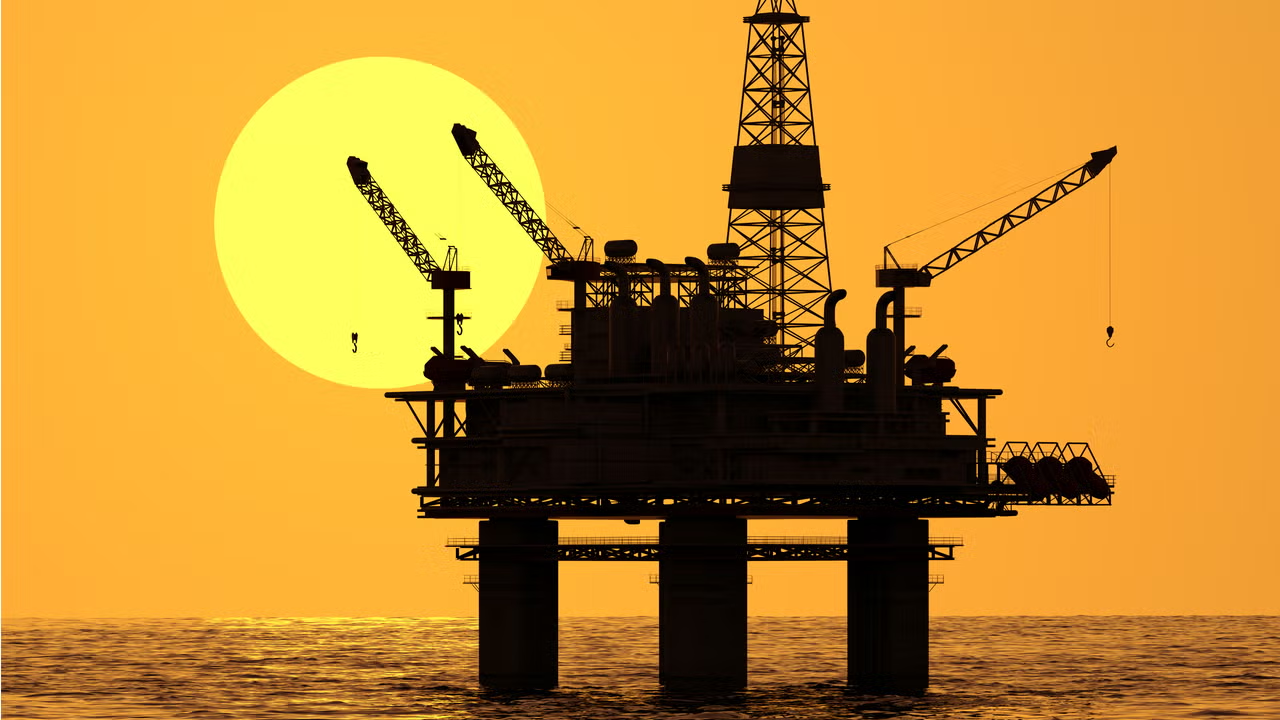
Ernst & Young has published its annual benchmarking study of the United States oil and gas industry, covering the 30 largest publicly traded exploration and production companies. Together they account for roughly 43% of all American oil and gas output. The study spans 2021 to 2025 and uses year-end 2025 data.
Three findings define it. Total capital spending fell 49% from the previous year. Oil production reached its highest level of the study period. And reserve replacement — the rate at which companies confirm new reserves against the oil they pump — dropped below 100% for the first time since 2021.
In plain terms: these companies produced more oil than ever, spent about half as much doing it, and took more out of the ground than they put back.
In Simple Terms
An oil company's proved reserves are its warehouse — the oil it has confirmed it can profitably extract. Every barrel sold comes out of that warehouse. Reserve replacement is the restocking rate.
Sell 100 barrels and confirm 100 new ones, and you have replaced exactly what you sold. That is 100%. Below 100%, the warehouse is emptying, even if sales look excellent.
For the first time in four years, this group of companies is restocking more slowly than it is selling. Not dramatically — combined oil reserves fell by less than 1%, which is close to flat. But the direction has changed.
The Money
The 49% collapse in capital spending is the figure most likely to be misread, so it is worth taking apart.
The largest component of the drop was acquisitions, which fell 70%. American producers spent the preceding years buying one another in a consolidation wave, and that wave ended. Money that had been going into deals simply stopped.
Exploration — the work of actually finding new oil — fell 11%, to $4.8 billion. EY notes that this represents just 3% of the industry's total capital spending.
That 3% is the number worth sitting with. Shrink the industry's entire capital budget to $100: about $3 went to looking for new oil. (Rainingmoney's illustration of EY's figure.) It also implies a total capital budget of roughly $160 billion. (Derived from $4.8bn being 3% of the total.)
The rest went into producing more from fields already owned. That is the mechanism behind the apparent contradiction: spending halved, output hit a record.
Follow the Money
Who this reaches. Beyond the study's own findings, this section is Rainingmoney's reading.
Shareholders are the immediate beneficiaries. Capital not spent on drilling or acquisitions is available for dividends and buybacks. BusinessDay reports that the global majors — Exxon Mobil, Chevron, BP, Shell and TotalEnergies — now put more than $100 billion a year into shareholder returns, absorbing around 80% of their combined earnings. Rainingmoney could not verify those two figures against a primary source, and they describe the global majors rather than the US producers EY studied.
The companies themselves get stronger near-term results and a thinner resource base. That is a trade, not a free lunch.
Oilfield services firms and drilling contractors feel a 49% capital cut directly, whatever its composition.
Oil-exporting governments, Nigeria among them, sit further down the chain. Slower long-run supply growth from the world's most productive oil province tends to support prices over time.
Consumers everywhere are on the other side of that same trade. Prices supported by tighter supply are prices paid at the pump.
The Bigger Picture
Framing this as an industry in retreat misses what the gas figures show. Production up 18%, reserves up 14%, discoveries up 21% — that is not a sector that has stopped investing. It is a sector that has changed what it invests in.
Patrick Jelinek of EY said US natural gas "is increasingly positioned at the center of several of the industry's most significant demand trends" — the data centres, LNG exports and electricity demand that have made gas the more attractive long-term bet.
Matt Melnar, who leads EY's Americas oil, gas and chemicals assurance practice, offered the caution that goes with reading any single metric too hard: "Reserve replacement metrics alone no longer tell the full story."
His colleague Regina Balderas framed the strategic shift directly: "The question is less about how much acreage a company owns and more about how effectively it can develop, operate and generate returns."
For Nigeria the parallel is uncomfortable but instructive. The same capital discipline that has US producers declining to spend on new oil is the logic that led the international majors to sell their Nigerian onshore assets to local operators. Capital discipline abroad and divestment here are two expressions of one decision about where a barrel is worth producing. (Rainingmoney context, not part of the EY study.)
The Jargon
Proved reserves — oil and gas a company has confirmed it can extract profitably with existing technology and prices. Not everything underground; only what counts commercially.
Reserve replacement ratio — new reserves added, divided by what was produced. Above 100% means growing the warehouse, below means shrinking it.
Capital expenditure (capex) — money spent on long-lived assets: drilling wells, building facilities, buying acreage.
Exploration spending — the slice of capex devoted specifically to finding new oil and gas, as distinct from developing known fields.
Buyback — a company purchasing its own shares, which reduces the share count and returns cash to shareholders.
Upstream / E&P — exploration and production, the finding-and-pumping end of the business, as opposed to refining and retail.
What Happens Next
Known. The study covers 2021 to 2025, on year-end 2025 data. Reserve replacement is below 100% for the first time since 2021. Combined oil reserves are down less than 1%. Gas is growing on every measure.
Possible. If reserve replacement stays below 100% across several years, the reserve decline stops being a rounding error. Rising costs — revenue up 7% against pretax results down 2% — could tighten budgets further. A sustained high oil price could instead revive exploration, as it has before.
Unknown. Everything about 2026. The study predates Brent crude passing $100 and the Strait of Hormuz conflict. Whether the industry's capital discipline is a durable change in thinking or a product of a softer price environment is precisely the question the data cannot yet answer.
Rainingmoney's Take
Analysis, not reporting.
The headline invites a conclusion the numbers don't quite support. This is not an industry running out of oil, and it is not an industry that has stopped investing. Reserves fell by less than 1%, and gas is growing across the board.
What the study does show is a change of purpose. These companies have concluded that finding new oil is a worse use of a dollar than producing existing oil efficiently and returning the remainder. On current evidence they are right — though revenue rising 7% while pretax results fell 2% suggests the efficiency story is getting harder to run.
Two things deserve scepticism. The first is the timing: capital discipline is easy at moderate prices, and this dataset closes before the price moved. The industry's history of holding discipline through a spike is not encouraging.
The second is the framing. The study is about US producers; the widely reported figures on $100 billion of shareholder returns are about the global majors. Both point the same way, but they are separate datasets and should not be welded into a single claim.
For Nigerian readers the useful question is not whether the world is running short of oil. It is that the companies best placed to add supply have decided, for now, not to — and that decision arrives eventually in the price of a barrel, and in the naira value of what Nigeria sells. With crude already above $100 and petrol above ₦1,400 a litre, both sides of that trade are already visible.
Sources & Verification
- Ernst & Young, "US oil and gas reserves, production and ESG benchmarking study".
- Analysis by Foley & Lardner
The Money Print
Market intelligence before the market opens.
Pan-African capital flows and the stories behind the numbers, on weekday mornings.