EnergyHigh
A sanctioned tanker burned off Sochi. The full picture, and what it costs Nigeria
The Aframax Rio burned off Sochi after a reported sea drone strike. Verified facts, the shadow fleet behind it, and what it means for oil and Nigerian fuel.
By Betini Udom Published 7 min read Editorial Policy Report a correction
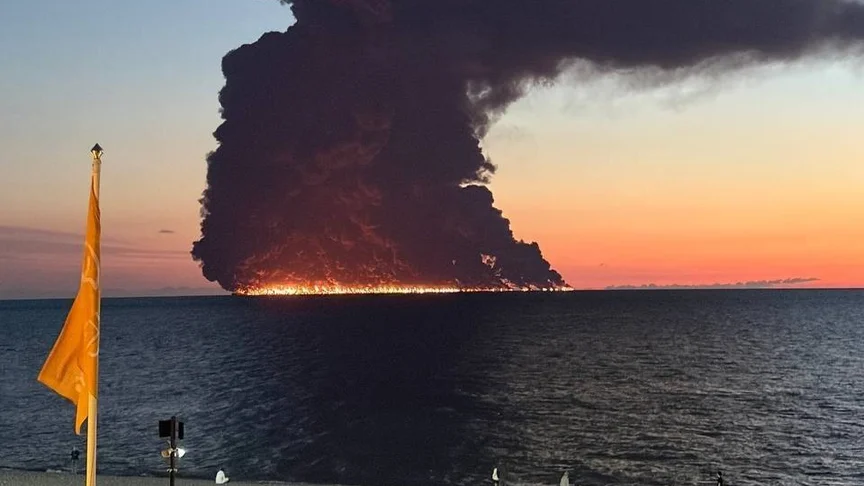
On the evening of Tuesday 6 October, an oil tanker named the Aframax Rio caught fire in the Black Sea off Sochi, the Russian resort city of almost half a million people on the country's southern coast.
Russia's transport ministry said the vessel had been attacked by naval drones — uncrewed explosive boats — and that crude oil was burning in open water. All 23 crew members, all of them Indian citizens, were rescued, and no casualties have been reported. Firefighters could not contain the blaze because of its intensity.
Black smoke spread over the coastline. Dmitry Plishkin, who heads the administration of the neighbouring Sirius federal territory, confirmed the fire and announced beach closures: "To ensure public safety, the beaches in Sirius will be temporarily closed." Sochi's mayor separately restricted access to the coast.
No government has claimed responsibility. Most international reporting attributes the strike to Ukraine, which has openly treated Russian oil infrastructure as a legitimate target, but Ukraine has not confirmed this particular attack.
In Simple Terms
A large crude oil tanker was hit by a remote-controlled explosive boat and set alight close to a Russian tourist city. Everyone aboard got off safely. The ship's oil is burning on the sea.
"Aframax" is not a brand — it is a size class for medium-large crude tankers, the standard workhorse for routes like the Black Sea. So this was a full-sized oil carrier, not a small vessel.
The ship was already on Ukraine's sanctions list, identified as part of what Ukraine calls Russia's "shadow fleet." In plain terms, that means a tanker suspected of moving Russian oil in a way designed to be difficult to trace.
The Money
There is no public figure for the value of the cargo, and no authority has confirmed what the ship was carrying or where it was going. A pro-Kremlin Telegram channel claimed it held crude from Novorossiysk bound for India, loaded almost to capacity. That claim is unverified, and Russian authorities have not said whether the vessel carried oil at all — though the transport ministry's own statement about burning crude strongly implies a crude cargo.
What can be documented is the ownership structure, and it is instructive. The vessel flies Liberia's flag. Its registered owner, Rio Enterprises SA, is incorporated in the Marshall Islands. Neither jurisdiction is near the Black Sea, and neither requires the beneficial owner to be publicly visible. This is ordinary practice in global shipping and also precisely what a sanctions-evading operation needs.
Follow the Money
Beyond the documented facts, the distribution of effects below is Rainingmoney's reading.
Russia loses a vessel from a fleet it depends on to keep oil revenue flowing, and absorbs an environmental cleanup beside a tourism economy.
The ship's owner faces a total loss on an asset that, being sanctioned and untracked, may be difficult to insure in conventional markets.
Marine insurers reprice war risk on Black Sea voyages. This is where the economic damage genuinely accrues — not in burning steel, but in premiums that make cargoes uneconomic to move.
India's refiners, among the largest buyers of discounted Russian crude, face a thinner and riskier pool of willing carriers.
Nigeria's government benefits from crude trading well above its $64.85 budget benchmark, provided production holds up.
Nigerian consumers pay for the same price level at the pump, in a market where petrol is now priced commercially rather than subsidised.
Sochi's tourism businesses lose beach access during an oil spill beside a resort coast.
The Bigger Picture
This fire sits inside two larger stories that are running simultaneously, and that combination is why oil is where it is.
The first is the Black Sea. Attacks on shipping from both sides have been escalating since 2022, and Ukrainian strikes on Russian refining and export infrastructure have had measurable effect — Russian refinery runs reportedly fell to a 24-year low earlier this year, according to Bloomberg. The violence is also widening: on the same day as the Sochi fire, two merchant ships were hit roughly 112km off Bulgaria's coast, reportedly the first such attack inside Bulgarian waters, and a vessel carrying rapeseed oil was attacked with at least one crew member killed.
The second is the Gulf. A crisis that began on 28 February has disrupted traffic through the Strait of Hormuz, the chokepoint carrying a large share of global oil. Brent moved from below $69 to above $102, with Gulf grade Murban at $110 on 5 October.
Two disrupted sea lanes at once is the condition under which a risk premium stops being temporary. Notably, the Financial Times has reported that Ukraine pledged to stop striking tankers carrying non-Russian crude from Black Sea ports — a signal that even belligerents understand the cost of frightening neutral shipping.
The Jargon
Aframax — a size class of crude oil tanker, typically used on medium-length routes rather than the longest intercontinental hauls.
Naval or sea drone — a small uncrewed boat, remotely piloted and carrying explosives, used to attack ships.
Shadow fleet — ageing tankers that move sanctioned oil while obscuring ownership and movement, often via flags of convenience and shell companies.
Flag of convenience — registering a ship in a country with light regulation and no connection to its real owners.
AIS — the transponder system broadcasting a ship's identity and position. Switching it off makes a vessel "go dark."
War-risk premium — the extra insurance charge for sailing into a conflict zone. Often the real mechanism by which conflict raises commodity prices.
Brent crude — the global benchmark price against which Nigerian crude grades are referenced.
Budget benchmark — the oil price a government assumes when planning its budget. Revenue above it is upside; below it is a shortfall.
What Happens Next
Known. The fire occurred on 6 October near Sochi. All 23 crew were rescued. Russia's transport ministry attributed it to naval drones. Beaches in Sirius were closed. The vessel was on Ukraine's sanctions list and had not been tracked since 20 September. It is not on US or UK sanctions lists.
Possible. Higher war-risk premiums on Black Sea voyages. Further attacks, given that both sides have pledged escalation in recent weeks. Pressure on India's Russian crude supply chain if carriers become harder to source. An environmental response along the Sochi coastline.
Unknown. Who carried out the strike. What the ship was actually carrying, and its value. Where it had been during its sixteen untracked days. Whether Russian Black Sea exports recover to July levels. And whether oil near $100 proves to be a spike or a new floor.
Rainingmoney's Take
Analysis, not reporting.
Two things in this story deserve more attention than the fire itself.
The first is the sixteen-day gap in the ship's tracking record. A tanker designed to be invisible to regulators is also a tanker with no verifiable account of itself — no documented cargo, no transparent owner, no state obviously obliged to protect it. The shadow fleet solved a sanctions problem by creating a security one. Expect more of these vessels to be hit, and expect the discount Russia must offer buyers to widen as a result.
The second is how little this single incident should move anyone's price expectations, and how much the pattern behind it should. Novorossiysk going from 800,000 to under 350,000 barrels a day is the event. The burning ship is the photograph.
For Nigeria, the practical conclusion is uncomfortable. The fiscal upside from $100 oil is conditional — it requires barrels actually produced and sold, against a budget assuming 2.6 million a day that recent output has not matched. The cost side is unconditional: every litre of petrol reflects global crude regardless of what Nigeria manages to pump. A windfall you might receive against a bill you definitely owe is not a windfall. It is exposure.
Sources & Verification
- Incident details from Russia's transport ministry and Dmitry Plishkin of the Sirius federal territory administration.
- Vessel ownership, tracking and sanctions records from The Insider.
- Export volumes from Reuters traders via Baird Maritime.
- Nigerian pump prices and regulator comments via Nairametrics.
The Money Print
Market intelligence before the market opens.
Pan-African capital flows and the stories behind the numbers, on weekday mornings.