
MarketsMedium
The Daily Brief: The Fed Pauses, Oil Refuses to Fall, and the World Bank Says Everything Costs More
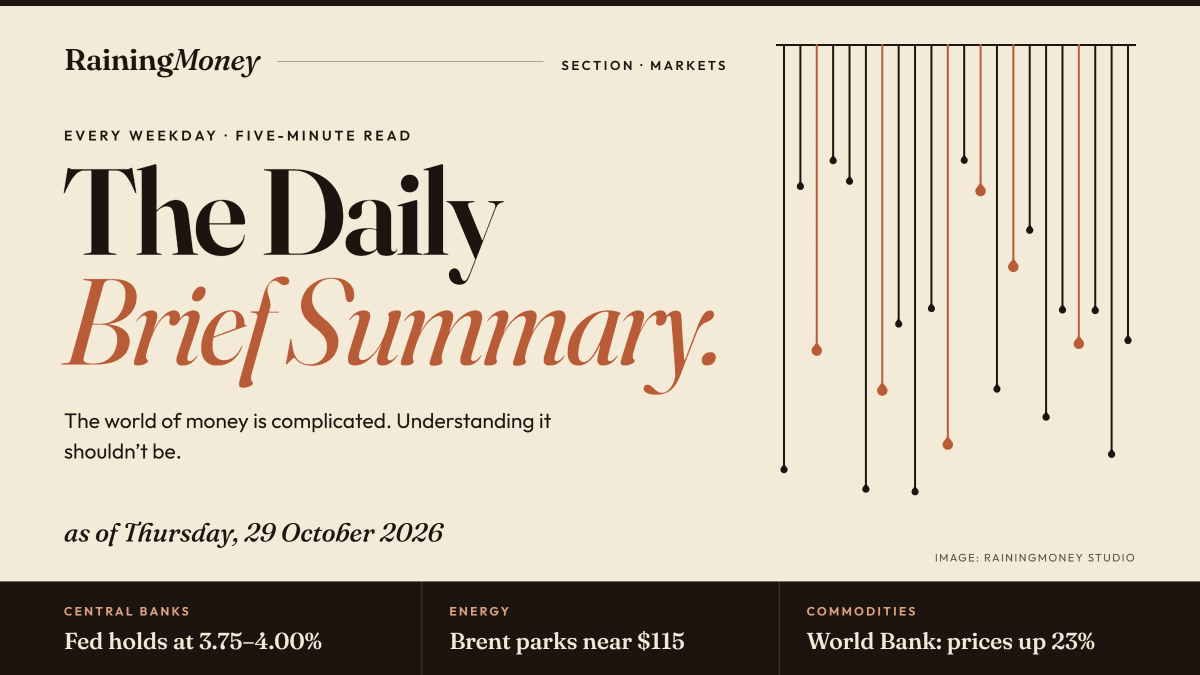
The Fed held rates at 3.75–4% as Brent sat near $115 and the World Bank lifted its 2026 commodity forecast to a 23% jump. Here's what it means for Nigeria.
By Betini Udom Published 5 min read Editorial Policy Report a correction
The US Federal Reserve ended its two-day meeting on Wednesday by leaving its benchmark interest rate unchanged at 3.75%–4.00%. That was what almost everyone expected. Going into the meeting, more than 90% of economists surveyed and most traders were betting on a hold.
But a pause is not the same thing as relief. In September, the Fed actually raised rates for the first time in three years, and Wednesday's vote showed that the appetite for more has not gone away. The decision passed 10–2. The two officials who voted against it, Governor Lisa Cook and Cleveland Fed President Beth Hammack, wanted another quarter-point increase on the spot.
The Fed's own statement explains why. It said the US economy is growing at a "strong pace" but that inflation "remains elevated." With US inflation running at about 3.7%, nearly double the 2% target, Fed Chair Kevin Warsh said he believes prices can be brought down without crushing growth, but he declined to say what comes next. He also said politics played no part in holding rates steady a week before the US midterm elections.
Markets heard the message clearly. After the decision, traders priced in roughly an 85% chance that the Fed will raise rates again at its December meeting.
In plain English: the world's most important central bank is still in "tightening" mode. It simply chose not to act this month.
2. Stocks breathed out
Investors treated the hold as a small win. Wall Street's major indexes closed modestly higher on Wednesday. The Dow rose about 0.2%, while the S&P 500 and the Nasdaq each added close to 0.3%. That calm carried into Thursday's trading in Asia, where regional markets were broadly firmer.
The gains were small for a reason. Nothing in Wednesday's decision made money cheaper. It only removed the risk of money becoming more expensive this month. When the next rate decision is a live debate, investors tend to tiptoe, not sprint.
3. Oil: why $115 won't budge
Brent crude, the global oil benchmark that Nigeria's Bonny Light is priced against, settled at $115.32 a barrel on Wednesday, up 1% on the day. It eased slightly on Thursday to close at $114.88.
The reason is not winter demand. It is war risk. A missile attack on a major Saudi refinery revived fears about Middle East supply on Wednesday. Earlier in October, Brent climbed above $117 after attacks on tankers near the Strait of Hormuz, the narrow waterway that normally carries about one-fifth of the world's oil. On Thursday, prices dipped as fresh attempts at US–Iran peace talks gave traders a reason to hope.
So oil is now trading headlines. Every report of an attack pushes it up, and every hint of diplomacy pulls it back. Until there is a real deal on shipping through Hormuz, it is hard to see Brent falling far.
4. The World Bank: brace for a 23% jump
On Wednesday the World Bank published its October 2026 Commodity Markets Outlook, and the numbers are heavy.
It now expects overall commodity prices to rise 23% this year, up from the 16% it forecast in April. That would put them at their second-highest level since 2013. Energy is the main driver: energy prices are projected to jump 32% in 2026, ending three straight years of decline. The Bank expects Brent to average $91 a barrel this year, against $69 in 2025.
Food is next. Food commodity prices are forecast to climb about 10% this year and another 7% in 2027, a cumulative rise of roughly 18%. Higher energy costs, attacks on grain shipping in the Black Sea and a strong El Niño weather pattern are all pushing in the same direction. Metals are heading for record highs, lifted by demand from renewable energy, electric vehicles and data centres. Fertiliser prices are forecast to rise 14%.
There is some good news. The Bank expects overall commodity prices to fall 7% in 2027, with Brent easing to an average of $79. But that relief depends on the conflicts not getting worse. In its gloomier scenario, Brent would average $105 next year and food prices would end up above their 2022 peak.
5. Companies are cutting to make room for AI
Away from central banks and oil, large employers kept trimming staff. Several multinational technology and pharmaceutical firms have announced targeted job cuts in recent weeks as they reorganise around AI-driven productivity tools. For now, the Fed describes the US labour market as steady, with job gains keeping pace with the growth of the workforce and unemployment little changed. Whether the layoffs start to show up in that data is one of the questions to watch before December.
What it means for Nigeria
The good: Oil near $115 is far above the levels most oil-dependent budgets were drawn up on. If Nigeria can lift and sell enough barrels, that means more dollars flowing to government and more support for the naira.
The bad: A Fed that may still raise rates keeps the dollar strong and makes US assets more attractive. That can pull foreign portfolio money away from markets like Nigeria's and put pressure on the naira.
For your pocket: The World Bank's forecast is a warning about the cost of living. Higher global prices for fuel, food and fertiliser tend to arrive in Nigerian markets as higher pump prices, transport fares and foodstuff prices. Households and small businesses should plan for those costs to stay high into 2027.
What to watch next
- US inflation data: the next reading will shape the odds of a December rate rise.
- US midterm elections next week: the Fed signalled it was waiting until after the vote before making any move.
- US–Iran talks: any agreement on Hormuz shipping is the biggest single risk to oil's price.
- Saudi supply: further attacks on Saudi facilities could send Brent back above $117.
The Numbers
| Indicator | Latest | Context |
|---|---|---|
| US Fed funds rate | 3.75%–4.00% | Held on 28 Oct; vote 10–2 |
| Odds of December hike | ~85% | Market pricing after the decision |
| US inflation | ~3.7% | Fed target is 2% |
| Brent crude (28 Oct) | $115.32 | Up 1% on the day |
| Brent crude (29 Oct) | $114.88 | Down 0.4% on peace-talk hopes |
| World Bank: 2026 commodity prices | +23% | April forecast was +16% |
| World Bank: 2026 energy prices | +32% | First rise in four years |
| World Bank: 2026 Brent average | $91 | $69 in 2025; $79 forecast for 2027 |
| World Bank: food prices | +10% (2026), +7% (2027) | About 18% over two years |
Sources & Verification
- US Federal Reserve FOMC statement (28 Oct 2026)
- World Bank Commodity Markets Outlook, October 2026
- Reuters; CNBC; CoinDesk; The Globe and Mail; Anadolu Agency; Gulf News.
- Editorial note: This explainer is an original RainingMoney adaption of the report, RainingMoney has added explanatory context.

Founder and Editor-in-ChiefAbuja
Betini Udom
Founder and Editor-in-Chief of RainingMoney. Covers Nigerian, pan-African and global markets, finance and economic policy.
Author profile & archive →The Money Print
Market intelligence before the market opens.
Pan-African capital flows and the stories behind the numbers, on weekday mornings.