EconomyHigh
Xi told Trump their countries can avoid war. What he meant, and what actually changed.
Trump and Xi extended the US-China trade truce two months to January 10. Tariffs, rare earths, farm purchases, Taiwan and AI all remain unresolved.
By Betini Udom Published 6 min read Editorial Policy Report a correction
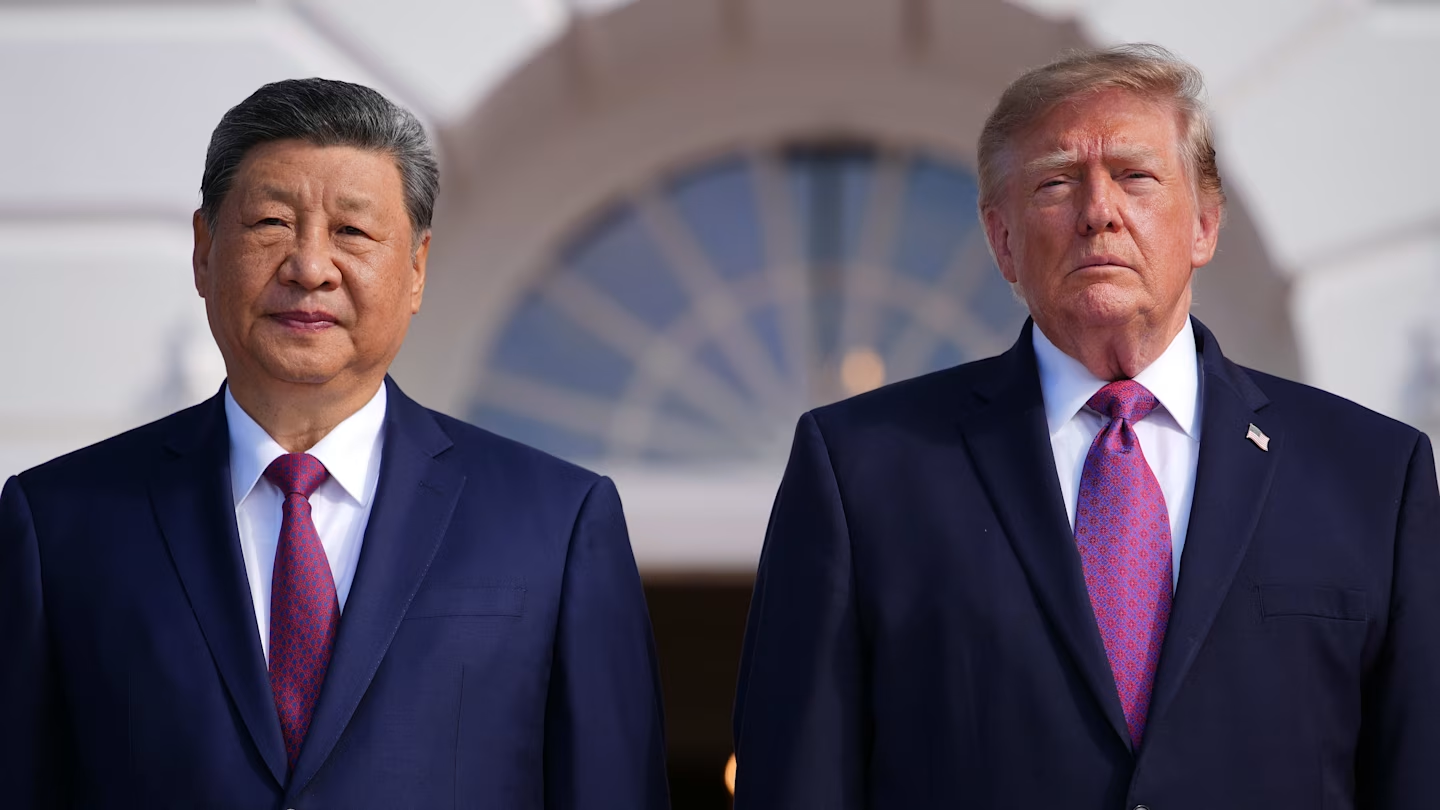
Chinese President Xi Jinping arrived in Washington on Wednesday for a state visit and met US President Donald Trump at the White House on Thursday, 24 September. It was his first state visit to the United States in more than a decade, and he travelled with a large business delegation.
Hours before the two leaders met, US Treasury Secretary Scott Bessent announced that the trade truce between the two countries had been extended. It had been due to expire on 10 November. It now runs to 10 January 2027.
In their public remarks, Trump described a "truly great friendship" built since his first election and said the two countries would work towards a better future. Xi spoke about friendship too, but spent more of his time on a different subject: preventing rivalry between the two countries from becoming war. He invoked the "Thucydides trap" and said it could be overcome.
The two also discussed artificial intelligence, the war involving Iran, market access for American farmers, and Taiwan.
In Simple Terms
Two governments that have spent years raising taxes on each other's goods agreed to keep their ceasefire running a little longer, and said almost nothing about how the underlying fight ends.
The Chinese president used the visit to make a broader argument: that his country and the United States are not condemned to end up at war just because one is catching up with the other. He asked for the two militaries to keep talking so that an accident does not become a crisis.
Everything that costs money — tariff rates, what China buys, which metals it will export, which technologies the United States will sell — was pushed into the next round of talks.
The Money
The financial substance of this relationship sits in four unresolved places, and it is worth being precise about the state of each.
Farm purchases. China committed to buying 25 million tons of American soybeans and is meeting that commitment, according to Bessent. It also pledged $17 billion for other agricultural goods, and on that it is lagging.
Rare earths and critical minerals. The original truce paused Beijing's export curbs on these materials. Bessent said Chinese deliveries have not been up to standard, and characterised some of China's deliverables as imperfect.
Tariffs. The Busan arrangement of October 2025 pulled tariffs back from triple-digit levels. No new schedule of cuts emerged from Washington this week.
Technology restrictions. American export controls on advanced chips remain, and no change was announced.
Follow the Money
Who this reaches. Beyond the announced facts, this section is Rainingmoney's reading.
American farmers get another two months of Chinese soybean demand, and continued uncertainty on everything else they sell.
Manufacturers worldwide who depend on rare earth magnets — carmakers, wind turbine builders, electronics firms — keep their supply for now, with the pause on Chinese export curbs expiring alongside the truce.
Non-Chinese mining companies benefit from every short, unresolved extension, because uncertainty is the strongest argument for building supply outside China.
Oil exporters, Nigeria among them, are affected indirectly. Trade conflict between the two largest economies lowers expectations for global growth, and expectations for growth drive expectations for oil demand.
Consumers everywhere pay for tariffs eventually, because import taxes raise the cost of manufactured goods well beyond the two countries imposing them.
The Bigger Picture
This was the second Trump-Xi summit of 2026, after Trump's visit to Beijing in May. Xi repeated several phrases from that meeting almost exactly: the Thucydides trap, "constructive strategic stability", and the argument that cooperation benefits both sides while conflict harms both.
Chinese diplomatic language is deliberately consistent, so repetition is a signal rather than a habit. Beijing is presenting a settled framework: manage the competition, keep the militaries talking, avoid the war that history suggests is coming.
Washington has not adopted that framework, and the two-month extension is the clearest evidence. A government that accepted the framing would have signed a longer deal.
The dispute is also no longer only about trade. Xi urged Washington to act with prudence on Taiwan and to oppose Taiwanese independence, a firmer line than current American policy. There was no sign the Trump administration would change its wording. On artificial intelligence, the two leaders set out different approaches rather than a shared one.
The Jargon
Trade truce — a temporary agreement to stop raising taxes on each other's goods, without settling the underlying dispute.
Tariff — a tax a government charges on imported goods. The importing company pays it, and usually passes some of the cost on.
Rare earths — a group of metals used in high-strength magnets for electric vehicles, wind turbines, phones and precision weapons. China dominates the processing.
Export controls — rules preventing a country's companies from selling certain products abroad, used by Washington to limit China's access to advanced chips.
Thucydides trap — the argument, named by Harvard's Graham Allison after the ancient Greek historian, that a rising power and an established one tend to end up at war.
Deliverables — in trade negotiation, the specific things each side promised to actually do, as opposed to what it agreed in principle.
What Happens Next
Known. The truce runs to 10 January 2027. Tariffs, purchase commitments, rare earth supply and technology restrictions all move into the next round. Summits in Shenzhen and in Miami for the G20 are expected before the year ends.
Possible. Bessent pointed to potential announcements on financial services and farm purchases. A longer or more detailed agreement could emerge from the remaining meetings. Equally, the January deadline could pass with another short extension.
Unknown. Whether Washington will trade any tariff relief for improved rare earth delivery. Whether the American position on Taiwan shifts at all. What happens to the truce if talks stall in December, which is when the negotiating time for a January deadline actually runs out.
Rainingmoney's Take
Analysis, not reporting.
Judge this summit by its arithmetic rather than its atmosphere. A relationship in genuine repair produces a long agreement. This one produced eight weeks.
That does not make the meeting worthless. Two governments that were exchanging triple-digit tariffs eighteen months ago are now holding state dinners and arguing about delivery schedules, which is a considerable improvement in itself. Xi's call for regular military dialogue and crisis-prevention machinery is the most substantively useful thing either leader said, and it costs neither side anything to honour.
But for readers trying to work out what this means for prices, jobs and budgets, the honest answer is that nothing was resolved and the clock was reset to a shorter interval. The next real information arrives in December, when negotiators either build something durable or start drafting another extension.
For Nigeria, the connection is indirect but real. Nothing at that table concerned this country, yet the crude assumptions underpinning the 2027 budget sit downstream of whether these two governments are cooperating or escalating in January. That is worth watching precisely because we cannot influence it.
Sources & Verification
- White House summit by Reuters, CNBC, Bloomberg and CNN; public statements by US Treasury Secretary Scott Bessent. The Thucydides trap concept is associated with Harvard's Graham Allison.
The Money Print
Market intelligence before the market opens.
Pan-African capital flows and the stories behind the numbers, on weekday mornings.